Funded By IUP Graduates from Westmoreland County
Five students at Indiana University of Pennsylvania have been selected for the 2026–27 IUP Fusion Fellowship Program, advancing interdisciplinary research in the humanities and the sciences with two unique, student-led projects.
The student teams and projects, selected through a competitive application process, are:
Abigail Hutchins, a first-year applied archaeology master’s student from Seymour, Tennessee, and Jenna LaGesse, a junior art history major from Coupon, will research “Daily Life Through Time in Indiana County,” exploring how indigenous histories are interpreted in small, community-based museum settings. Francis Allard and Lara Homsey-Messer, from the Department of Anthropology, Geospatial and Earth Sciences, and Sean Derry, from the Department of Art and Design, are the project faculty mentors.
Tanner Braniff, a Cook Honors College computer science software engineering major from Revloc; Remy Radwane, a Cook Honors College computer science major from Indiana; and Daniel Raynes, a Cook Honors College mathematics and actuarial science and statistics major from New Stanton, will research “Interface and Interpretation in Electronic Literature,” studying the preservation of historical literature while developing and documenting best practices for reimplementing it in current, accessible, and future-proof web formats. Sam Grieggs from the Department of Mathematical and Computer Sciences and Ken Sherwood from the Department of Language, Literature, and Writing are the project faculty mentors.
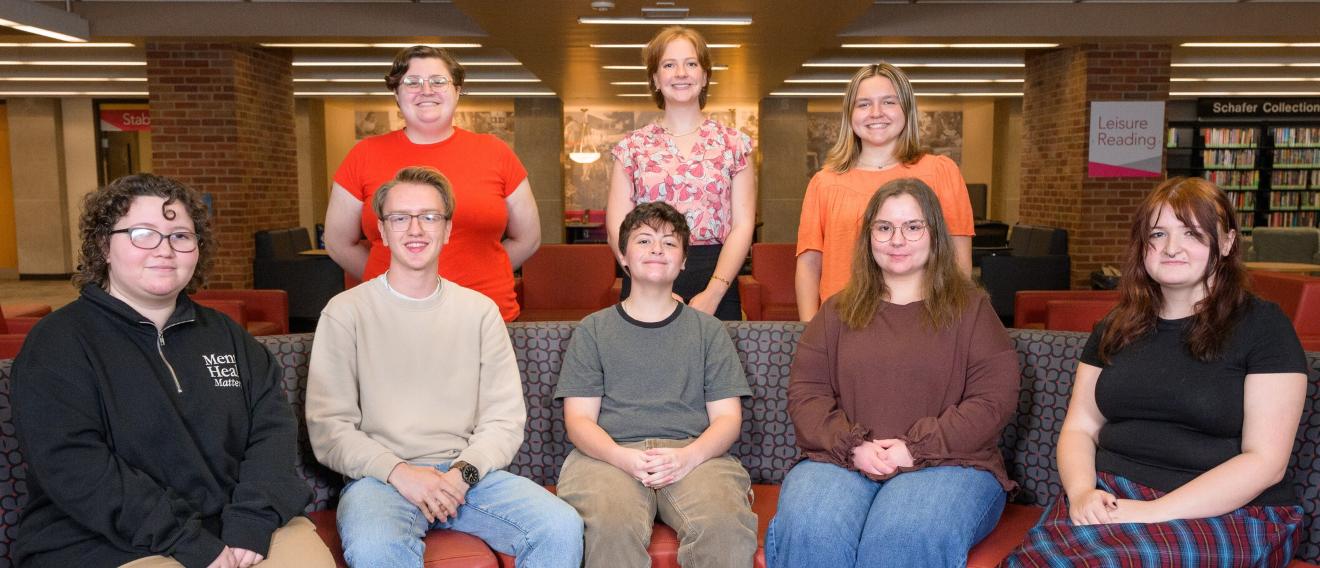
Standing, from left, 2025–26 Fusion Fellows Jocelyn McCray, Serena Aumick, and Riley Whiskeyman. Seated, from left, 2026–27 Fusion Fellows Remy Radwane, Tanner Braniff, Daniel Raynes, Abigail Hutchins, and Jenna LaGesse. Madilyn House-Groff, a 2025–26 Fusion Fellow, is not pictured.
The Fusion Fellowship program, launched during the 2025–26 academic year, encourages collaboration between students and faculty from the College of Arts, Humanities, Media, and Public Affairs and the John J. and Char Kopchick College of Natural Sciences and Mathematics through innovative projects that address complex, real-world challenges through multifaceted perspectives.
IUP alumni Tim and Deb Cejka, 1973 IUP graduates from Westmoreland County, gifted $265,000 to establish the IUP Fusion Fellowship Program and support it through 2030; this donation is part of IUP’s Impact 150, the university’s $150-million comprehensive campaign.
As of June 30, Impact 150 is at $122,847,723, or 81.9 percent of its $150 million goal. Impact 150 centers around raising funds for healthy students, including supporting students academically and personally; a healthy university, including maintaining IUP’s commitment to excellence and innovation; and healthy communities, including IUP’s work to establish a college of osteopathic medicine. The largest fundraising campaign in the university’s history, the campaign is named in honor of the university’s 2025–26 sesquicentennial celebration.
“I want all our students to engage in rigorous research experiences,” IUP President Michael Driscoll said. “These experiences develop the teamwork and problem-solving abilities that are in high demand by employers. The Fusion Fellowship program offers an amazing opportunity for our students to work collaboratively with faculty mentors on cross-disciplinary research.
“We are grateful to Tim and Deb Cejka for their ongoing generosity,” President Driscoll said. “They continue to create opportunities that give IUP students the competitive edge that sets them apart from students from other universities. I appreciate and value all that the Cejkas have done, and continue to do, for IUP and our students.”
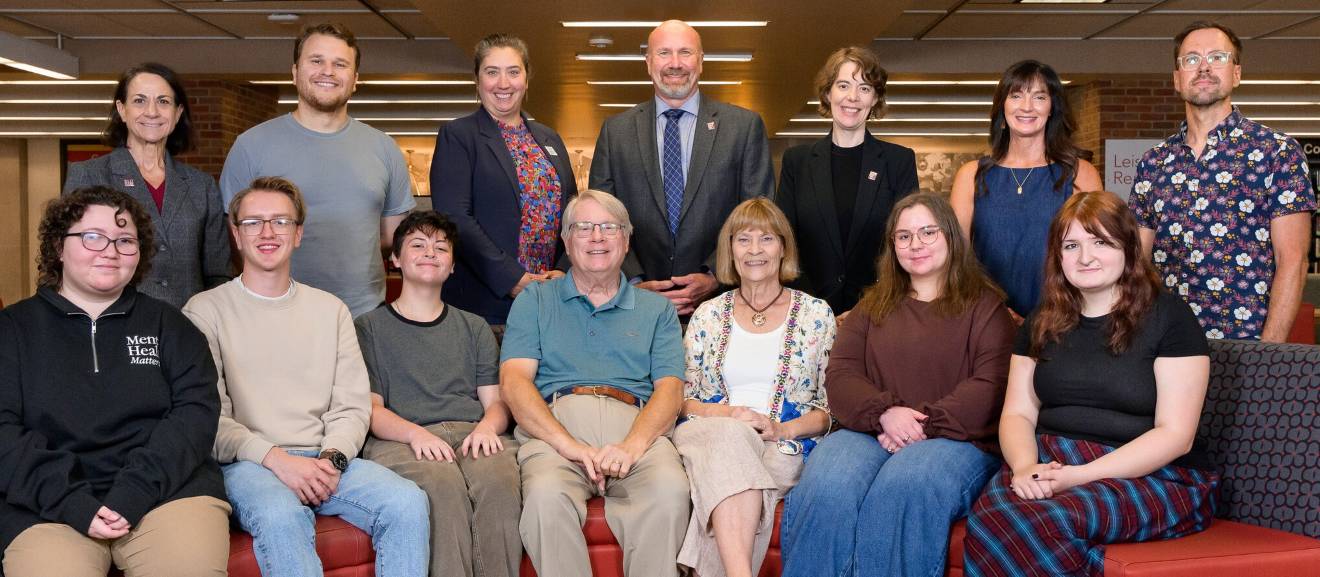
Standing, from left, Provost and Vice President for Academic Affairs Lara Luetkehans; faculty mentor Sam Grieggs, Department of Mathematical and Computer Science; Vice Provost for Research and Innovation Hilliary Creely; Dean of the John J. and Char Kopchick College of Natural Sciences and Mathematics Steve Hovan; Dean of the College of Arts, Humanities, Media, and Public Affairs Emily Rutter; Associate Vice Provost for Libraries and Research Support Services and Fusion Fellowship Program Coordinator Kelly Heider; faculty mentor Sean Derry, Department of Art and Design. Seated from left are 2026–27 Fusion Fellows Remy Radwane, Tanner Braniff, and Daniel Raynes; Tim Cejka, Deb Cejka; and 2026–27 Fusion Fellows Abigail Hutchins and Jenna LaGesse. Faculty mentors Ken Sherwood from the Department of Language, Literature, and Writing, and Francis Allard and Lara Homsey-Messer, from the Department of Anthropology, Geospatial and Earth Sciences, are not pictured.
The Fusion Fellowship program is open to students from the Kopchick College and the College of Arts, Humanities, Media, and Public Affairs who have earned at least a 3.0 grade point average and who are sophomores, juniors, or graduate students.
In addition to completing their proposed projects, Fusion Fellows participate in monthly seminars featuring guest speakers, workshops, and discussions on topics at the intersection of arts, humanities, and sciences. They also serve as program ambassadors at student admissions, orientations, and other university events.
At the end of the program, Fusion Fellows present their work at the IUP Scholars Forum, held during the university’s Research Appreciation Week in April, showcasing the outcomes of their interdisciplinary collaborations.
Funding for the Fusion Fellowship Program supports costs associated with research, project execution, and travel and supplies.
IUP Dean of the Kopchick College Steve Hovan; IUP Dean of the College of Arts, Humanities, Media, and Public Affairs Emily Rutter; and Associate Vice Provost for Libraries and Research Support Services and Fusion Fellowship Program Coordinator Kelly Heider coordinated the application and selection process.
“The Fusion Fellowship program showcases the very best of what can happen when students bring different disciplines together to tackle meaningful questions,” Dean Hovan said. “These projects combine the creativity of the arts and humanities with the analytical approaches of the sciences, creating opportunities for students to engage in research that is innovative, collaborative, and impactful. We are grateful to Tim and Deb Cejka for making these experiences possible and for investing in the next generation of scholars, leaders, and problem-solvers.
“Innovation and creative problem-solving do not happen in silos but instead by bringing distinct voices and disciplines into conversation,” Dean Rutter said. “When students and faculty from across the sciences, arts, humanities, and media join forces on hands-on, community-engaged projects, they model the transformative power of interdisciplinary learning. Tim and Deb Cejka understand the value of these experiences, and their generosity enables students to become leaders in interdisciplinary research that makes a positive impact in the communities we serve.”
“The Fusion Fellowship gives our students the opportunity to see what is possible when they bring different ways of thinking to the same question,” Heider said. “This year’s projects demonstrate the power of that approach, bringing together the humanities, sciences, technology, and the arts to address meaningful questions in creative and collaborative ways. We are excited to see how these students grow as researchers, communicators, and problem-solvers while producing work that has value beyond the classroom.”
About the 2026–27 Fusion Fellows
Braniff, the son of Jeff and Tricia Braniff, is a 2025 graduate of Central Cambria High School. At IUP, he is a dean’s list student and a member of the Jazz Ensemble, Levity Jazz Jams, Marching Band, Saxophone Studio, Cybersecurity Club, and Competitive Coding Club.
Hutchins, daughter of Julie and Doug Hutchins, formerly of Seymore, Tennessee, and currently of Statesboro, Geogia, received her bachelor’s degree from the University of Tennessee, Knoxville in 2025 and is a 2020 graduate of Seymour High School. A first-generation college student, she was a member of the Pennsylvania Highway Archaeological Survey Team and was an intern for the Pennsylvania Department of Transportation. She is a volunteer for the Community Archaeology Day at IUP and is a member and presenter for the Society for Pennsylvania Archaeology.
LaGesse, daughter of Daniella LaGesse, is a 2023 graduate of Penn Cambria High School. She is a dean’s list student and provost scholar and received the 2026 Dean’s Excellence Award. She is active with WIUP-FM student radio station, is a member of the University Museum Board, and is a student assistant for the IUP Kipp Gallery.
Radwane is a graduate of the PA Virtual Charter School, is a dean’s list student, and is a recipient of the Sutton Scholarship.
Raynes, the son of Amber Raynes and Donald Raynes, is a 2025 graduate of Hempfield Area High School. He is a dean’s list student and volunteers for the Indiana Community Garden and Habitat for Humanity.
About the Fusion Fellowship Projects
“Daily Life Through Time in Indiana County” will develop an alternative, interdisciplinary exhibition framework to support the Historical and Genealogical Society of Indiana County and rethink how Indigenous histories are interpreted in small, community-based museum settings.
Integrating archaeological research and analysis with exhibition design and interpretation, this cross-disciplinary collaboration responds to the society’s original plan, initiated by board member and IUP alumna Katie Gaudreau, to construct a permanent exhibit of a narrative timeline of Indigenous occupation (around 16,000 years ago through the early 1620s), with the goal of fostering community engagement with Indiana County’s vibrant Indigenous history.
The students will work collaboratively to integrate archaeological research and exhibit design. Hutchins will use material culture analysis and geographic information system (GIS)-based methods of data analysis to identify spatial and temporal patterns associated with Indigenous settlement, land use, and daily practices.
LaGesse will draw on these data and interpretations to develop three-dimensional, spatial, and interactive elements of the exhibit, including mapped archaeological site data, recreations of daily life, and experiential components that support visitor engagement. Together, their work interacts to guide the exhibit’s organization, content, and interpretation.
To support hands-on engagement, the project will use IUP’s STEAMSHOP to produce 3D-printed replicas of selected objects, which contribute to tactile experiences. To ensure accurate and ethical representation, the project incorporates Indigenous perspectives through consultation with regional tribes, informing the language used in exhibit text and how traditional practices and materials are described.
Ultimately, the project will produce a museum exhibit featuring Indiana County’s first residents, organized around a thematic focus on “Daily Life Through Time,” with the timeline serving as an element of temporal orientation.
“Interface and interpretation in Electronic Literature” is a technical reconstruction and humanistic inquiry, addressing the question: What happens to meaning, reader agency, and literary experience when a digital work is moved from the platform for which it was created into an entirely new technological environment?
The project coordinates with The NEXT: Museum, Library, and Preservation Space, an “open-access, travel-free” collection of e-literature which is an initiative of the Electronic Literature Organization and sponsored by the Electronic Literature Lab at Washington State University, Vancouver. Egypt: The Book of Going Forth by Day will be the focus of the project; this book is a clear instance of platform decay, as the now-defunct Macromedia Shockwave environment on which it depends can no longer be executed on modern systems. Through this project, the IUP student team will complete a tangible project and document best practices for digital humanities preservation. The technical aspects of the project are deeply intertwined with the artistic and preservation aspects.
“In reimplementing and documenting Egypt, and with faculty guidance from Dr. Sherwood and Dr. Grieggs, we aim to make future preservation work more accessible. Countless e-literature works have been lost in ‘dead languages,’ but they don’t have to stay lost,” Braniff, Radwane, and Raynes said.
During an event held September 18 to introduce the 2026–27 Fusion Fellows, the inaugural 2025–26 Fusion Fellows presented an update about their projects, which will be showcased at the 2027 Scholars Forum in April during Research Appreciation Week.
Serena Aumick, a student in IUP’s biology master’s program, who graduated in May from IUP with a bachelor of science degree in biology (pre-veterinary concentration) from Tunkhannock, and Riley Whiskeyman, a communications media major from Shillington, are completing “Conserving Honduras: The People Behind the Process,” which highlights the vital role of communications media in conservation biology. They are producing a documentary focused on mainland Honduras and the contributions of IUP students and faculty to local conservation efforts.
Madilyn House-Groff, an applied archaeology master’s student from Orbisonia, and Jocelyn McCray, an applied anthropology major and history minor from Franklin, are continuing ongoing work by IUP researchers to document, interpret, and share the history of Brown’s Farm—an early free African American community in the Laurel Highlands—by combining geophysical surveying and oral history research for their project, “Geophysics and Oral History.”
Since its founding in 1875, IUP has evolved from a teacher-training institution into a doctoral research university recognized for its commitment to student success and achievement. IUP’s Impact 150 comprehensive campaign is designed to honor a legacy of educational excellence while looking toward a future of innovation, public service, and leadership in healthcare education, including the first college of osteopathic medicine at a public