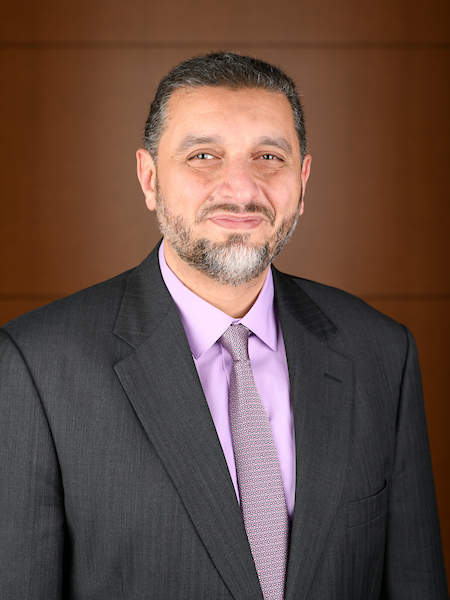
Waleed Farag
Waleed Farag, Indiana University of Pennsylvania professor of computer science in the Department of Mathematical and Computer Sciences and director of the IUP Institute for Cyber Security, has been selected as IUP’s 2026–27 Distinguished University Professor.
The Distinguished University Professor is a faculty member who exemplifies excellence in all areas of teaching, research and scholarly activities, and service. This recognition is a title that the recipient holds for life.
“Dr. Farag has earned a reputation for excelling as a researcher and author, for securing important grants that benefit both students and the cybersecurity profession, while remaining committed to mentoring students and to excellence in the classroom,” IUP President Michael Driscoll said.
“His leadership and service to the university is exemplary, and I couldn’t be more pleased about his selection as a Distinguished University Professor,” President Driscoll said.
“I am truly honored to be selected as the recipient of this prestigious, lifetime award,” Farag said.
“Over the past 24 years, I have been committed to supporting my students in every way possible, serving IUP, and advancing cybersecurity education and research at both the regional and national levels. From mentoring the next generation of professionals to developing practical, scalable security solutions, my work has always been guided by the goal of creating lasting academic and real-world impact. It is incredibly meaningful to see this work recognized by the IUP community through the Distinguished University Professor Award, and I share this honor with my students and colleagues who have been part of this journey,” Farag said.
The Distinguished University Professor honor includes a reduced teaching load for the academic year that professors hold the designation to permit recipients to pursue an academic project.
During 2026–27, Farag will work on a research and workforce development project, “The Cyber Workforce Ecosystem and Pathway Initiative,” focused on systematically mapping, analyzing, and strengthening regional STEM (science, technology, engineering, and mathematics) workforce pipelines, with a targeted emphasis on cybersecurity.
The CWEPI will employ data‑informed and partnership‑based approaches to identify structural gaps, misalignments, and points of attrition across educational and workforce transitions, while designing interventions to improve pathway coherence and workforce outcomes.
Although regionally grounded, Farag has structured the work to yield broad findings with national relevance, addressing a well‑documented and increasingly urgent challenge: the persistent shortage of qualified professionals across STEM fields, especially in cybersecurity, where unmet demand carries significant economic, societal, and national security implications, he said.
The CWEPI will engage a wide network of stakeholders, including kindergarten through grade 12 school districts, community colleges, universities, industry partners, and state workforce development entities.
“Working collaboratively, these partners will help design, implement, and assess a set of coordinated interventions focused on improving alignment between education, credentials, and cybersecurity workforce needs,” Farag said.
“The project will emphasize applied learning experiences, clear credential‑to‑career pathways, and data‑driven decision making. Through longitudinal data collection and mixed‑methods evaluation, this effort aims to generate practical, evidence‑based insights that support more effective and sustainable approaches to addressing regional STEM and cybersecurity workforce gaps,” he said.
Farag joined the IUP community in 2002 as an associate professor of computer science and was promoted to full professor in 2010. He has been director of the IUP Institute for Cyber Security for the past 14 years. In his role as director of the Institute, he has organized many security conferences and meetings, including the annual IUP Cybersecurity Day and IUP Cybersecurity Seminars, which have included nationally recognized security experts as presenters.
He has been the principal investigator for 33 different projects, securing more than $20 million in federal funding for IUP. His success in grant writing includes securing the largest grant in the history of the university: $4.981 million from the Department of Defense for “A Collaborative PA-wide Community College Consortium for Enhancing STEM and Cybersecurity Education” in 2022. He also secured a nearly $1 million grant for a program to help cybersecurity students develop Chinese language skills.
In 2025, he won a Pennsylvania Cyber Workforce Alliance grant of $316,440 from the National Institute of Standards and Technology, engaging more than 12 stakeholders collaborating to address the national security workforce gap.
Farag’s research has meaningfully contributed to the artificial intelligence, machine learning, and cybersecurity fields. He served as the PI on a $250,000 federal research award from the National Security Agency for the IUP IoT Anomaly Detection project. Selected as one of only 12 awards nationwide, the project marked a significant milestone for cybersecurity research at IUP. It trained more than 20 undergraduate and graduate student researchers, produced nine scholarly publications and presentations, and delivered efficient anomaly‑detection methods and publicly valuable datasets for securing resource‑constrained IoT systems. Moreover, Farag recently secured, as the PI, $500,000 over three years from the National Centers of Academic Excellence in Cybersecurity to establish the ARMZTA project, one of the largest research awards in IUP’s history. The project developed a novel, automated framework for mitigating cyber risks in zero‑trust environments by integrating federated learning with zero‑trust principles, advancing scalable and next‑generation cyber defense capabilities.
He has secured 72 scholarships—each worth about $50,000—from the Department of Defense for scholarships for undergraduate cybersecurity majors. He has also secured funding through the CAE-C PhD Scholarship program, a pilot program that provides full scholarships to five PhD cybersecurity students nationally. One of these scholarships was awarded to one of Farag’s PhD students.
Farag is responsible for establishing the first GenCyber cybersecurity summer program in Pennsylvania at IUP. This program began in 2016 and has continued to receive support for the past 10 years, allowing students and teachers to attend entirely free of charge. IUP is the only Pennsylvania university selected to host and present this program. IUP’s program has trained more than 550 kindergarten through grade 12 teachers and students from across the United States in cybersecurity.
IUP is one of the first institutions in the nation to receive the Center for Academic Excellence in Cyber Defense designation by the National Security Agency. IUP has held that designation since 2002 and is one of only 16 universities in Pennsylvania with this designation, due to Farag’s work.
He has played an instrumental role in IUP’s success in securing ABET accreditation—the world’s leading accrediting body for programs in applied and natural science, engineering, and engineering technology—overseeing all course and program assessment tasks.
Farag’s reputation is well known in the Commonwealth, nationally, and internationally. In 2023, he was an invited participant for a roundtable discussion with Jake Braun, acting principal deputy national cyber director in the White House Office of the National Cyber Director, on cybersecurity and workforce development. He is a frequent presenter at national security and technology conferences and has been a featured annual presenter at the Centers for Academic Excellence Community Symposia since 2014.
He has authored more than 75 refereed publications and three book chapters with original contributions to the literature of multimedia content-based retrieval systems, and he is the recipient of a best paper award from the Association for Computing Machinery. He is frequently consulted by national universities to serve as an external evaluator of promotion applications for their faculty and is a reviewer for many international journals and conferences.
He has been a faculty mentor for students entering original research in IUP’s Scholars Forum since 2019 and has been the dissertation committee chair or member for seven doctoral students completing dissertations. He is the faculty advisor for IUP’s Cyber Security Club, which has consistently won awards in regional “Hackathon” competitions.
He also has been a member of many important department and university-wide committees and task forces, including serving as an elected senator in the University Senate.
In addition to his Distinguished University Professor recognition, Farag was selected by President Driscoll for a “Raising the Research Profile of IUP” award in recognition of his securing the largest grant in IUP history, the IUP University Senate Distinguished Faculty Award for Research, the IUP John J. and Char Kopchick College of Natural Sciences and Mathematics Dean’s Outstanding Researcher Award, and six IUP-sponsored program awards in these categories: outstanding research, public service, commitment to sponsored programs, centers and institutes, curriculum and instruction, and high impact teaching. He received the IUP Mathematical and Computer Sciences Department’s outstanding scholarship award for the 2018–19 academic year.
He completed his PhD in computer science at Old Dominion University in 2002, his master’s degree in engineering (electronics and communications) at Zagazig University in 1997, and his bachelor’s degree in electrical engineering at Zagazig University in 1993, graduating with distinct honor and the highest rank in his department.
IUP began offering its bachelor of science in computer science/cybersecurity track (originally information assurance) and a minor in cybersecurity in 2002 when Farag joined the IUP faculty. This program combined core computer science and cybersecurity classes with a minor in criminology, creating a novel curriculum that helped students gain a broad understanding of the field and be work-ready.
The IUP cybersecurity program has about 130 students enrolled, and about 20 students annually complete the program and receive their bachelor’s degree in the computer science/cybersecurity track. IUP’s program also focuses on cybercrime detection, loss prevention, and how to collect the evidence to prosecute cybersecurity offenders as part of the cybersecurity degree.
Since its founding in 1875, IUP has evolved from a teacher-training institution into a doctoral research university recognized for its commitment to student success and achievement. As IUP celebrates its 150th anniversary during the 2025–26 academic year and through the Impact 150 comprehensive campaign, the university honors a legacy of educational excellence while looking to its next 150 years of student success, innovation, leadership in healthcare education, and public service.