The Wood Center at Indiana University of Pennsylvania will host national artist and activist Scott Braun for a “social practice” art event on November 18 and 19.
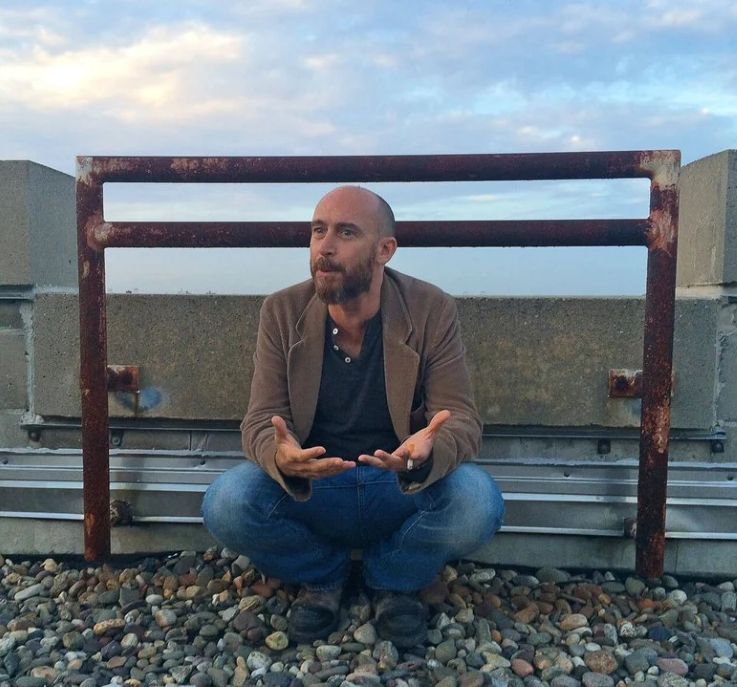
Scott Braun
These two social practice art events, free and open to the community (materials are provided), are part of the national “Decency Project.” The IUP event provides the opportunity for participants to learn to carve a wooden spoon while engaging in civil conversation together.
The program on November 18 is in Jane E. Leonard Hall lobby and will be in John J. and Char Kopchick Hall lobby on November 19. The event on both days will be held from 10:00 a.m. to 5:00 p.m.
“This program provides a unique opportunity for students, employees, and the community to come together to experience the power of craft. Making things together with our own hands fosters care and breaks down barriers,” IUP Wood Center Director B A Harrington said.
Students in Harrington’s woodworking class are preparing the spoon blanks for the project.
This event is supported by the Wood Center at IUP; College of Arts, Humanities, Media, and Public Affairs; Cook Honors College; Social Equity and Title IX Office; student chapter of the National Art Education Association; Department of Anthropology, Geospatial and Earth Sciences; Department of Art and Design; Department of History, Political Science, Philosophy, and Religious Studies; and Sustainability Studies.
“In addition to offering the experience of creating art and exchanging civil dialogue, visiting artist Braun will speak to several classes as part of his week-long visit, including the Civics Savvy class in the political science program and students in the Cook Honors College,” Harrington said.
Students in Amanda Poole’s anthropology class will conduct qualitative research during the sessions about the relationship between craft skills and the capacity for human empathy. This research is funded through a University Senate Research Committee Faculty Research Grant secured by Harrington.
Braun is an interdisciplinary artist and activist based in Baltimore, Maryland. His sculpture and social practice performances engage participants in critical exploration of societal structures and human relationships.
Braun has held teaching appointments at Yale School of Art, New York School of Interior Design, and Virginia Commonwealth University Arts, and he has been an artist-in-residence and visiting lecturer and critic at dozens of universities and institutions during the past 25 years. He has a bachelor’s degree in music from Berklee College of Music and an MFA in studio art/social practice from Queens College.
“The Decency Project is an ongoing participatory work which forms connection and conversation through shared labor,” Braun said. “Seeking a bond between people of unlike mind, culture, or lived experience, I teach strangers to make a functional object while having a conversation. We are guided by a pedagogy of awareness embracing conceptual and critical thinking, and what I refer to as ‘the historical contextualization of everything.’ This dialogue is not about contemporary politics, but instead about abstract ideals and our ability to coexist despite our differences. We question what it means to be human: What must I do? What can I do? What must I not do?”
The project was conceived in late 2019, in the debate surrounding the existence of the Robert E. Lee monument in Richmond, Virginia. The first participants were invited from the Richmond City Republican Committee, local gun rights organizations, and protestors surrounding the statue. Since that time, for the last five years, Braun has performed “The Decency Project” events with more than 2,300 people in cultural and academic institutions and public parks in 18 states across the nation.
Since its founding in 1875, IUP has evolved from a teacher-training institution into a doctoral research university recognized for its commitment to student success and achievement. IUP’s Impact 150 comprehensive campaign is designed to honor a legacy of educational excellence while looking toward a future of innovation, public service, and leadership in healthcare education, including the first college of osteopathic medicine at a public university in the commonwealth.