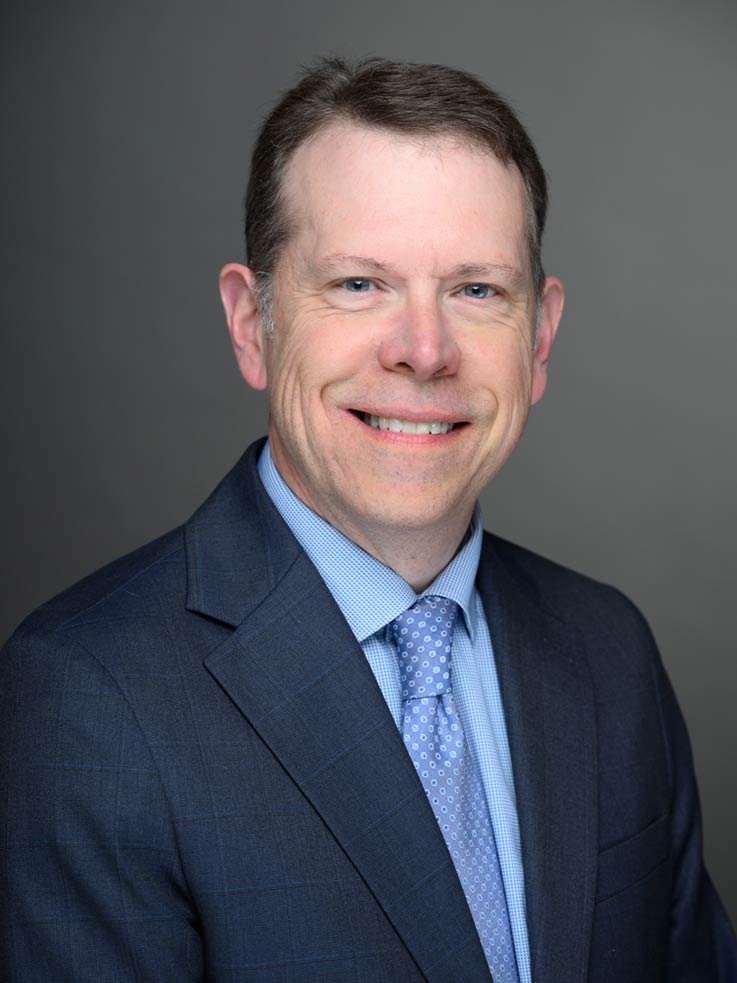
 Jamie Murphy
An experienced administrator for colleges of osteopathic medicine and health care organizations has been selected to fill the position of director of admissions and student affairs at Indiana University of Pennsylvania’s College of Osteopathic Medicine (IUP COM).
Jamie Murphy, a native of Pittsburgh and now of Indiana, joined the IUP COM administrative team in January. He comes to the role with experience as executive director of the Northwest Pennsylvania Area Health Education Center, as an admissions consultant at Duquesne Nasuti College of Osteopathic Medicine, and as director of student affairs, assistant director of student affairs, and an admissions counselor and recruiter at Lake Erie College of Osteopathic Medicine.
He also worked as a career services coordinator for the Erie Institute of Technology, as the marketing manager for the Erie Otters Hockey Club, as assistant director of the Great Lakes Institute of Technology, and as a sports anchor and reporter for Erie television stations WJET-TV and WFXP-TV.
“Jamie brings a great deal of experience, a passion for addressing the rural health care crisis, and an understanding and commitment to the needs of students to be successful in osteopathic medical education,” IUP COM Founding Dean Miko Rose said. “He has hit the ground running and has already demonstrated that he’s an excellent fit for our team and for IUP, and we are very fortunate and glad to have him lead the charge to recruit and fill our first classes at IUP COM.
“He has a longstanding record of success in his field, with a perfect alignment of the skills that are critically important to IUP COM, working at a Pennsylvania osteopathic medical school in admissions for more than 13 years with a focus on early acceptance programs and more than three years as the executive director of the southwestern regional AHEC, focused on early pathways rural recruitment for healthcare professions,” she said. “We are very pleased to have him join the team and the Indiana community.”
In May, IUP’s College of Osteopathic Medicine earned “pre-accreditation status” from the American Osteopathic Association’s Commission on Osteopathic College Accreditation (COCA), meaning that IUP can begin recruiting and admitting students to its College of Osteopathic Medicine and begin medical instruction within the approved osteopathic medical curriculum.
There are only three colleges of osteopathic medicine in Pennsylvania, all at private universities; IUP’s College of Osteopathic Medicine is the only college of osteopathic medicine at a public university.
“I am honored to join this team,” Murphy said. “I enjoyed my previous role at the Northwest Pennsylvania Area Health Education Center and the Area Health Education Center addressing the shortage of health care workers in rural areas, but the effort by IUP and IUPCOM sparked my passion for working in medical school admissions and student affairs. The community collaboration I have witnessed since I began this role is remarkable,” he said.
In his role as director of admissions and student affairs, Murphy will be responsible for recruiting qualified students for the IUP COM and for establishing and maintaining programs that ensure success for medical students once they arrive on campus.
Murphy earned a master’s degree in organizational leadership from Robert Morris University and a bachelor’s degree in communication studies from Edinboro University of Pennsylvania.
Colleges holding COCA pre-accreditation status are permitted to admit no more than 50 percent of the approved class size in the first year and no more than 75 percent of the approved class size in year two, transitioning to the approved class size in years three and four. IUP’s College of Osteopathic Medicine approved class size is 120 students.
IUP anticipates its first class of students entering the program in fall 2027. It is already receiving applications for admission to the program.
COCA is recognized by the US Department of Education as the accreditor of colleges of osteopathic medicine; only 46 colleges of osteopathic medicine, operating at 73 sites, are accredited by COCA.
IUP’s Council of Trustees endorsed the exploration of a possible development of a college of osteopathic medicine at IUP in December 2022.
In April, IUP’s Doctor of Osteopathic Medicine degree program was approved by Pennsylvania State System of Higher Education Chancellor Chris Fiorentino; approval of the degree program by the Chancellor is part of the process for a university in the Pennsylvania State System to add an academic program to its offerings.
Securing clinical training sites for students is part of a successful accreditation process; IUP has secured clinical training partnerships at more than 30 sites across the Commonwealth, 279 percent of the required 120 percent of clinical training spots needed for accreditation.
Typically, students in colleges of osteopathic medicine spend the first two years of their education in the classroom; during the third and fourth years, students are based in the community at clinical sites, so the first class enrolled in IUP’s college of osteopathic medicine would graduate in 2031.
Once fully operational, IUP’s College of Osteopathic Medicine is expected to generate almost $50 million in annual economic impact for the Commonwealth. Long-term, if just 60 percent of IUP’s College of Osteopathic Medicine graduates remain in Pennsylvania, the annual economic impact for the state is estimated at $1.3 billion.
IUP’s College of Osteopathic Medicine and IUP’s commitment to addressing the rural health crisis have resulted in funding of more than $54 million from individual donors, foundations, and agencies. In May, a Pittsburgh-area foundation gifted $4 million to IUP COM.
Students studying for a doctor of osteopathic medicine degree complete four years of osteopathic medical school, with an emphasis on preventive medicine and comprehensive patient care. Students are trained to recognize the interrelated unity among all systems of the body, each working with the other to promote overall health and wellness. Osteopathic medical schools have a long tradition of serving rural communities.
National data shows that physicians who are trained in osteopathic medicine are four times more likely to select primary care specialties and almost twice as likely to practice in rural areas as allopathic (MD) students are. The Association of American Medical Colleges forecasts a shortage of up to 86,000 US physicians by 2036.
National studies also show that graduates from programs of osteopathic medicine are more likely to pursue primary care in rural and underserved areas—57 percent of all doctors of osteopathic medicine practice as general practitioners, and more than 20 percent of DO graduates practice in rural areas.
Demand is high for osteopathic medicine training: in 2024, more than 22,000 applicants competed for 9,600 seats at schools of osteopathic medicine; students in osteopathic medicine programs currently make up more than 25 percent of medical students in the US.
Since its founding in 1875, IUP has evolved from a teacher-training institution into a doctoral research university recognized for its commitment to student success and achievement. As IUP celebrates its 150th anniversary during the 2025–26 academic year, the university honors a legacy of educational excellence while looking toward a future of innovation, leadership in healthcare education, and public service.