Indiana University of Pennsylvania professor of anthropology Abigail Adams presented a program on medical anthropology, disease theory systems, and the Appalachian region, of which Indiana is included, to the leadership team and steering committee of IUP’s proposed college of osteopathic medicine.
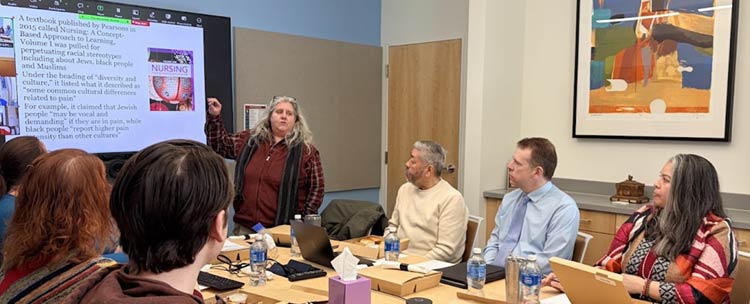
IUP professor Abigail Adams presented a program on medical anthropology, disease theory systems, and the Appalachian region to members of the IUP proposed college of osteopathic medicine administrative team and the proposed college’s steering committee and advisory board.
Adams is a cultural anthropologist in IUP’s Department of Anthropology, Geospatial and Earth Sciences and is director of IUP’s Global Health Program. She specializes in political conflict, human rights, and medical anthropology and teaches courses in medical anthropology, anthropology of gender, anthropology of human rights, anthropology of food, cultural anthropology, contemporary anthropology, and Latin America.
She is extensively involved in the Appalachian Teaching Project and the Center for Appalachian Studies and Services. Working with several faculty colleagues, she has led students studying issues of opioid addiction, COVID-19, rural food security and poverty, sustainable and asset-based development, and community gardens in the communities surrounding IUP. She is also a research associate with the Mid-Atlantic Research Teaching Institute (MARTI).
Most recently, she mentored a student team from IUP who developed “The Youngest Appalachians: Obstetric and Pediatric Care and Infant Wellbeing in Rural Communities,” presented to the Appalachian Collegiate Research Initiative, a grant-funded program of the Appalachian Regional Commission. For the past several years, she has aligned her research to train police departments about concerns over racism and social injustice, including the Indiana Borough Police Department.
In her presentation, Adams discussed the “fallacy of underdifferentiation,” which is the tendency to view lesser-developed countries and poor people as all the same with the exact same needs, noting that providers may not be aware of or ignore cultural diversity among and between people living in poverty and adopt a uniform approach.
She also discussed Appalachia’s identity and heritage, noting its unique subculture, including that 42 percent of the region’s population is rural, compared with 20 percent of the population. She also shared her research on Appalachian folk illness and folk medicine; “granny women” and matrilocality and women’s work; the history of the region; and 10 cultural values of Appalachians: individualism, religion, neighborliness and hospitality, family solidarity or familism, personalism, love of place, modest and being oneself, sense of beauty, sense of humor, and patriotism. Her presentation also addressed the issue of “insider versus outsider,” stereotypes of the region, the importance of cultural awareness, and recommendations for best practices, including avoiding over-medicalizing social suffering and respecting boundaries of traditional Appalachian families.
“Medical anthropologists serve as cultural interpreters between local systems, and Western biomedicine and medical anthropology has a role in training new doctors as cultural awareness is critical to reduce health disparities, build trust, and improve patient outcomes,” Adams said. “Cultural competencies enable providers to avoid diagnostic errors caused by misunderstandings, improve treatment adherence, and deliver equitable, patient-centered care by respecting diverse backgrounds, beliefs, and communication styles.
“Cultural awareness involves acknowledging one’s own biases, gaining knowledge about different cultural practices, and developing skills to interact effectively across cultural boundaries. I’m absolutely thrilled that IUP’s proposed college of osteopathic medicine will be training new doctors for rural health to bridge the mortality gap, as residents of the Appalachian region often experience higher disease burdens with fewer resources,” Adams said.
“The proposed college of osteopathic medicine team is very grateful to Dr. Adams for her outstanding, and very relevant, presentation,” IUP proposed college of osteopathic medicine Founding Dean Miko Rose said. “IUP’s faculty and staff have deep expertise on so many important topics, based on groundbreaking research and study at national and international levels,” she said. “We do not take for granted the opportunities and resources that we have through these ‘gems’ of IUP,” Rose said. “Having so many expert colleagues, who continue to be so supportive of the project and so willing to share their knowledge and advice with us, is so incredibly valuable and is a great advantage for our work to establish the college,” she said.
IUP’s Council of Trustees endorsed the exploration of a possible development of a college of osteopathic medicine at IUP in December 2022.
IUP’s proposed college of osteopathic medicine has “candidate status” from the American Osteopathic Association’s Commission on Osteopathic College Accreditation, which recognizes that IUP has done the required planning and has the resources necessary to apply for pre-accreditation status within two years. “Candidate status” is the second step in seeking accreditation from COCA.
The IUP proposed college of osteopathic medicine team is working on the next step in the accreditation process, seeking “pre-accreditation status.” When proposed colleges achieve pre-accreditation status, they are permitted to begin recruiting students.
In December 2025, IUP’s Council of Trustees approved the Doctor in Osteopathic Medicine degree, which would be offered through IUP’s proposed college of osteopathic medicine. The next step in the approval process is review by the Pennsylvania State System of Higher Education Board of Governors.
In December 2025, Founding Associate Dean of Clinical Affairs and Graduate Medical Education Ryan Smith was selected as the National Board of Osteopathic Medical Examiners 2025 Item Writer of the Year for the Comprehensive Osteopathic Medical Licensing Examination of the United States (COMLEX-USA) Level 1 examination. The NBOME is an independent examination board that provides the sole means for assessing on a national level the competencies for osteopathic medical practice through national, standardized examinations for osteopathic medical students.
There are only three colleges of osteopathic medicine in Pennsylvania, all at private universities; IUP’s proposed college of osteopathic medicine would be the only college of osteopathic medicine at a public university.
Doctors of osteopathic medicine, or DOs, complete four years of osteopathic medical school, with an emphasis on preventive medicine and comprehensive patient care. They are trained to recognize the interrelated unity among all systems of the body, each working with the other to promote overall health and wellness. Osteopathic medical schools have a long tradition of serving rural communities. Physicians who are trained in osteopathic medicine are four times more likely to select primary care specialties and almost twice as likely to practice in rural areas as allopathic (MD) students are.
National studies show that graduates from programs of osteopathic medicine are more likely to pursue primary care in rural and underserved areas—57 percent of all doctors of osteopathic medicine practice as general practitioners, and more than 20 percent of DO graduates practice in rural areas. Demand is high for osteopathic medicine training: in 2021, 22,708 applicants competed for 8,280 seats at schools of osteopathic medicine.
IUP’s proposed college of osteopathic medicine and IUP’s commitment to addressing the rural health crisis have resulted in funding from individual donors, foundations, agencies, and legislators totaling more than $48 million. Fundraising for the project is part of IUP’s Impact 150 $150 million comprehensive fundraising campaign, raising funds for healthy students, a healthy university, and healthy communities.
Since its founding in 1875, IUP has evolved from a teacher-training institution into a doctoral research university recognized for its commitment to student success and achievement. As IUP celebrates its 150th anniversary in 2025 and through the Impact 150 comprehensive campaign, the university honors a legacy of educational excellence while looking to its next 150 years of student success, innovation, leadership in healthcare education, and public service.