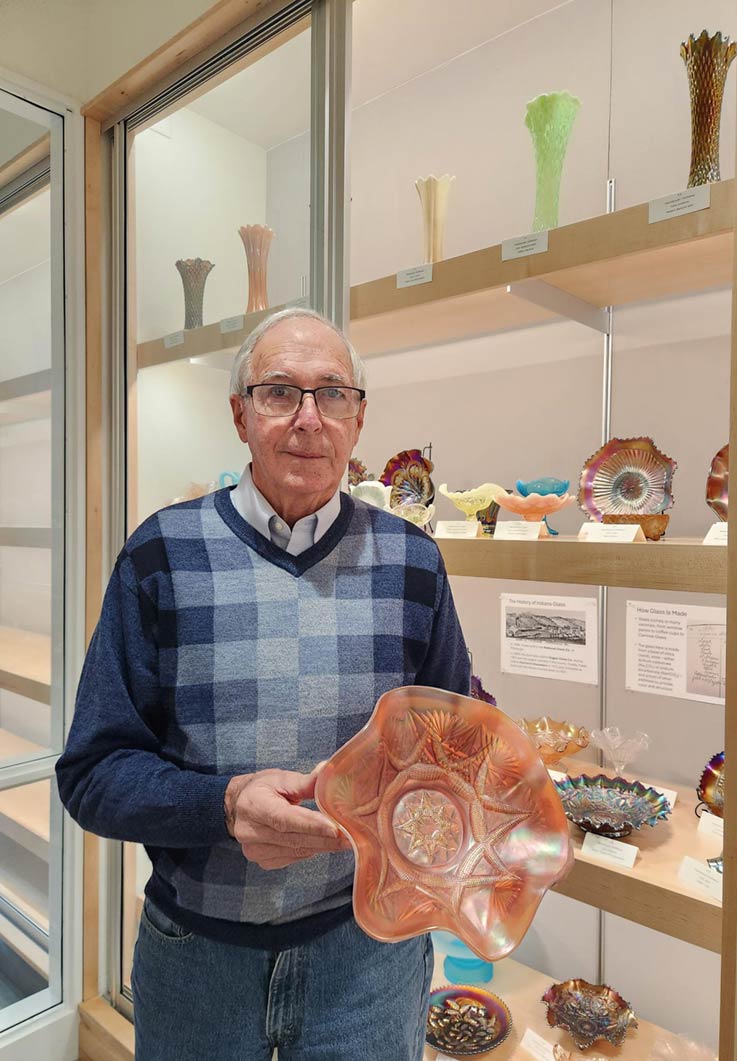
 Arnold Wolfe with a piece of Indiana Glass from his collection, on display during the spring semester as part of the Kopchick College’s Science on Display exhibitions.
As you would expect, Indiana University of Pennsylvania’s John J. and Char Kopchick Hall, home to IUP’s Kopchick College of Natural Sciences and Mathematics, has laboratories with sophisticated equipment and state-of-the-art classroom technology.
What you might not expect is a special display of Indiana Glass, on loan from Indiana collector Arnold Wolfe.
This semester, Kopchick Hall’s “Science on Display”—which features skeletons of prehistoric animals, the Charles Darwin Collection, a flight suit of the late IUP alumna and astronaut Patricia Hilliard Robertson, and a student-created DNA Bunsen Burner sculpture—features more than 100 pieces of decorative and carnival glassware produced by the Indiana Glass Company, which operated in Indiana between 1892 and 1931.
The manufacturing plant, which was owned by several companies, was located on what is now the parking lot next to IUP’s Miller Stadium. The Indiana Glass Company—later the Northwood Company, Dugan Glass Company, and Diamond Glassware—produced decorative and carnival glassware until a fire destroyed the plant in 1931.
The Science on Display project and creation of an Art and Outreach Committee were initiated by Dean of the Kopchick College Steve Hovan. The committee consists of faculty from each department of the Kopchick College and is currently chaired by Jana Villemain, faculty member in the biochemistry program.
Distinguished University Professor and professor in the anthropology program Ben Ford set up the Science on Display web page and printed the QR code stickers. All faculty members are invited to submit an idea for an exhibit and usually take responsibility for curating the exhibition. The Science on Display exhibitions vary from semester to semester.
Nate McElroy, professor of chemistry in IUP’s Madia Department of Chemistry, Biochemistry, and Physics, originated the idea for the Indiana Glass display.
Members of the community are welcome to visit the displays in Kopchick Hall Monday through Friday from 8:00 a.m. to 8:00 p.m. The Indiana Glass display, which includes several different types of glass items, is on the second floor of Kopchick Hall near the Oak Grove entrance.
“Chemistry tends to intimidate most people and can seem quite mysterious, but it’s just the study of matter and its reactions that we interact with every day: food and drink, medicine, plastics, fabrics, and even colorful glassware,” McElroy said. “Once students understand the connections between their discipline—whether it’s chemistry, economics, or art—and their everyday experiences, it becomes less abstract and more approachable.”
The Indiana Glass display is the result of a friendship that developed between McElroy and Arnold from casual meetings at a local coffee shop.
“Nate and I go to the same coffeeshop in the mornings,” Wolfe said. “One of the baristas there likes flowers, so I’d bring her flowers in a vase from home. One day, I used an Indiana Glass pitcher, and Nate asked me about it. I told him about the Indiana Glass factory, and Nate did a lot of research, including on the chemistry of making glass and colored glass, and invited me to share some of my pieces for the display,” Wolfe said.
“This display makes sense to be in the science building, because there is so much science involved in making glass, and it’s a great opportunity to tell the story of a great local company, the importance of beautiful glass pieces to families, as well as how science and the art of making glass are tied together,” Wolfe said.
More information on Indiana Glass, the Indiana Glass Company, and the chemistry of glassmaking is on Kopchick’s Science on Display website.
“We are really pleased to have these beautiful pieces as part of this semester’s Science on Display project, and we appreciate Arnold’s generosity and willingness to loan us pieces from his collection,” McElroy said. “It presents a nice mix of science, local history, and artistic craftsmanship.”
Since its founding in 1875, IUP has evolved from a teacher-training institution into a doctoral research university recognized for its commitment to student success and achievement. As IUP celebrates its 150th anniversary in 2025 and through the Impact 150 comprehensive campaign, the university honors a legacy of educational excellence while looking to its next 150 years of student success, innovation, leadership in healthcare education, and public service.