Experiential learning is nothing new for IUP. “Learning by doing” has been around since Indiana Normal School was training students to be teachers in the 1800s.
Fast forward to 2026, and these experiences have taken on many forms—at least 17 by a recent count, ranging from internships to study-abroad experiences to research. The value placed on experiential learning has made it a focus of one of the six IUP strategic priorities for 2026-27.
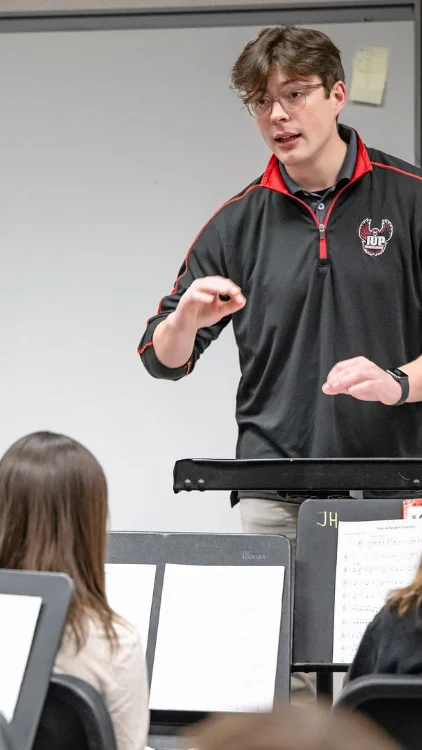
Music education major Alistair Horton student taught at Indiana Area Junior High School last spring. Our students have gotten real-world experiences in classrooms since 1875.
For the team working on this priority, the ultimate goal is to make sure all students have at least one of these experiences before they graduate and enter the workforce.
“Experiential learning helps you figure out what you love and don’t love to do,” said team lead Michele Petrucci, associate vice president for International Education and Global Engagement.
She gave the example of nursing or pre-med students who, until they have a real-world experience, might not know that the sight of blood makes them sick or that they don’t like dealing with patients.
“You need to sample things and get out there,” Petrucci said. “This will help you focus for a career and give you the soft skills that all employers are clamoring for—that will distinguish you from AI.” Time management, communicating effectively verbally and in writing, and teamwork were among her examples.
Ensuring that every student participates in experiential learning, team members say, will require documenting and centrally tracking these experiences to see who has and has not completed one, making sure there are enough high-quality experiences available, and doing a better job of connecting students with those options.
The team has created three work groups. A software and technology solutions group, led by Ileana Townsend, director of Education Abroad, is looking into how to aggregate data about student experiences from departments across IUP. A marketing and outreach group, led by Kira Wertz, assistant director of University Branding, is focused on ways to promote experiential learning to students and potential experience providers, including IUP alumni. And, a staffing and space group, led by Petrucci, is exploring the creation of an experiential-learning hub at IUP.
The proposed hub, Petrucci said, would have a director and a clerical assistant who would serve as IUP’s points of contact for experiential learning. Both positions are expected to be posted soon. Departments would receive support from the hub’s staff but would retain their academic autonomy.
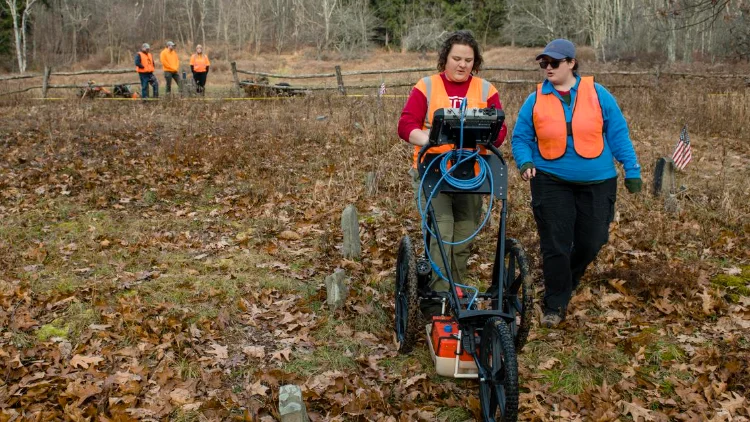
Laura Broughton watched as Emma Lashley used ground-penetrating radar at the site of the former Laurel Hill settlement in what’s now Laurel Ridge State Park.
The future director would also have the ability to convene a university-wide council, made up of faculty, staff, administrators, and students, to oversee planning and procedures relating to experiential learning.
Faculty members on the experiential-learning team spoke about ways the proposed hub might be able to help their areas.
Ben Ford, chair of the Department of Anthropology, Geospatial, and Earth Sciences, said he could see the EL staff helping by working with departments, internship sites, and university administration to assist with new internship agreements.
Also, if the staff would coordinate housing and dining for students from other universities who take part in IUP field schools, it would allow him to focus more on archaeology.
“For departments that have existing experiential-learning programs,” he said, “those are the kinds of things that would hopefully free us up to do more experiential learning, or better experiential learning, because we’ve got that support.”
Strategic priority team member Vicky Ortiz, chair of the Communications Media Department, said her majors have always done hands-on work, though they may not have called it experiential learning.
For example, the department’s Digital Sports Production class streams home football and basketball games. Students take turns doing the broadcasting, camera work, directing, script writing, and other tasks so that they can experience the different roles.
In addition, all communications media majors take at least two production courses, such as photography and TV production; a student team runs the department’s social media presence; and almost all majors are required to do an internship.
Ortiz estimates that half of COMM courses have built-in experiential-learning components. “It’s what sets our program apart,” she said.
Still, she sees benefits to having a central record of those experiences and to labeling them “experiential learning.”
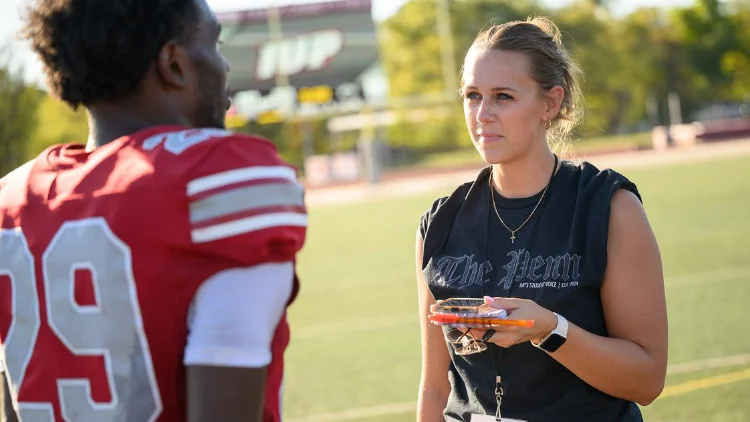
Communications media major Riley Yonchiuk interviewed Kalen Frazier for The Penn after a football game in 2025.
“When students apply for jobs, it often says five-plus years of experience,” she said, “and they’re just graduating from college. So, I think if we start tagging things as experiential learning while they’re in school, that helps solve that problem.”
At the all-employee meeting in October, team member Kelly Heider, associate vice provost for Libraries and Research Support Services, gave a presentation on the experiential-learning strategic priority and collected extensive feedback, much of it department specific, on what the EL director’s role and potential functions should include.
The feedback, according to a summary, pointed toward a “coordinated, visible, measurable experiential-learning ecosystem” and suggested that the director “acts as a connector and organizer across existing programs.”
As head of the team’s software and tech solutions work group, Townsend believes the EL hub’s visibility will help connect more students with experiential-learning activities. The hub is expected to have a physical and online presence through which students can learn about all the experiences IUP offers.
And, the central tracking of experiential-learning activities will help staff members identify the students they have yet to reach.
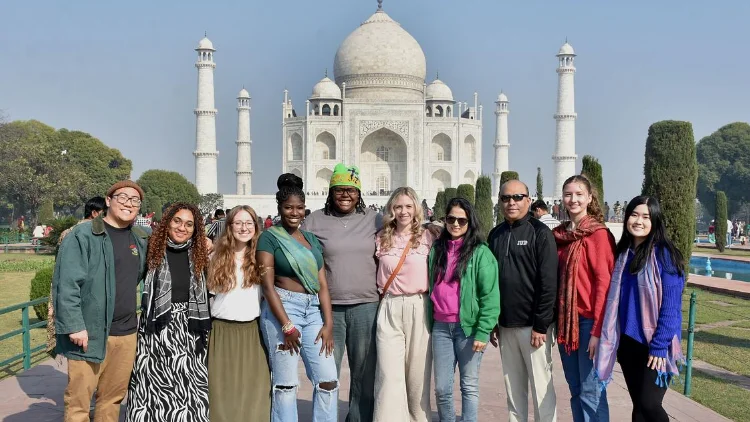
Prashanth Bharadwaj and his students visited the Taj Mahal during a study-abroad trip to India.
“That gives us an opportunity to understand the barriers those students face,” Townsend said, “and to connect them with experiences that align with their interests and goals.”
Central tracking would also make it easier to award credentials for completed experiences.
While many activities, such as internships and archaeology field schools, are included on student transcripts, many are not, Townsend said. She envisions IUP implementing cocurricular transcripts—official documents that track activities and achievements outside of the classroom—and more custom digital badges so that students have credentials to show for their work.
Last school year, she worked with Rich Muth, executive director of Graduate and Special Admissions, to create digital badges for the completion of Collaborative Online International Learning programs, which allow students to have international experiences without leaving campus. COIL involves a partnership between a class at IUP and a class at an international university, with the students working together on activities.
“It was very exciting to give the students an acknowledgment that they can proudly share,” Townsend said of the digital credential. “They can feature it on their LinkedIn profile or other professional platforms to highlight their experience.”
The experiential-learning team also hopes to increase opportunities for students to reflect on their experiences. Townsend has ideas from Education Abroad that she thinks would be worth implementing in other experiential-learning activities. One is to bring students together, after they return to the university, to share their experiences with members of the IUP community. Another is to develop a team of peer advisors who would share what they’ve learned from their own hands-on experiences and encourage other students to participate.
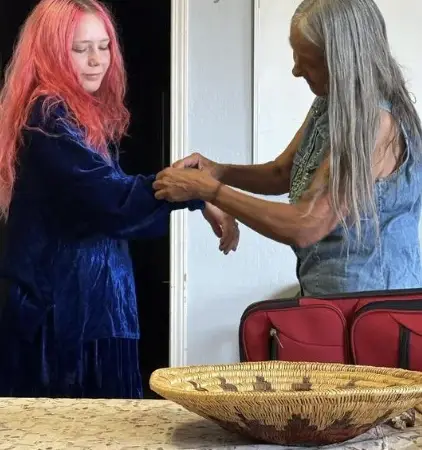
Applied anthropology major Adiya Murrell, with host Vanessa Brown, during a service-learning project at the Navajo Nation in Arizona last May.
“Hearing directly from a fellow student makes the experience feel more relatable,” she said, “and gives them the confidence to take that next step.”
Centralized experiential-learning data, she said, would also have benefits for risk management, such as being able to locate students studying in a region affected by a natural disaster; for selecting award recipients based on their activities and accomplishments; and for required reporting, such as the reporting of out-of-state learning placements under State Authorization Reciprocity Agreements.
Although the strategic priority team has cast a wide net, all efforts point to ensuring that students get the real-life work experience they need to move on to a successful career.
That’s what students—and their parents—want from a university education, Ortiz said.
“They want to see their students actually doing things that they can use to get a job,” she said. “I think it’s going to be great in terms of what we’re promising people.”
Learn more about IUP’s experiential-learning strategic priority.