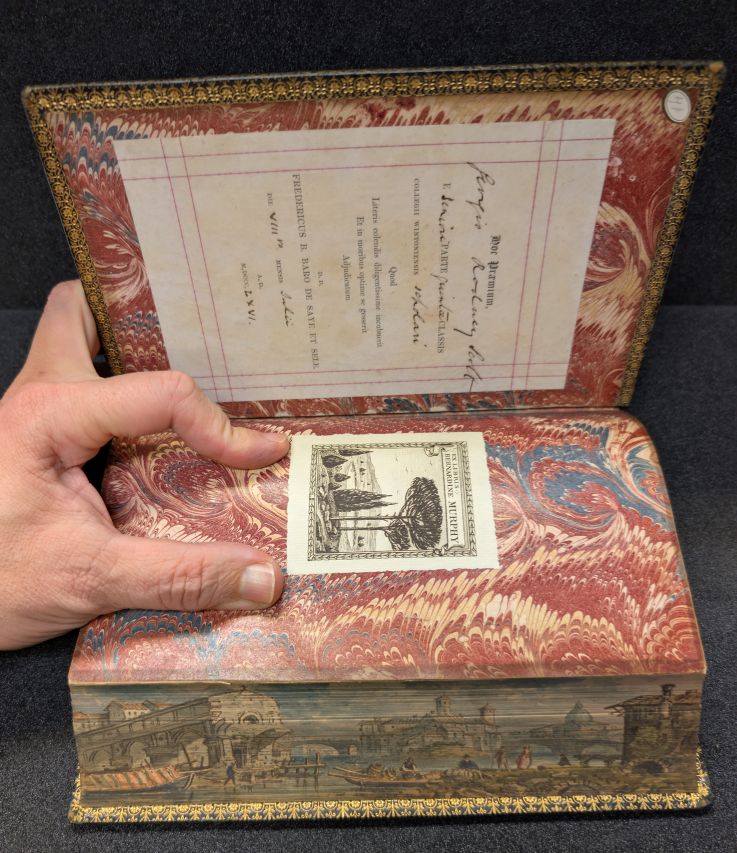
The Ponte Rotte bridge in Rome, Italy. It was painted in the 1920s by the “Dover painter” on a book printed in 1853 and is based on an engraved print by J. D. Harding. The “Dover painter “is an unknown artist who worked for the London bookseller Marks & Company in the 1920s. (IUP Special Collections)
Indiana University of Pennsylvania Special Collections Librarian and University Archivist Harrison Wick will present “The Discovery of Hidden Treasure: The Art of Fore-edge Paintings” on November 2 at 6:00 p.m. in the Elkin Hall Great Room.
The program is free and open to the community and is part of IUP’s Six O’Clock Series.
Fore-edge painting is a unique form of watercolor artwork combining an affinity for art, history, literature, and the rare book. Fore-edge paintings can be original designs or emulate artwork of others, often drawing inspiration from illustrations, paintings, photographs, and prints. There are two general types of fore-edge painting—visible when the book is closed, or hidden and can only be seen when the text block is fanned.
The IUP Special Collections and University Archives has built a teaching collection of more than 150 examples, including visible and hidden fore-edge paintings on books dating from 1557 to the present.
“The history of this art form has origins as book edge decoration in the Middle Ages,” Wick said. “Hidden fore-edge paintings vanish under gilded edges or another form of book edge decoration, including marbled edges. The term ‘fore-edge painting’ is a misnomer—although it implies that the artwork is added to the edge opposite the spine, this artwork can be added to the top, fore-edge, or bottom book edge.”
Hidden fore-edge paintings are not directly applied to the book edge, but are only visible when the text block is fanned. They are painted on the paper adjacent to the edge, and the artwork vanishes when the text block is closed. Fore-edge paintings exist all over the world.
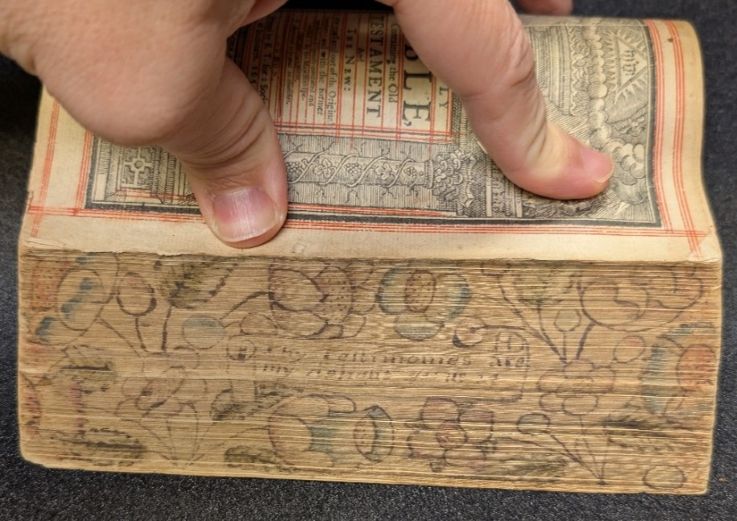
A first-generation hidden fore-edge painting on a 1655 Holy Bible with the inscription “thy testimonies are my delight” Psalms 119:24 (IUP Special Collections)
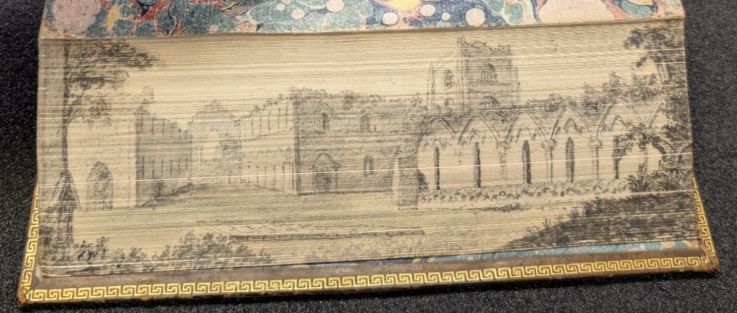
Hidden fore-edge painting of Fountains Abbey in Yorkshire, UK, painted by an artist working for the English bookbinders, the Edwards of Halifax. This was painted on their 1773 edition of the Holy Bible. (IUP Special Collections)
Wick will discuss both the history of fore-edge painting and modern fore-edge painters, including Martin Frost, who has painted more than 3,500 examples since 1970. Frost is the last full-time fore-edge painter in the United Kingdom and was made a member of the British Empire (MBE) by Queen Elizabeth II in 2017. One of his favorite themes is painting scenes from Harry Potter, and each fore-edge painting features a distinct monogram hidden in the background.
Wick has served in his current role at IUP since 2007. His work includes assisting researchers utilizing primary sources relevant to IUP history, as well as the history of Pennsylvania. As a member of the library faculty, Wick assists library patrons by answering reference and research questions. He serves as the bibliographer for several departments on campus and purchases titles in support of library collection development, the Pennsylvania Collection, and the Rare Book Collection.
The IUP Special Collections and University Archives is located on the third floor of the IUP Libraries. Its focus is to be proactive about collecting, organizing, preserving, and providing access to research materials, including archival resources, primary sources, rare books, regional history, and information related to IUP. It is open to the public and includes diverse collections and primary sources, the Rare Book Collection, and the Pennsylvania Regional History Collection.
Since its founding in 1875, IUP has evolved from a teacher-training institution into a doctoral research university recognized for its commitment to student success and achievement. IUP’s Impact 150 comprehensive campaign is designed to honor a legacy of educational excellence while looking toward a future of innovation, public service, and leadership in healthcare education, including the first college of osteopathic medicine at a public university in the commonwealth.