While it’s not unusual to find Pao Ying Hsiao, a registered dietitian and food and nutrition professor in Indiana University of Pennsylvania’s Department of Allied Health, surrounded by students in IUP’s Teaching Kitchen in Ackerman Hall, her most recent group looked a little different than a typical college class, and the outcomes of the classes will have impact beyond what the students have learned about nutrition and cooking.
This spring, Hsiao conducted a four-part cooking series for a group of 12 homeschooled students from Indiana County, mostly ages 10 to 12 years old, with one eight-year-old, for “Little Hands, Big Impact: A Pilot Study Exploring How Teaching Kids to Cook Influences Family Food Practices.”
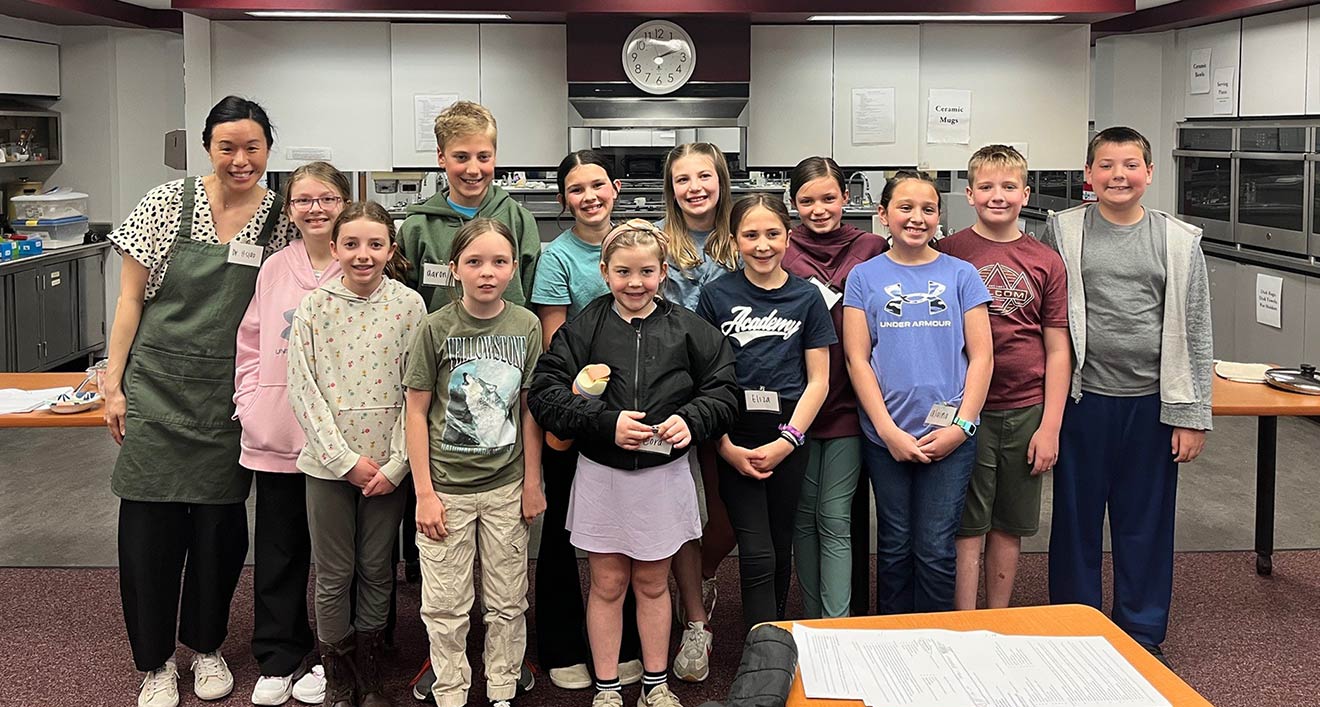
From left, front row: Olivia Kellerman of Blairsville, Emma Brooks of Indiana, Cora Merrow of Indiana, Eliza Petrillo of Indiana, Alaina Spearman of Indiana. Back row, from left: IUP faculty member Pao Ying Hsiao, Emma Kennedy of Indiana, Aaron Cribbs of Indiana, Ruby Hartnett of Homer City, Maeve Merrow of Marion Center, Maci Smith of Indiana, Briggs Wensel of Indiana, and Liam Seale of Indiana.
Supported by a grant from IUP’s College of Health Sciences, the project has two primary goals: to explore the feasibility of hosting cooking classes for children in IUP’s Teaching Kitchen in Ackerman Hall and to investigate whether children’s participation influences family food behaviors, such as trying new foods and sharing meals. This work builds on Hsiao’s fall 2025 sabbatical work, which focused on the development of community programming in the Teaching Kitchen.
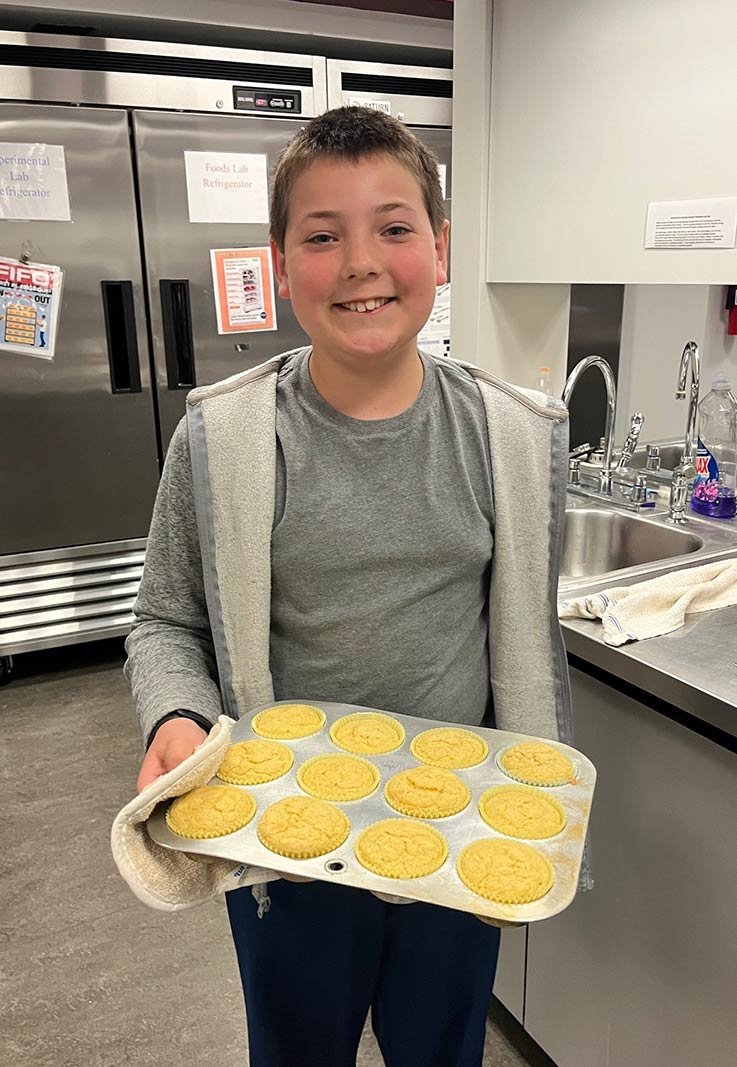
Liam Seale, of Indiana
Hsiao brings extensive experience teaching evidence-based nutrition and hands-on cooking, with an emphasis on practical food skills, nutrition application, and experiential learning. She has also worked with homeschooled children and families through prior community-based educational programming, as well as her perspective and personal experience as a homeschooling parent.
Four undergraduate dietetics students assisted Hsiao during the classes, working to guide students in their knife skills and helping the children as they followed recipes. Classes were offered on Thursday afternoons in April in IUP’s Teaching Kitchen in Ackerman Hall.
In addition to preparing recipes, the students learned about food safety and nutrition and were challenged with weekly “nutrition missions,” such as eating a fruit and a vegetable at every meal for three days. They also practiced using kitchen tools—mincing garlic, chopping onions, grating cheese, and using appliances like blenders and ovens—while learning techniques such as thickening soups by using a slurry and taking meat temperatures. The classes emphasized “mise en place”—organizing and preparing ingredients before cooking; exposed the children to cultural flavors like cardamom, cumin, and turmeric; and encouraged creative ways to explore foods beyond just tasting, like listening to how crunchy a food was.
“To say that the class was a phenomenal success would be an understatement,” she said.
“The children tried so many foods and flavors new to them, and they were truly excited and said that they loved the classes,” she said. “The parents were excited about the opportunity and have already asked if this can be offered again and also asked if an adult cooking classes could be offered,” she said.
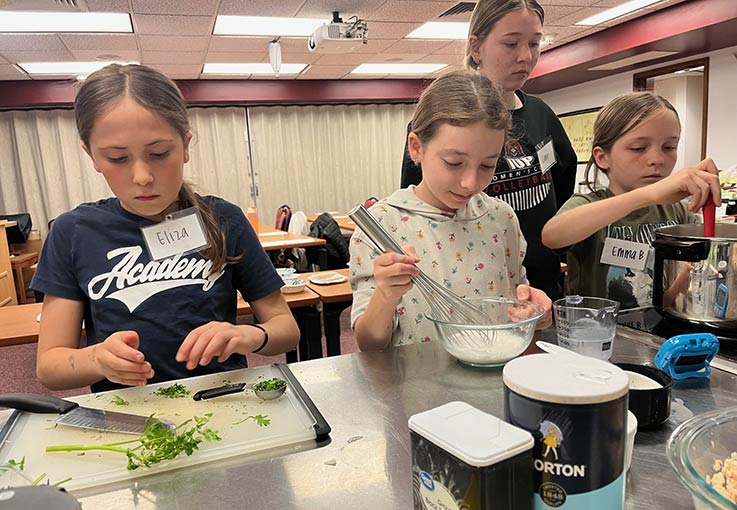
From left: Eliza Petrillo, Olivia Kellerman, Emma Brooks; in back is IUP dietetics student Lana Fairman of Berlin, who served as student lab assistant
During the first class, the children made three kinds of hummus (classic, roasted red pepper, and edamame hummus), served with mini sweet peppers, cucumber, and jicama. They also made “build your own” smoothies with a choice of a fruit, a vegetable (spinach or riced cauliflower), and a fiber booster (hemp hearts, flaxseed, or chia seed). To explore different flavors from different cultures, the students sampled mango lassis.
For the second class, “Upgraded Takeout,” the students made Korean beef with edamame, orange chicken, orange tofu (which the students voted as the favorite dish made during the classes), salad dressing from scratch (ranch and garlic lemon vinaigrette), and homemade croutons.
During the third class, students made quesadillas with black beans; a “make it your way” microwave macaroni and cheese, to which the students could add peas or broccoli and their own seasonings, including paprika, garlic powder, and onion powder; and a vegetarian cashew “cheese” sauce.
During the final class, students made broccoli and cheddar soup, white chicken chili, cornbread muffins with homemade butter (regular and honey cinnamon), and black bean brownies.
“During each class, on the average, students tried at least eight to 10 new-to-them flavors and foods,” Hsiao said.
“Cooking education has emerged as a promising strategy for improving food literacy and supporting healthy eating behaviors among children,” she said in her grant application, citing existing studies on the topic.
“Hands-on cooking education for children has been associated with improvements in nutrition knowledge, cooking self-efficacy, and food-related attitudes; however, little research has examined the feasibility and family-level spill-over effects of child-focused cooking interventions in rural community settings,” Hsiao said in the grant application.
Hsiao also noted in her grant application that studies show that rural families face unique challenges related to food access, availability of nutrition education programs, and opportunities for skill-based enrichment activities, suggesting that community-based cooking programs may represent an accessible and scalable approach to addressing these gaps.
“This project addresses a critical gap by piloting a cooking education program in a rural context and explicitly examining both child-level and family-level outcomes. By focusing on feasibility testing, this study lays the groundwork for future research that can evaluate broader impacts on diet quality and family health behaviors,” she said.
“Our findings will inform the design of future, larger-scale studies examining the role of child-centered cooking education as a strategy for improving family food practices in rural populations,” she said.
Data collected during the study will be used to examine whether participation influences family behaviors, including openness to new foods, frequency of family meals, and children’s involvement in cooking and grocery shopping.
The $1,960 grant covered cooking ingredients and supplies, funding for the student research assistants, and provided a children’s cookbook, mini waffle maker, and grocery store gift card to the children as an incentive for their participation.
“I thank the College of Health Sciences for its funding support for the project,” she said.
“With the enthusiastic feedback from the children and their families and strong early outcomes, I plan to continue the research and explore other opportunities to teach nutrition through community-based cooking programming using IUP’s Teaching Kitchen,” Hsiao said.
Since its founding in 1875, IUP has evolved from a teacher-training institution into a doctoral research university recognized for its commitment to student success and achievement. As IUP celebrates its 150th anniversary during the 2025–26 academic year, the university honors a legacy of educational excellence while looking toward a future of innovation, leadership in healthcare education, and public service.