Members of Indiana University of Pennsylvania’s proposed college of osteopathic medicine leadership team and IUP faculty members Rick Adkins and John Benhart were invited presenters for the Appalachian Regional Commission “Network Appalachia” meeting held in Pittsburgh April 8 and 9, showcasing the region’s experts on transportation, robotics, economic development, and emerging technologies.
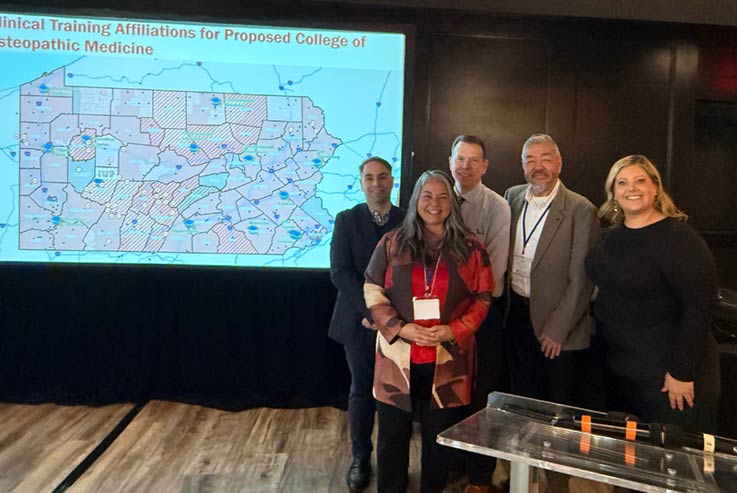
Members of IUP’s proposed college of osteopathic medicine team with Southwest Pennsylvania Commission director Jennifer Lasser (far right). From left, Founding Associate Dean of Clinical Affairs and Graduate Education Ryan Smith, Founding Dean Miko Rose, Director of Admissions and Student Affairs Jamie Murphy, Founding Associate Dean of Pre-Clinical Affairs Luke Mortensen.
The ARC is an economic development partnership entity of the federal government and 13 state governments, focusing on 423 counties across the Appalachian region.
The IUP group presented “Powering Appalachia’s Future: IUP’s Leadership in Drones, Safety Science, AI-Enabled Robotics, and Healthcare.”
In addition to the IUP presenters, the conference featured several regional leaders, including Southwestern Pennsylvania Executive Director Rich Fitzgerald, President and CEO of Pittsburgh Downtown Partnership Jeremy Waldrup, and Pennsylvania Safety and Transportation Research Track (PennSTART) Peter Castelli.
IUP Director of Strategic Partnerships Christina Koren worked closely with Jennifer Lasser, a 2004 IUP graduate and director of Workforce and Economic Development for the Southwest Pennsylvania Commission, to coordinate the invitation for the IUP team to present at the conference. The SPC worked with the Appalachian Regional Commission to bring the conference to Pittsburgh.
“ARC worked with the Southwestern Pennsylvania Commission at a local level on the event to find presenters and organizations who were doing amazing work in the areas of transportation, technology, safety, and building coalitions,” Lasser said. “IUP was a natural choice to present at Network Appalachia on behalf of the southwestern Pennsylvania region, as IUP is known for its excellence within robotics, drones, and groundbreaking work in rural healthcare.”
Koren offered introductory remarks for the IUP presentation, which included proposed IUP college of osteopathic medicine team members Founding Dean Miko Rose, Founding Associate Dean for Pre-Clinical Affairs Luke Mortensen, and Founding Associate Dean for Clinical Affairs and Graduate Education Ryan Smith. The team’s presentation included updates on progress toward the IUP proposed college of osteopathic medicine accreditation and establishing clinical sites.

From left: IUP Regional Planning Program director Rich Hoch, IUP Regional Planning Program faculty member Chris Schaney, Appalachian Regional Commission Critical Infrastructure Program Director Jim Sinette, IUP proposed college of osteopathic medicine Founding Dean Miko Rose, IUP Computer Science faculty member Rick Adkins, IUP Geoscience program faculty member John Benhart, Southwest Pennsylvania Commission director Jennifer Lasser, IUP Interim Dean of the College of Health Sciences and Vice Provost for Research and Innovation Hilliary Creely, IUP Director of Strategic Partnerships Christina Koren.
Jamie Murphy, director of admissions and student affairs for IUP’s proposed college of osteopathic medicine, also was in attendance and participated in the question-and-answer session.
Adkins is a professor of mathematics in IUP’s Department of Mathematical and Computer Sciences. He is the principal investigator for a $1.5 million Build Back Better Regional Challenge Grant allocated for an entrepreneurial makerspace ecosystem that includes IUP.
Benhart is a faculty member in the Geographic Information Systems program and director of IUP’s Uncrewed Aircraft (drone) program in the IUP Department of Anthropology, Geospatial and Earth Sciences. IUP’s uncrewed aircraft program was honored in 2024 by the Pennsylvania Drone Association as “an educational institution that has helped to elevate the drone industry in our commonwealth in a meaningful and significant way.”
IUP is the only university in Pennsylvania recognized by the Federal Aviation Administration as an FAA Collegiate Training Institution. Benhart is a GISCI-certified GIS professional and an FAA-certified remote sUAS (drone) pilot.
In addition to the distinction by the FAA as a Collegiate Training Institution, IUP has received funding from the federal Build Back Better Regional Challenge grant to purchase and test a WingtraOne Gen II hybrid drone for IUP’s Geospatial Intelligence and Unmanned Aircraft Systems certificate programs. IUP has offered an Unmanned Aerial Systems Science and Applications Certificate since 2019.
IUP’s Council of Trustees endorsed the exploration of a possible development of a college of osteopathic medicine at IUP in December 2022.
IUP’s proposed college of osteopathic medicine has “candidate status” from the American Osteopathic Association’s Commission on Osteopathic College Accreditation, which recognizes that IUP has done the required planning and has the resources necessary to apply for pre-accreditation status within two years. “Candidate status” is the second step in seeking accreditation from COCA.
The IUP proposed college of osteopathic medicine team is working on the next step in the accreditation process, seeking “pre-accreditation status.” When proposed colleges achieve pre-accreditation status, they are permitted to begin recruiting students.
Rose, a board-certified physician in psychiatry and neurology who is nationally known for wellness programming, was selected in November 2023 as the founding dean for IUP’s proposed college of osteopathic medicine. She is an elected fellow of the American College of Neuropsychiatrists by the Fellows of the American College of Neuropsychiatrists/American College of Osteopathic Neurologists and Psychiatrists.
In 2019 and again in 2024, Rose received an award as one of the top medical educators in the country, the National American Osteopathic Medical Educator Fellowship Teaching award, which is a five-year fellowship. She has also been recognized by City & State Pennsylvania as one of the state’s “50 over 50” honorees. Rose recently served as a member of the planning committee on healthcare training and affordability for the National Academies of Sciences, Engineering, and Medicine.
Mortensen and Smith joined the proposed college of osteopathic medicine team in August 2024 and July 2024, respectively. Mortensen is a fellow of the National Academy of Osteopathic Medical Educators and immediate past chair of the Academy. He is also a fellow of the American Heart Association and has been in leadership positions for the International Association of Medical Science Educators and the National Board of Osteopathic Medical Examiners.
Mortensen has a PhD in pharmacology and toxicology from Michigan State University and completed a National Institutes of Health post-doctoral fellowship at the University of Texas Health Sciences Center. His undergraduate degree is in chemistry and music from Westminster College in Missouri.
Smith is an experienced psychiatrist, a leader in medical education, and a national expert in psychiatry and mental health. He has a doctor of osteopathic medicine with a PhD in education and health science education leadership, a master’s degree in medical education leadership, an MBA with a concentration in strategic leadership administration, and a bachelor’s degree in medical biochemistry and physics.
Smith is a board-certified psychiatrist and diplomat and a fellow of the American Osteopathic Board of Neurologists and Psychiatrists, National Academy of Osteopathic Medical Educators Fellow, an American Psychiatric Association Fellow, and an American Association of Osteopathic Examiners Fellow. He was honored as the National Board of Osteopathic Medical Examiners 2025 Item Writer of the Year for the Comprehensive Osteopathic Medical Licensing Examination of the United States (COMLEX-USA) Level 1 examination. The NBOME is an independent examination board that provides the sole means for assessing on a national level the competencies for osteopathic medical practice through national, standardized examinations for osteopathic medical students.
In fall 2025, Rose, Mortensen, and Smith presented “Together We Thrive, Building Inclusive Excellence Across the State System” at the Pennsylvania State System of Higher Education’s Summit.
In June 2025, Rose was a panelist for the Federal Reserve Bank of Philadelphia’s Rural Economic Development Summit, discussing “What Can Be Done in Rural Pennsylvania? The Power of Partnership.” She was also an invited presenter for the 2024 Osteopathic Medical Education Conference, the world’s largest gathering of osteopathic physicians, held in conjunction with the American College of Neuropsychiatrists/American College of Osteopathic Neurologists and Psychiatrists.
Rose is currently leading an initiative with the Center for Rural Pennsylvania to determine commonalities of physicians who commit to and stay in rural health care practice through a survey of Commonwealth physicians.
In December 2025, IUP’s Council of Trustees approved the Doctor in Osteopathic Medicine degree, which would be offered through IUP’s proposed college of osteopathic medicine. The next step in the approval process is review by the chancellor of the Pennsylvania State System of Higher Education.
There are only three colleges of osteopathic medicine in Pennsylvania, all at private universities; IUP’s proposed college of osteopathic medicine would be the only college of osteopathic medicine at a public university.
Doctors of osteopathic medicine, or DOs, complete four years of osteopathic medical school, with an emphasis on preventive medicine and comprehensive patient care. They are trained to recognize the interrelated unity among all systems of the body, each working with the other to promote overall health and wellness. Osteopathic medical schools have a long tradition of serving rural communities. Physicians who are trained in osteopathic medicine are four times more likely to select primary care specialties and almost twice as likely to practice in rural areas as allopathic (MD) students are.
National studies show that graduates from programs of osteopathic medicine are more likely to pursue primary care in rural and underserved areas—57 percent of all doctors of osteopathic medicine practice as general practitioners, and more than 20 percent of DO graduates practice in rural areas. Demand is high for osteopathic medicine training: in 2021, 22,708 applicants competed for 8,280 seats at schools of osteopathic medicine.
IUP’s proposed college of osteopathic medicine and IUP’s commitment to addressing the rural health crisis have resulted in funding from individual donors, foundations, agencies, and legislators totaling more than $48 million. Fundraising for the project is part of IUP’s Impact 150 $150 million comprehensive fundraising campaign, raising funds for healthy students, a healthy university, and healthy communities.
Since its founding in 1875, IUP has evolved from a teacher-training institution into a doctoral research university recognized for its commitment to student success and achievement. As IUP celebrates its 150th anniversary in 2025 and through the Impact 150 comprehensive campaign, the university honors a legacy of educational excellence while looking to its next 150 years of student success, innovation, leadership in healthcare education, and public service.