Josiah Townsend, professor in Indiana University of Pennsylvania’s Department of Biology, has been selected for his second Fulbright US Scholar Award—this time to conduct research and teach in Costa Rica during the 2026–27 academic year.
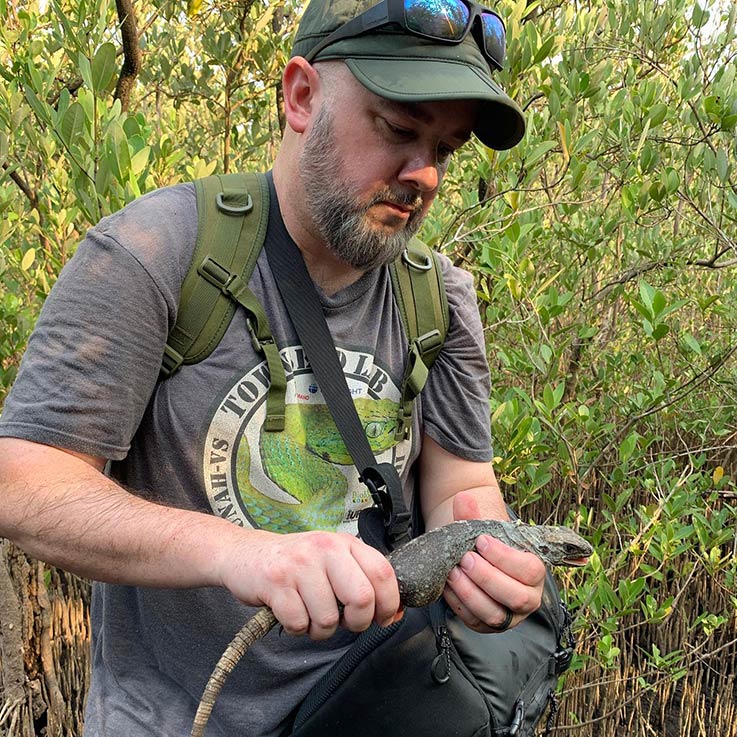
Josiah Townsend
His 2026 Fulbright project, “Resolving 70+ years of confusion over Costa Rican leopard frogs using integrative systematics,” will be hosted by Mahmood Sasa-Marín and Erick Arias at the Museum of Zoology, University of Costa Rica. In addition to conducting research while in-country, he will be teaching and doing outreach.
The US Department of State’s Bureau of Educational and Cultural Affairs oversees the Fulbright program, which is directed by the Institute for International Education. Fulbright is the country’s “flagship international academic exchange initiative” designed to “advance knowledge and innovation, foster solutions to complex global challenges, and promote peaceful relations between the United States and other nations,” Fulbright officials said.
With Townsend’s 2026 Fulbright award, current and former IUP faculty and administrators have won a total of 78 Fulbright Awards.
Townsend’s first Fulbright Award was in 2019; for that Fulbright award, Townsend spent the 2019–20 academic year in Honduras working at Zamorano Agricultural University and the National Autonomous University of Honduras, Valle de Sula.
“IUP faculty are extraordinary researchers and scholars while maintaining a commitment to excellence in the classroom and to mentoring students,” IUP Provost and Vice President for Academic Affairs Lara Luetkehans said. “Dr. Townsend is a perfect example of the teacher-scholar model.
“The Fulbright is one of the most prestigious and competitive awards in the nation, and I congratulate Dr. Townsend on being selected for a second Fulbright Award,” she said.
“Dr. Townsend’s selection for a second Fulbright award is a remarkable achievement and a reflection of his international leadership in biodiversity conservation and his deep commitment to student mentorship,” IUP John J. and Char Kopchick College of Natural Sciences and Mathematics Dean Steve Hovan said. “His work not only advances scientific understanding on a global scale but also creates transformative opportunities for IUP students through biological research and study abroad experiences. We are incredibly proud to see his contributions recognized at this level,” Hovan said.
“Being selected for a second Fulbright Scholar award is a tremendous honor, and given the current global climate, I think it is more important than ever for researchers and educators to go abroad and try to put our best foot forward on behalf of our country,” Townsend said. “The proposed research is exciting for me and my partners. After more than seven decades of uncertainty, the dedicated focus and supporting evidence needed to bring clarity to questions of basic amphibian taxonomy have aligned, and it is my intent to complete this challenge during my time as a Fulbright Scholar in Costa Rica.”
Townsend’s 2026 Fulbright project will focus on the taxonomic confusion surrounding leopard frogs, which scientists have long considered a model in vertebrate anatomy and physiology, noting that “the taxonomic status of many populations of American leopard frogs remains surprisingly understudied,” Townsend said.
“Recent advances have presented the opportunity to resolve and stabilize the taxonomy of these widespread and recognizable frogs, and I am pleased to be leading a team of regional experts focused on the problem,” he said. “In 2025, we published a long-awaited collaborative study that integrated genome-wide analyses to clarify relationships among Mesoamerican leopard frogs, confirming the presence of three lineages and at least one new species in Costa Rica and Panama. This also helped to stabilize their taxonomy across the region.”
The 2025 study was published in the Proceedings of the National Academy of Sciences, led by collaborators from the University of Texas, National Autonomous University of Mexico, and Northern Arizona University.
As part of his preparation to apply for this Fulbright research, Townsend completed exploratory field trips to Costa Rica in July 2025 and March and April 2026, collecting baseline data and establishing the relationships and local experience needed to plan a complete reevaluation of these frogs in lower Central America.
These exploratory research trips included IUP graduate students Dagan Hunt, Lindsey Levine, Emma Menard, and Anthony Ye. This February, Townsend and Ye also presented preliminary results of this research at the thirteenth Latin-American Herpetology Congress, coincidentally held at the University of Costa Rica.
Before setting off for Costa Rica, Townsend and these same four students are organizing an ambitious 70-day field season in Honduras to collect their thesis data during the summer, where they will be studying the population status of endemic snakes and geckos, the impact of introduced frogs on native species, the ecology of freshwater turtles, and the biodiversity of caves and groundwater.
These research trips have been supported by the Kopchick College Catalyst Fund, the University Senate Research Committee Grant, the IUP Graduate Student Conference Grant, and the Dean Snavely Professional Development Grant.
His research and experiences will also have direct benefits to IUP students and to IUP’s study abroad program.
“In addition to the benefit of seeing the project executed by their faculty and the academic impact of the resulting publications and outreach, I anticipate expansion of student-led research of my laboratory,” Townsend said.
“I anticipate further expansion of student-led research opportunities in my lab, to include graduate and undergraduate research and course-based research experiences, along with the support and expansion of faculty-led study abroad offerings through IUP’s Office of International Education.”
During his 2019 Fulbright, Townsend designed a new faculty-led study abroad program in Honduras, which has allowed him to lead over 60 IUP students to Honduras through last year. This coming summer, 12 more IUP students will participate in this Honduras Summer Study Abroad program, focused on the Lago de Yojoa region.
As part of his 2026 Fulbright, Townsend will have the opportunity to co-teach the flagship amphibian and reptile biology course at the University of Costa Rica, while also offering guest lectures and workshops that will be open to students, staff, faculty, and the community.
He will also focus on outreach and broad dissemination of the results of his work to the Costa Rican public.
“One of my goals is that these research findings become the basis for a public outreach campaign focused on introducing Costa Ricans—and the world—to the new species of leopard frog, using the species as a model to promote conservation and sustainable farming practices,” he said.
Over the past 25 years, Townsend has distinguished himself internationally as a leading authority in Mesoamerican herpetology, authoring hundreds of articles and three books, which include the formal descriptions of 27 new species of neotropical amphibians and reptiles. IUP students have been co-authors and contributors to many of these peer-reviewed papers and publications.
Townsend joined the IUP community in 2012. His laboratory utilizes molecular phylogenetics, comparative morphology, and macroecological modeling to reveal underestimated species-level diversity and unexpected patterns of evolution diversification.
Townsend is committed to serving as a faculty mentor to both undergraduate and graduate students. He is a faculty mentor for IUP’s Fusion Fellows program, launched in spring 2026, and is the faculty mentor for many award-winning Scholars Forum projects, for honors and master of science degree thesis projects, and for students in IUP’s Undergraduate Summer Opportunities for Applying Research and Biology Undergraduate Research Experience programs.
“Mentoring students is one of the most rewarding parts of my job, and I have been fortunate to have some outstanding young scientists come through my lab,” he said. “Most of my graduate students have continued on to success in their PhD programs and careers, and having the opportunity to work with students as they progress and grow over a two- to four-year period is rewarding in and of itself.”
Townsend completed his doctoral and post-doctoral work at the University of Florida, where he was recognized for the Best Doctoral Dissertation in 2011 and as Latin American Studies Outstanding Young Alumni in 2017. While a student at Miami-Dade Community College in 1999, he had the chance to study with one of the leading authorities in tropical reptiles, Larry Wilson, who invited him to go to Honduras for a field study.
“I fell in love with the country, and I’ve gone back every year since.” He also met his wife, Ileana Townsend, who is also a biologist and the director of education abroad at IUP, in Honduras.
While he completed his studies in Florida, Townsend grew up in the Pittsburgh suburb of Bethel Park before moving to New York and Florida as a teenager.
In 2022, IUP was designated as a Doctoral University–High Research Activity (R2) by the National Center for Postsecondary Research’s Carnegie Classification in recognition of its commitment to research and student success; this ranking was reaffirmed in February 2025.
IUP is one of only two public universities in Pennsylvania and one of only 97 public universities with this ranking in the United States. More than 3,900 colleges and universities are included in the ranking system.
Since its founding in 1875, IUP has evolved from a teacher-training institution into a doctoral research university recognized for its commitment to student success and achievement. As IUP celebrates its 150th anniversary during the 2025–26 academic year and through the Impact 150 comprehensive campaign, the university honors a legacy of educational excellence while looking to its next 150 years of student success, innovation, leadership in healthcare education, and public service.