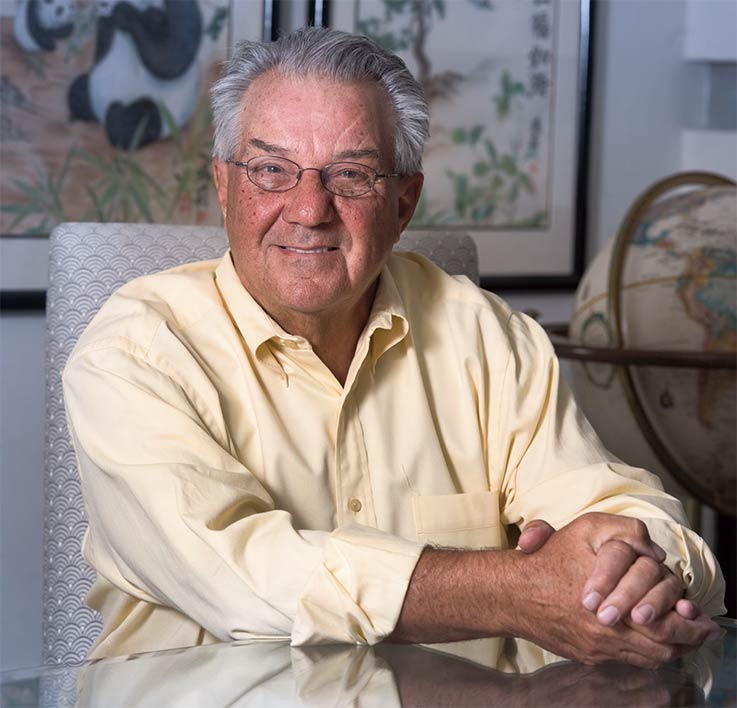
Terry A. Serafini
Terry A. Serafini, a 1961 mathematics education and physics education graduate of Indiana University of Pennsylvania from Pittsburgh, has gifted IUP $1 million for IUP’s proposed college of osteopathic medicine—bringing IUP’s Impact 150 comprehensive fundraising campaign to more than $102 million.
With a goal of $150 million, Impact 150 is the largest campaign in the history of the university. Its public launch took place in August 2025; the campaign is named in honor of the university’s sesquicentennial celebration.
Impact 150 centers around raising funds for healthy students, including supporting students academically and personally; a healthy university, including maintaining IUP’s commitment to excellence and innovation; and healthy communities, including IUP’s work to establish a college of osteopathic medicine. IUP’s proposed college of osteopathic medicine and IUP’s commitment to addressing the rural health crisis have resulted in funding from individual donors, foundations, agencies, and legislators totaling more than $48 million.
At the time of the public campaign launch, a total of $81,236,852—54 percent of the campaign goal—had been gifted to IUP from 11,673 donors. As of December 31, 2025, the campaign total stands at $102,427,224, or 68 percent of the goal, which includes more than 55,000 gifts made by 12,867 donors.
IUP’s Council of Trustees endorsed the exploration of a possible development of a college of osteopathic medicine at IUP in December 2022. There are only three colleges of osteopathic medicine in Pennsylvania, all at private universities; IUP’s proposed college of osteopathic medicine would be the only college of osteopathic medicine at a public university.
With this gift to IUP’s proposed college of osteopathic medicine, Serafini has donated more than $3 million to IUP for initiatives including the IUP Food Pantry and Help Center, scholarships for students in business and mathematics through the Serafini Outstanding Scholars Program, the Grant Street Park project, and the Eberly College of Business atrium project. As part of his commitment to addressing the issue of food insecurity, he provided funding for an IUP student to attend a national conference on the issue.
His generosity includes providing thousands of dollars in matching gifts during IUP’s student giving campaigns, including support for the Food Pantry and Help Center, with the goal of helping students to develop a spirit of philanthropy. One of his student giving challenges was the Grant Street Park project, which transformed Grant Street between Pratt Drive and 11th Street to a student gathering and event space.
“Terry Serafini’s longstanding support for IUP and our students is inspiring,” IUP President Michael Driscoll said. “His focus is always on what our students need to thrive and to be successful, now and in the future, and how he can impact both the future of individual students and IUP’s future. We are very grateful,” President Driscoll said.
“The IUP community has fully embraced the goals of Impact 150, with gifts at all levels, all addressing the themes of healthy students, healthy university, and healthy communities,” IUP Vice President for University Advancement Jennifer DeAngelo said.
“Exceeding the $100 million mark within six months of the public campaign launch is a testament to the loyalty and love that IUP alumni, friends, employees, and students have for IUP, and the respect and outstanding reputation that IUP has among businesses, legislators, and state and federal agencies,” she said. “We thank Mr. Serafini for his consistent generosity, which continues to make a difference in the lives of our students and our university,” she said.
Following his graduation from IUP and from IUP’s ROTC program, Serafini was an officer in the Army, where he got his initial experience with computers. After his military service, Serafini began his business career in 1964 as a computer systems marketing representative for the IBM Corporation. In 1970, he became a co-owner of Computerpeople, Inc., working there for 27 years. During his leadership, the company grew to employ more than 1,300 computer professionals. Headquartered in Pittsburgh, the company also maintained offices in Columbus, Ohio; Cincinnati; Sacramento, California; and Portland, Oregon, providing systems expertise in all disciplines to major corporations throughout the United States.
Serafini also co-founded Compucom, Inc., a digital-imaging and microfilm-solutions company in Pittsburgh, and formerly served on its board of directors.
Serafini was honored with the Eberly Entrepreneur of the Year award in 1996 and was selected for the Eberly College of Business Hall of Fame.
While at IUP, in addition to serving in the ROTC program, he was president of the Student Government Association and was a member of Sigma Tau Gamma fraternity, serving as vice president of the organization.
“I met recently with members of the Advancement Team, and then with the proposed college of osteopathic medicine Founding Dean (Miko) Rose, and her passion for the project was clear,” Serafini said.
“I have a soft spot in my heart for IUP, and I appreciate the fact that IUP was taking the blinders off, trying to do something that was beyond what they had ever done before. The osteopathic field seems to be aligned with rural communities, and that struck a chord with me—the fact that a college of osteopathic medicine could help not so much the research centers of the world but the Punxsutawneys, the Clymers, and places like Creighton, Pennsylvania, where I grew up—those smaller communities, so there were a number of boxes that were checked, especially in my session with Dr. Rose and her team,” he said.
“The one thing I’ve learned in life is that it’s okay to have a game plan in mind, but game plans don’t always work out. The things I keep going back to include IUP. I majored in math, and that was a good thing. I participated in ROTC at IUP, and that was a very good thing because it got me into the military, where I got a broad-brush exposure to computers. Luckily, I took some correspondence courses in the Army, and when it came time to get out of the service, IBM liked my math background and that I had exposure to computers, thanks to IUP ROTC leading me to the Army, and IBM hired me. One thing led to another, I made a couple of right choices, and I’ve been fortunate in my career,” he said.
“It’s been very rewarding to me that I’ve probably helped more than 500 people with getting an education, including through the Homeless Children’s Education Fund in Pittsburgh, at IUP, and through other projects, including Project Lift in Florida. Education and food insecurity have always been passions of mine; I don’t know where they came from, but they’ve been a driver and motivator for me.
“Supporting IUP has just been the right thing for me to do,” Serafini said.
About IUP’s Proposed College of Osteopathic Medicine
The IUP proposed college of osteopathic medicine has “candidate status” from the American Osteopathic Association’s Commission on Osteopathic College Accreditation, which recognizes that IUP has done the required planning and has the resources necessary to apply for pre-accreditation status within two years. “Candidate status” is the second step in seeking accreditation from COCA.
The IUP proposed college of osteopathic medicine team is working on the next step in the accreditation process, seeking “pre-accreditation status.” When proposed colleges achieve pre-accreditation status, they are permitted to begin recruiting students.
In December 2025, IUP’s Council of Trustees approved the Doctor in Osteopathic Medicine degree, which would be offered through IUP’s proposed college of osteopathic medicine. The next step in the approval process is review by the chancellor of the Pennsylvania State System of Higher Education.
Doctors of osteopathic medicine, or DOs, complete four years of osteopathic medical school, with an emphasis on preventive medicine and comprehensive patient care. They are trained to recognize the interrelated unity among all systems of the body, each working with the other to promote overall health and wellness. Osteopathic medical schools have a long tradition of serving rural communities. Physicians who are trained in osteopathic medicine are four times more likely to select primary care specialties and almost twice as likely to practice in rural areas as allopathic (MD) students are.
National studies show that graduates from programs of osteopathic medicine are more likely to pursue primary care in rural and underserved areas—57 percent of all doctors of osteopathic medicine practice as general practitioners, and more than 20 percent of DO graduates practice in rural areas. Demand is high for osteopathic medicine training: in 2021, 22,708 applicants competed for 8,280 seats at schools of osteopathic medicine.
Securing clinical training sites for students is part of the successful accreditation process; IUP has secured more than 240 percent of the needed clinical training spots, surpassing the 120 percent required for accreditation, at 19 different sites. Typically, students in colleges of osteopathic medicine spend the first two years of their education in the classroom; during the third and fourth years, students are based in the community at clinical sites. IUP also has secured a pre-clinical training agreement with the Indiana County Coroner’s Office for future students at IUP’s proposed college of osteopathic medicine.
IUP’s proposed college of osteopathic medicine and IUP’s commitment to addressing the rural health crisis have resulted in funding from individual donors, foundations, and agencies. In addition to Serafini’s donation, these gifts include:
-
In December 2025, Ruth Riesenman, of Indiana, a 1964 alumna and retired IUP administrator, designated part of her $25,000 gift to support the proposed college of osteopathic medicine.
-
In September 2025, IUP graduates David (1971) and Becky Walzak (1970) made a $500,000 donation for the proposed college of osteopathic medicine.
-
In August 2025, John (Jack) and Linda Brose, of Athens, Ohio, gifted $25,000 for scholarships for future students at the proposed college of osteopathic medicine; Brose joined IUP’s proposed college of osteopathic medicine team as a consultant and executive mentor in 2022.
-
In July 2025, John Ninosky, a 1993 criminology graduate, gifted $50,000 for future students at the proposed college of osteopathic medicine in honor of his late wife, Tammy Beale Ninosky, a 1993 IUP child development and family relations graduate.
-
In June 2025, IUP received a $50,000 gift from Thomas R. Smith, of Hollidaysburg, who received a master’s degree in secondary counselor education from IUP in 1976 and retired from a 40-year career in education.
-
In April 2025, IUP received a $1-million gift from an anonymous alumnus of IUP, who is a native of Indiana County, and a $50,000 gift from Lt. Col. Barry Gasdek, a 1964 graduate and 2015 Distinguished Alumni Award recipient originally from Westmoreland County.
-
In February 2025, IUP announced gifts totaling $500,000: a $250,000 gift from an anonymous donor and a $250,000 gift from the Fairman Family Foundation of DuBois.
-
In December 2024, Theodore Lazzaro, board-certified surgeon and founder of Aestique Med Spa, gifted $50,000 to IUP for scholarships for students in health care professions.
-
In October 2024, the Pennsylvania State System of Higher Education Board of Governors designated $2 million in design funds as part of the 2024–25 State System of Higher Education capital allocations budget for the academic building renovation for the health sciences cluster and proposed college of osteopathic medicine.
-
Senator Joe Pittman and Representative Jim Struzzi announced in October 2024 that $2 million from the 2024–25 state budget has been set aside for the project.
-
In July 2024, IUP graduates Tim and Debra Phillips Cejka (1973) gave $2 million for the proposed college.
-
In June 2024, the Foundation for IUP committed $20 million.
-
In May 2024, Congressman Guy Reschenthaler included $2 million for IUP’s project among his FY25 requested community projects, and Senator John Fetterman included $2 million on his list to advance in the FY25 Community Project Funding process.
-
IUP received a $150,000 allocation for the project in the federal Consolidated Appropriations Act for Fiscal Year 2024, which was sponsored by Congressman Reschenthaler and Senator Fetterman and signed into law by President Joe Biden on March 9, 2024.
-
In February 2024, the Board of Governors allocated $500,000 for a facilities feasibility study for academic facilities for IUP’s health sciences cluster and proposed college of osteopathic medicine.
-
In January 2024, IUP’s Alumni Association Board of Directors authorized a donation of $500,000.
-
In December 2023, Sen. Pittman announced that as part of the 2023–24 state budget, $2 million was set aside for the project.
-
In July 2023, IUP graduates Nick Jacobs and Mary Ann Hoysan Jacobs donated $40,000 to advance the project. Nick Jacobs is a 2005 Distinguished Alumni Award recipient who has a 1969 bachelor’s degree in education and a 1972 master’s degree in music education; Mary Ann Jacobs has a 1968 bachelor’s degree in music education and a 1993 master’s degree in adult and community education.
-
In May 2023, Rich Caruso, a 1983 accounting graduate from Meadow Lands, 2023 Distinguished Alumni Award recipient, and former president and current member of the Foundation for IUP Board of Directors and member of the Pennsylvania State System of Higher Education Board of Governors, announced a pledge of $1 million for the project.
Since its founding in 1875, IUP has evolved from a teacher-training institution into a doctoral research university recognized for its commitment to student success and achievement. As IUP celebrates its 150th anniversary in 2025, the university honors a legacy of educational excellence while looking toward a future of innovation, leadership in healthcare education, and public service.