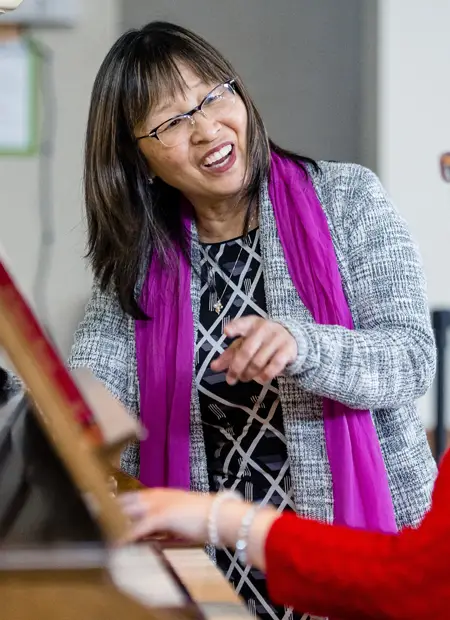
Christine Clewell
Christine Clewell describes music as a cultural force that connects people across time, borders, and emotions. She’s drawn to its power to communicate what words cannot and to build community between performers and listeners.
Learn more about her in this installment of Meet Our Faculty.
What is it about the music field that initially drew you in—and that ultimately keeps you interested?
Music is culture. The field of music education is the exchange of cultures that can span centuries and borders, empowering humans to exercise agency in the best and worst of times.
The relationship between the performing artist and the audience has held timeless power to heal and to be a life force for good, binding people together through the expression of the ineffable. Where words are present, and where words fall short, the exchange of music is dialectic, where the language spoken keeps us connected to ourselves and to our neighbors. Every emotion can be experienced and expressed more fully through making and listening to music.
From grief to despair, joy to hope, music can unite the performer and the listener, facilitating and fostering a keen sense of community from one person to another, from one village to another, one nation to another.
Spanning centuries of styles across empires that rise and fall, the world comes together in the international dialogues found in music, the universal language.
Why do you enjoy teaching in this discipline?
Throughout my artist career and teaching vocation, I have immersed myself in the ineffable, enriching exchange of studying, learning, and teaching a vast array of repertoire conceived for the pipe organ in both sacred and secular spaces.
Pipe organ music offers a distinct experience of making music because no two instruments are alike, where oftentimes, one must practice on one pipe organ to prepare a performance on an entirely different instrument. It keeps life remarkably interesting and in a constant state of learning, adaptation, flexibility, and engagement when moving one’s feet and hands and pushing lots of buttons to master the instrument’s mechanics. This kind of consistent variety keeps the organ professor and her student on their toes!
Endemic to pipe organ repertoire, I love collaborating with other musicians, from accompanying solo vocalists and instrumentalists to large ensembles. I also thoroughly enjoy performing solo organ repertoire, because the pipe organ can be its own orchestra. It is found housed in beautiful, storied, religious spaces and universities all over the world.
The opportunities to collaborate with solo artists, choirs, and instrumentalists afford a fascinating array of repertoire possibilities. It is an ever-expanding field of music.
What advice would you give students about how to succeed in college?
The best advice given to me is a Fab Five bundle:
- Be curious, stay curious—it makes life incredibly adventuresome and enjoyable at every stage.
- Make sure you engage fully in life and opportunities, making the most of every chance offered to you; you can only learn if you are engaged.
- In the words of Eleanor Roosevelt, “. . . Stop to look fear in the face. Do the thing you think you cannot do.”
- Fifty percent of success is showing up . . . for class, rehearsal, a meeting, a commitment.
- Be kind. We never know what is happening in the lives of our family, friends, colleagues, and students. Be kind and seek to understand.
Tell us something most of your students may not know about you.
I love to travel, learn different languages, eat, cook, and try different ethnic dishes.
I am an ethnomusicologist at heart; I love the dialogue that music affords between people across centuries and cultures. Music gives voice to people in every occupation, ethnicity, race, and faith, and our lives would be deeply lacking without dialogue. Whether you are the performer or a member of the audience, engage and care, invest, and listen to each other. It is this capacity to express that gives voice to people of all races, ethnicities, faiths, and social levels. People need to be seen, recognized, and respected.
I am also deeply committed to CrossFit, where I focus on being the best version of myself through movement and community. An object in motion stays in motion!