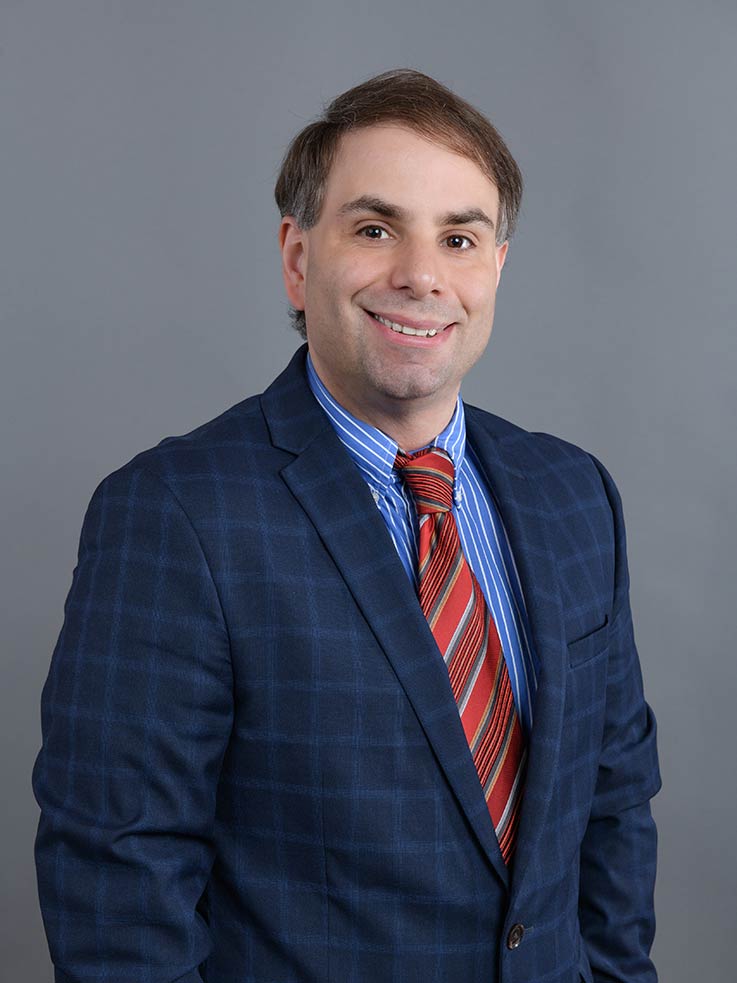
 Ryan Smith
A member of Indiana University of Pennsylvania’s proposed college of osteopathic medicine administrative team has been honored by the National Board of Osteopathic Medical Examiners.
Founding Associate Dean of Clinical Affairs and Graduate Medical Education Ryan Smith has been selected as the NBOME 2025 Item Writer of the Year for the Comprehensive Osteopathic Medical Licensing Examination of the United States (COMLEX-USA) Level 1 examination.
The NBOME is an independent examination board that provides the sole means for assessing on a national level the competencies for osteopathic medical practice through national, standardized examinations for osteopathic medical students.
The COMLEX-USA series is designed to assess osteopathic medical knowledge, knowledge fluency, clinical skills, and other competencies essential for practice as an osteopathic generalist physician. It is a three-level, national standardized exam designed for licensure for the practice of osteopathic medicine, designed to assess osteopathic medical knowledge, knowledge fluency, clinical skills, and other competencies essential for practice as an osteopathic generalist physician.
Passing this examination sequence is a requirement for attaining a DO (doctor of osteopathic medicine) degree from colleges of osteopathic medicine in the United States, and for entry into and promotion within graduate medical education (residency) training programs and the attainment of a state medical license.
“This honor recognizes Dr. Smith’s commitment to excellence for osteopathic medical education and his experience and expertise,” IUP proposed college of osteopathic medicine Founding Dean Miko Rose said. “He continues to do an outstanding job in securing clinical training agreements for our future students, and his experience on the national level related to student education and proficiency will continue to provide an advantage to our proposed college and to the success of our future students,” she said.
IUP has secured 19 clinical training affiliation agreements and a pre-clinical training agreement with the Indiana County Coroner’s Office. Securing clinical training sites for students is part of the successful accreditation process; IUP has secured more than 240 percent of the needed clinical training spots, surpassing the 120 percent required for accreditation. Typically, students in colleges of osteopathic medicine spend the first two years of their education in the classroom; during the third and fourth years, students are based in the community at clinical sites.
Smith was chosen for the Item Writer of the Year honor following an objective evaluation of dozens of item writers who contributed to the COMLEX examinations in 2025. The committee concluded that Smith’s items are a model for the type and format needed to produce a valid, high-quality examination that assesses competencies for osteopathic medicine and related health professions.
“I have been working with the NBOME for the past 15 years, and have served in several chair and leadership positions within the organization, and thoroughly enjoy the academic rigor of our work as well as the collegiality,” Smith said. “In fact, Dr. Rose and I initially met at NBOME many years ago, and now find ourselves as colleagues here at IUP. I am excited to continue in my roles at NBOME for many years to come.
IUP’s proposed college of osteopathic medicine has “candidate status” from the American Osteopathic Association’s Commission on Osteopathic College Accreditation, which recognizes that IUP has done the required planning and has the resources necessary to apply for pre-accreditation status within two years. Candidate status is the second step in seeking accreditation from COCA.
The IUP proposed college of osteopathic medicine team is working on the next step in the accreditation process, seeking “pre-accreditation status.” When proposed colleges achieve pre-accreditation status, they are permitted to begin recruiting students.
In December 2025, IUP’s Council of Trustees approved the doctor in medicine degree, which would be offered through IUP’s proposed college of osteopathic medicine. The next step in the approval process is review by the Pennsylvania State System of Higher Education Board of Governors.
IUP’s Council of Trustees endorsed the exploration of a possible development of a college of osteopathic medicine at IUP in December 2022.
Smith joined the IUP team in July 2024. He has a doctor of osteopathic medicine degree with a PhD in education and health science education leadership, a master’s degree in medical education leadership, an MBA with a concentration in strategic leadership administration, and a bachelor’s degree in medical biochemistry and physics. He is a board-certified psychiatrist and diplomat and a fellow of the American Osteopathic Board of Neurologists and Psychiatrists.
Smith came to IUP from Orlando Health Sciences University’s Orlando College of Osteopathic Medicine, where he was the founding associate dean for preclinical education and professor of psychiatry; he also continues to serve as an adjunct associate clinical professor of psychiatry at the University of New England College of Osteopathic Medicine, the Philadelphia College of Osteopathic Medicine, and the Geisel School of Medicine at Dartmouth.
He is a National Academy of Osteopathic Medical Educators Fellow, an American Psychiatric Association Fellow, and an American Association of Osteopathic Examiners Fellow, serving as vice president of the organization until 2023. Smith has been practicing psychiatry at the New Hampshire State Hospital in Concord, New Hampshire, for the past 15 years and directed the mental health division of a federally qualified rural health center in Washington County, Maine.
Prior to his work at Orlando Health Sciences University, Smith was the founding psychiatry residency program director at Tufts University School of Medicine’s site at Portsmouth Regional Hospital in Portsmouth, New Hampshire, and adjunct associate professor of psychiatry at Tufts University School of Medicine. He also served for eight years as a full-time faculty member at the University of New England College of Osteopathic Medicine in Maine, where he led psychiatry and systems-based education and was named Professor of the Year twice in his tenure there.
Smith completed his graduate medical education at Maine Medical Center and Tufts University School of Medicine (psychiatric post-graduate training year four and child psychiatry fellowship); Dartmouth-Hitchcock Medical Center and Geisel School of Medicine at Dartmouth (psychiatric post-graduate training years two and three and psychiatric residency); and Harvard Medical School (psychiatric post-graduate training year one and psychiatry residency).
He was honored as professor of the year and as clinical faculty member of the year at the University of New England College of Osteopathic Medicine, and he received the James K. Lally, DO, Emerging Leader of the Year Award from the American Osteopathic Foundation, the Marguerite Elliot Innovator in Clinical Medical Education Award from the Society of Osteopathic Medical Educators, and the Young Physician of the Year Award from the Maine Osteopathic Association; earned membership in the Arnold P. Gold Foundation Gold Humanism Honor Society; and was a National Health Service Corps Scholar for the US Department of Health and Human Services, serving in Washington County, Maine, which has one of the highest uninsured rates in all of New England.
He has held several clinical, consultant, and voluntary supervisory positions and has been in leadership positions for many national professional organizations. He has been active in research, including in two ongoing projects: “Gender Differences in the Perception of Stress after High-Stakes Medical School Examinations” and “Predictors of Performance on National Medical Licensing Board Exams.”
He has also been a contributor to articles in many professional journals and has been an invited lecturer at medical colleges and professional meetings. Smith served for five years via gubernatorial appointment to the Maine State Board of Osteopathic Medical Licensure.
There are only three colleges of osteopathic medicine in Pennsylvania, all at private universities; IUP’s proposed college of osteopathic medicine would be the only college of osteopathic medicine at a public university.
Doctors of osteopathic medicine, or DOs, complete four years of osteopathic medical school, with an emphasis on preventive medicine and comprehensive patient care. They are trained to recognize the interrelated unity among all systems of the body, each working with the other to promote overall health and wellness. Osteopathic medical schools have a long tradition of serving rural communities. Physicians who are trained in osteopathic medicine are four times more likely to select primary care specialties and almost twice as likely to practice in rural areas as allopathic (MD) students are.
National studies show that graduates from programs of osteopathic medicine are more likely to pursue primary care in rural and underserved areas—57 percent of all doctors of osteopathic medicine practice as general practitioners, and more than 20 percent of DO graduates practice in rural areas. Demand is high for osteopathic medicine training: in 2021, 22,708 applicants competed for 8,280 seats at schools of osteopathic medicine.
IUP’s proposed college of osteopathic medicine and IUP’s commitment to addressing the rural health crisis have resulted in funding from individual donors, foundations, agencies, and legislators totaling more than $48 million. Fundraising for the project is part of IUP’s Impact 150 $150 million comprehensive fundraising campaign, raising funds for healthy students, a healthy university, and healthy communities.
Since its founding in 1875, IUP has evolved from a teacher-training institution into a doctoral research university recognized for its commitment to student success and achievement. As IUP celebrates its 150th anniversary in 2025 and through the Impact 150 comprehensive campaign, the university honors a legacy of educational excellence while looking to its next 150 years of student success, innovation, leadership in healthcare education, and public service.