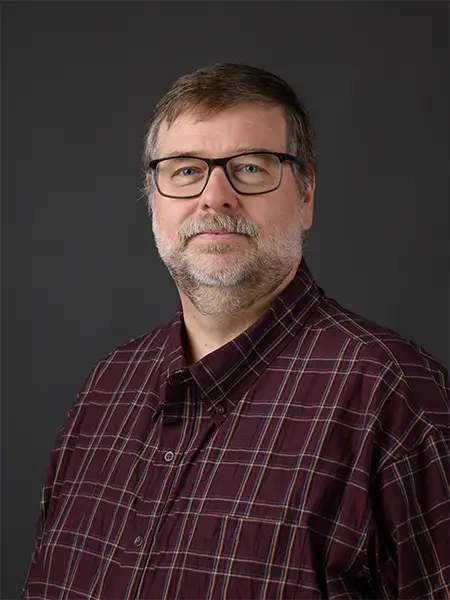
Bill Chadwick
Bill Chadwick’s journey into anthropology started unexpectedly during a family trip, when an archaeological dig captured his imagination. Through his early fieldwork to his advanced studies in geophysics and geomorphology, he has focused on understanding how past humans interacted with changing environments.
Today, as a faculty member in IUP’s Department of Anthropology, Geospatial and Earth Sciences, he shares that passion with students, blending science and history through hands-on activities. Learn more about him in this installment of Meet Our Faculty.
What is it about the anthropology field that initially drew you in—and ultimately keeps you interested?
I developed an early interest in anthropology without knowing it. During a family trip to Williamsburg, Virginia, I spent over an hour, to the dismay of my family, simply watching an archaeological excavation. I entered college as a geology/chemistry major, but quickly found anthropology and archaeology courses. As a federal work-study student, I worked in the campus Archaeological Research Center and then began working summers conducting cultural resource management archaeological surveys and excavations. This is what pushed me further into anthropology.
Through graduate school, I moved to the science side of archaeology, focusing on geophysics and geomorphology to examine the environments and landscapes of archaeological sites. Understanding the landscapes on which and environments in which the archaeological site once lay provides a greater understanding of how past humans interacted with their environs and reacted to changes in climate and changing sea levels. That is my passion.
Why do you enjoy teaching in this discipline?
I find it exciting to open students’ eyes to the breadth of knowledge regarding how humans interact with each other and with the world around them, how those interactions for millennia have shaped the world we live in, and how we can all learn from past people and civilizations to shape our future. One of my favorite activities is teaching students how people from thousands of years ago made stone tools, pottery, and baskets. Having students physically follow the process of taking a piece of stone and making a tool that people would use to hunt, fish, do woodworking, or make fire. Or, using pine needles to make baskets or clay to make pottery, using methods thousands of years old. Watching the students realize that the process of creating these tools and objects is linked to human activities based on physics, geology, chemistry, and biology.
What advice would you give students about how to succeed in college?
Every semester, on the first day, I tell my students to show up for college, not just go to college. I explain that they need to be present in every activity and action at school. They need to be engaged and fulfill all the requirements of the course to succeed.
Students need to talk to their faculty, advisors, and other students in their program. These are part of their support structure. The faculty and advisors want all students to succeed, and your fellow students either have, or are currently, going through many of the issues you are encountering. They are all resources for your success.
Engage in the university and all it has to offer. From student activities to faculty research, there is something for you. If you are interested in research, meet with your faculty. It does not even need to be in your discipline. These activities will make you stand out from your peers when it is time for the next stage of your academic or professional career.
Tell us something most of your students may not know about you.
In college, I was a competitive paintball player.