Keeping Up with Money-Driven College Sports Could Prove Difficult
By Matthew Burglund
On the eve of his team’s annual spring scrimmage in April, one of IUP’s best football players received a call from an area code in Texas.
On the other end was a Division I coach, dangling a six-figure deal: transfer schools and pocket $100,000 from the program’s NIL collective—a booster-backed fund created to pay student-athletes for use of their name, image, and likeness.
It might sound like something out of a spy movie, but it’s real. And although it violates many NCAA rules, scenarios like this are common and increasingly the norm in college athletics today. It’s one example of how recent changes in Division I athletics have impacted Division II, leading to questions about the future of athletics for schools like IUP.
“Division II has always been about ‘life in the balance.’ If we lose that, we lose what makes Division II special.”
“I worry about the long-term sustainability of Division II,” said IUP President Michael Driscoll. “Division II has always been about ‘life in the balance’—helping students become good people, good citizens, and earn their degrees while learning leadership through competition. If we lose that, we lose what makes Division II special.”
This apocalyptic new world primarily affects the so-called “big three” college sports: football and men’s and women’s basketball. But it has the potential to impact them all.
“I think everyone in the industry is still trying to figure things out,” said Todd Garzarelli M’22, director of athletics. “I’m talking to colleagues and friends, even at the Division I level, and they’re still trying to sift through it all. The only thing we can be sure of is that whatever happens in Division I usually trickles down to Division II.”
More Money, More Problems
For decades, Division I schools made a lot of money from TV rights, product branding, and ticket sales, but student-athletes at that level received only a scholarship in exchange for their athletic talents.
Many thought it was an unfair trade-off, as student-athletes didn’t get a penny from the millions of dollars they helped generate. And those who chose not to finish their college education when their eligibility clock ran out were left empty-handed.
“We can’t dismiss the fact that they are athletes, but what we’re seeing in Division I stems from a belief that there was inequity—that student-athletes were being taken advantage of—and that’s a fair concern,” said Thomas Segar, vice president for the Division of Student Affairs, which includes IUP Athletics.
“I have to recruit my own roster every year, hoping our guys will stay. It never stops.”
In response to those concerns, the Name, Image, and Likeness system was created; the transfer portal opened, making the names of athletes interested in switching schools readily available; and the recent House v. NCAA settlement came down, allowing Division I student-athletes to be paid directly by their university. All of it has led to unprecedented instability in college athletics. That’s not to mention the elimination of two key policies: the one-year sit-out rule, which required athletes transferring up a division or between Division I schools to sit out a season before competing, and the restriction that limited athletes to no more than two transfers during their college career. The result is a college sports landscape in which every offseason looks like free agency does in pro sports.
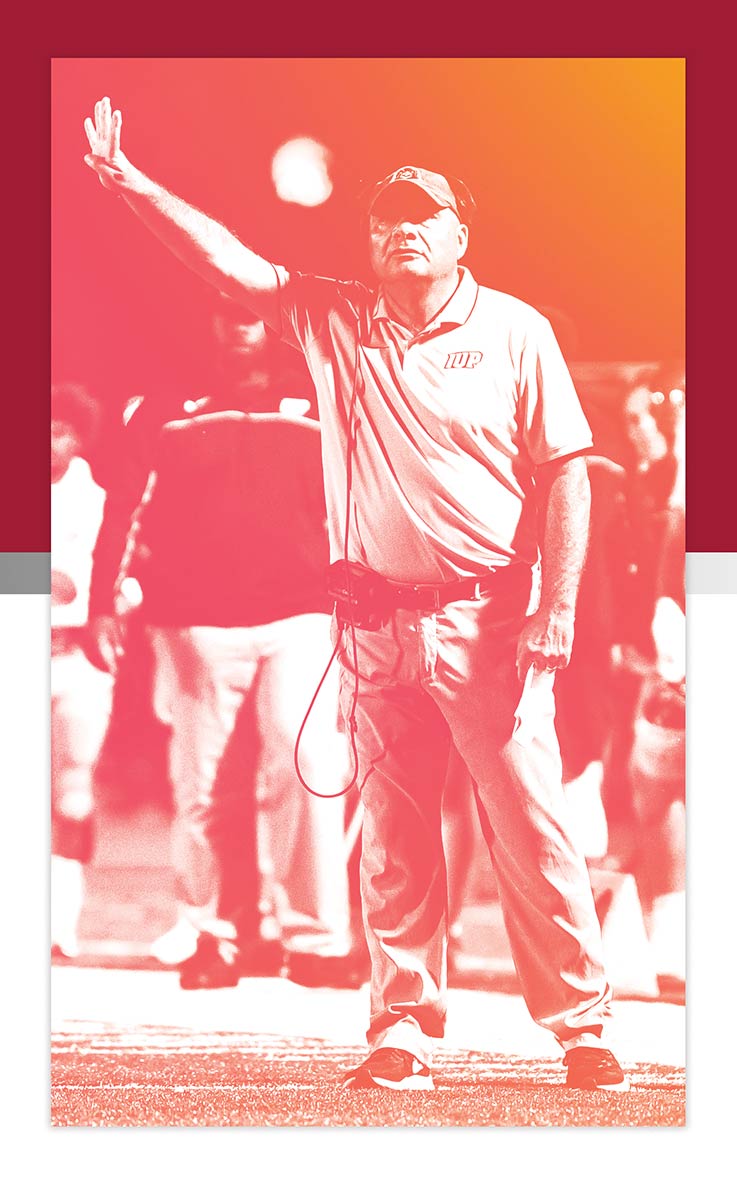
“I came to Division II to get away from year-round recruiting,” said head football coach Paul Tortorella, who had stops at Division I Maryland and Akron before coming to IUP in 1995. “But now it’s year-round again. I have to recruit my own roster every year, hoping our guys will stay. It never stops.”
The 2014 creation of the College Football Playoff, which generates an estimated $1.3 billion per year, has led to high earnings for the “Power 4” Division I conferences—the Atlantic Coast, Big Ten, Big 12, and Southeastern. Division I schools begrudgingly dole out some revenue to the NCAA to be shared with Division II and III schools. However, it isn’t enough for the smaller schools to afford the same perks that Division I schools offer their student-athletes.
Understanding D2 Scholarships
 The common belief about college athletes is that these are students who get a free education and play their favorite sport.
That’s true in Division I. Most student-athletes at that level get a full scholarship to cover their cost of attendance, which includes housing and dining, books, and other associated fees. But that’s not how Division II operates.
IUP and other Division II schools award what the NCAA calls “scholarship equivalencies.” Each school raises money to give to student-athletes to help defray the cost of attendance, and the coaches award that money at their discretion. Few, if any, student-athletes receive full scholarships. Instead, they get a portion.
At IUP, student-athletes receive anywhere from a couple hundred to several thousand dollars per year, but they still have a balance to pay. Sometimes grants and federal student aid cover that, but not all students qualify.
By law, Pennsylvania public universities are not permitted to use state tax dollars for scholarships—athletic or academic—so every dollar handed out to students must be raised by the university.
Some schools raise more money and give out more scholarship equivalencies than others, although Division II sets an upper limit on how many can be awarded in each sport. Currently, IUP does not offer the maximum in any of its 19 varsity sports.
To donate to IUP Athletics in support of student-athletes, go to Make a Gift.
Another significant source of revenue is the NCAA Division I men’s basketball tournament, which earned more than $900 million in 2024. Some of that trickles down to the lower divisions, but the lion’s share stays with the big conferences and their schools.
The current TV deal for the basketball tournament expires in 2032. Steve Murray, commissioner of the Division II Pennsylvania State Athletic Conference, in which IUP competes, said he expects changes that could have far-reaching effects on Division II.
“I think they’ll start negotiating a new deal by 2029,” he said. “I think whatever deal they make will tell you a lot about what the future of Division II and the NCAA will look like.”
While Division I schools, fueled by billion-dollar TV deals, push these changes, Division II schools are left with strained budgets, disrupted rosters, and fundamental questions about whether some programs can survive in this new world. The conferences these schools compete in also face uncertainty, because some of their operational budgets come from Division I.
And now and then, there are rumblings that the Power 4 conferences are talking about breaking away from the NCAA and creating their own for-profit governing body. If that were to happen, what would become of Division II?
In 2020, the PSAC Board of Directors asked Murray to develop a contingency plan in case funding from Division I schools was unexpectedly cut. As a result, the PSAC now has enough financial reserves to operate independently for a short time. However, it would need to decide what to do in the long term. Disbanding, sponsoring fewer sports, and merging with another conference could be among the options.
Transfer Mania
Fortunately for Tortorella and the IUP football program, the player who got the call from Texas couldn’t accept the offer—because of NCAA rules. In Division I, student-athletes have five calendar years to play four seasons of a sport, and this player had already been in college longer than that, so his eligibility had run out.
That didn’t stop the Division I coach from trying.
“It’s a shotgun approach,” Tortorella said. “Those coaches just call a bunch of players and hope some of them transfer.”
This kind of hunting expedition puts a lot of stress on young people who might not be equipped to make a sound decision when faced with such an offer.
On one hand, they know they can excel on Division II playing fields and courts, and they’re making progress toward a degree; on the other, cash is king, and the need to make money now trumps any academic work the student-athlete might be undertaking.
“They may not play much or have a championship experience, but they’ll chase the money,” Garzarelli said. “For some families, that’s hard to turn down.”
Transferring up to Division I may sound like a solid career move, and in the short term, it may be. However, it could also slow a student-athlete’s academic progress. Considering that only about 2 percent of college athletes become professional athletes, a college degree should be the goal, although often it’s not.
“I think the most important thing is that institutions need to be more vigilant about prioritizing the needs of student-athletes as students and learners,” Segar said. “So, we have to balance both realities: the desire of student-athletes to benefit from their talents and our responsibility to support and educate them.
“Educating students is key. We need to prepare them to be successful, wherever they go.”
An Uncertain Future
All of this leaves schools like IUP—which has been a Division II institution since the NCAA adopted the three-division system in 1973—wondering what the future holds for athletics.
“The problem is the [NCAA] membership dictates the legislation,” Garzarelli said, “and when a Power 4 school doesn’t like the legislation, they sue the NCAA. They’re suing against the legislation they helped create. Until the membership decides what it wants and how it wants to be governed, the NCAA is going to keep having issues.”
“We have to balance both realities: the desire of student-athletes to benefit from their talents and our responsibility to support and educate them.”
The House v. NCAA settlement, which more or less allows schools to create payrolls for their student-athletes, is Division I-only right now. But it could eventually make its way to Division II, creating an even wider gap between the haves and the have-nots.
Driscoll said that’s a future that fans of IUP Athletics certainly won’t like.
“If paying our student-athletes becomes a requirement,” he said, “we’ll likely see [Division II] sports disappear. That means fewer students getting the chance to go to college to earn a degree.”
But Murray isn’t sure the future would be that bleak.
“I don’t think it would change that much,” he said. “I don’t see schools dropping sports. I just see them having conversations about how we want to approach this. The NAIA [National Association of Intercollegiate Athletics] is out there as a possibility. Some schools depend on sports for enrollment, so they wouldn’t want to give that up. They’ll just have to find a way to do it within their means.”
For now, Division II schools face an uncertain future as they wait for Division I to settle its affairs.
“The next 7 to 10 years will be interesting to watch,” Murray said. “Once the curtain was pulled by Division I, there was no stopping it.”
While the transfer portal, NIL money, House settlement, and revised transfer rules have muddied the college sports water more than ever, Driscoll is sure of one thing.
“We’ve lost something,” he said, “and I don’t know if we can get it back.”