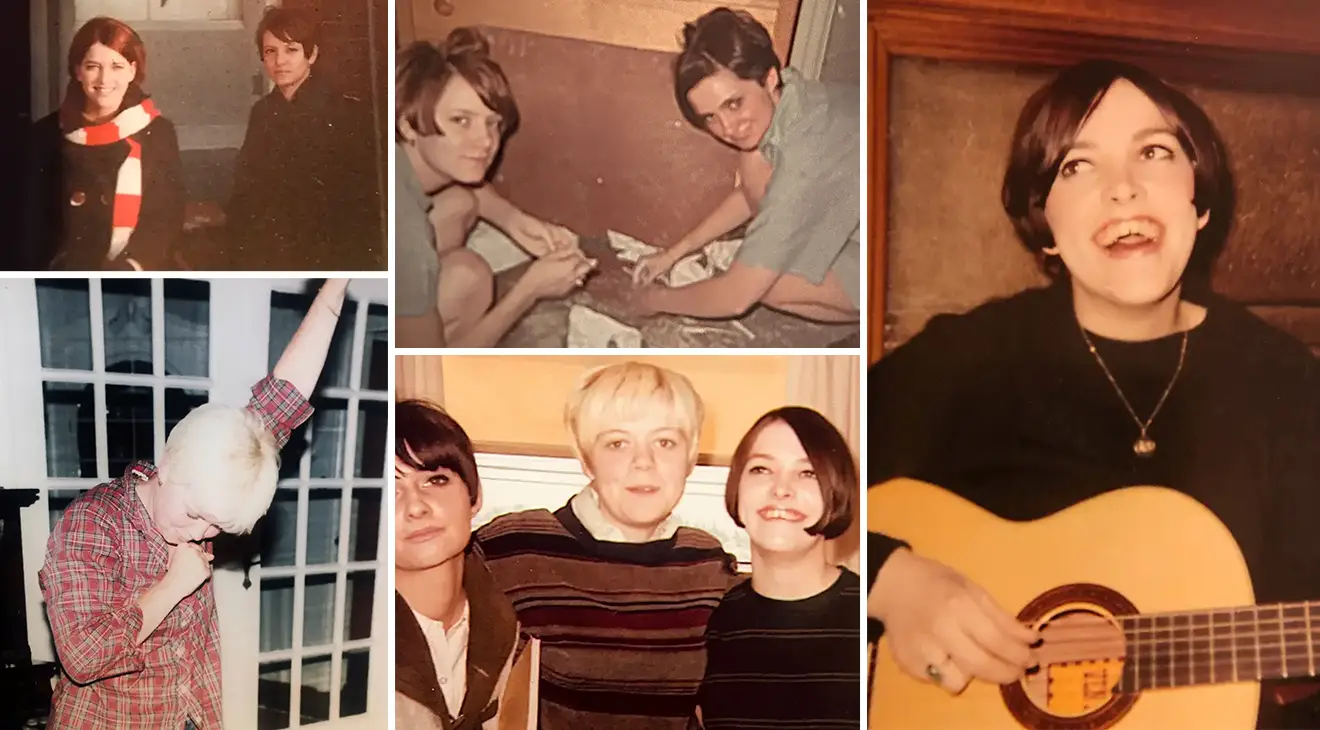
Clockwise from the top left: Marianne and Jayne in Pittsburgh during Christmas break, 1967; Jayne, left, and Julie in Sutton Hall in the 1960s; Marianne at IUP in the late ’60s; Julie, Claudia, and Marianne in Stewart Hall in the late 1960s; Claudia’s Mick Jagger impression at an informal reunion in the early 1980s in State College. (Courtesy of Marianne Dougherty)
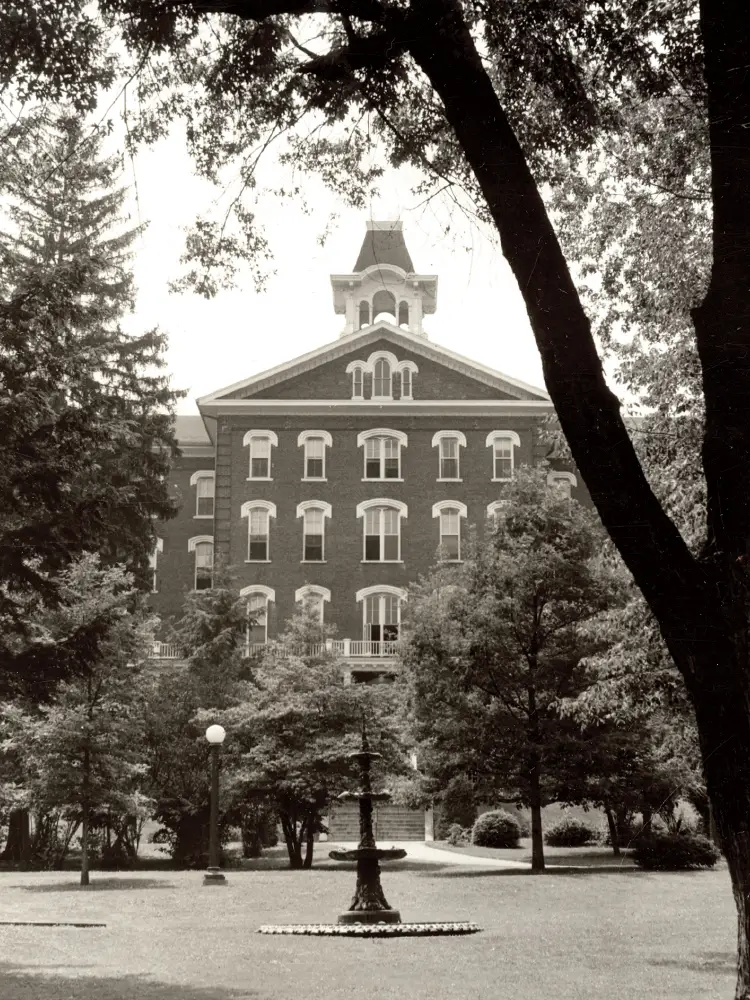
John Sutton Hall from the East Lawn in 1975 (IUP Archives)
As a product of the Baby Boom, which resulted in the largest generation in US history, I was one of the first in my family to go to college. My family was middle-class at best, so I applied to a couple of state-supported schools. Room, board, and tuition at Indiana State College were about $900 a year, and I was accepted as part of a program that required me to start classes in the summer, take the fall semester off, and return in January. Apparently, I’d applied too late, and enrollment for fall was at capacity, but statistics showed that enough students would drop out, flunk out, or transfer after their first semester to make room for me that spring. It wasn’t the way I’d imagined starting college life, but because of the lifelong friendships I forged that summer, it turned out to be one of the best things that ever happened to me.
Completed in 1875, John Sutton Hall was saved from demolition a century later and added to the National Register of Historic Places. It houses administrative offices today, but in its early years it served as a dormitory for as many as 225 young women and included an infirmary, dining hall, and gymnasium. Designed in the Italianate style by James Drum, Indiana’s “Old Main” was named for John Sutton, the Indiana merchant from whom the school’s original land was purchased and the first president of the board of trustees.
When I arrived just days after graduating from high school in June 1965, I was assigned to a room on the fourth floor of John Sutton Hall. I’d gone to high school with my roommate, but she went home every weekend to see her boyfriend, so I made new friends. Sixty years later, I still get together for reunions with Claudia, Julie, Jayne, and Sharon; Sharon calls us the John Sutton Chicks.
Before cassette tapes, CDs, and streaming services like Spotify, we listened to music on vinyl records, which Gen Z is rediscovering after all these years. Sure, streaming is more convenient, but in the transition to newer formats, we lost the evocative cover art that became de facto visual storytelling: the iconic Andy Warhol-designed banana you could literally peel on the cover of The Velvet Underground & Nico; a collage of historical figures and celebrities, including Albert Einstein, Bob Dylan, and Marilyn Monroe, on the Beatles’ Sgt. Pepper’s Lonely Hearts Club Band; and, at Janis Joplin’s insistence, an illustration by artist Robert Crumb on Cheap Thrills, her second studio album with Big Brother & the Holding Company.
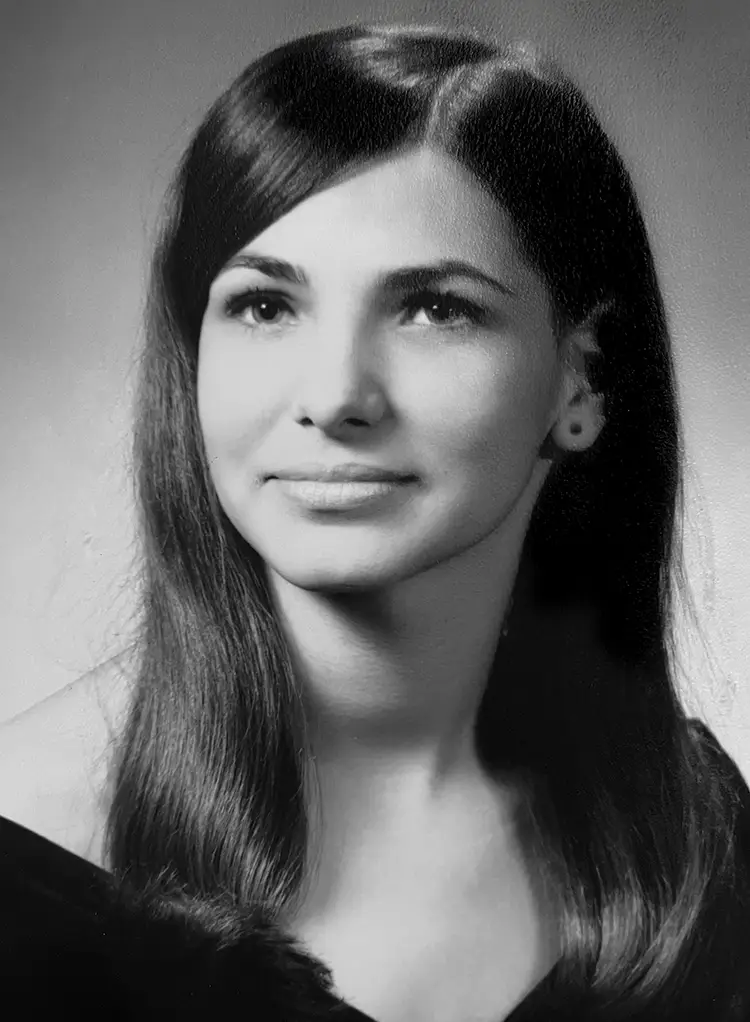
Sharon’s Sigma, Sigma, Sigma portrait (Courtesy of Marianne Dougherty)
At the risk of an “OK, Boomer” eyeroll from anyone under 50, things were just different in the analog world of my college days. We got calls on a black rotary phone in the hallway that was tethered to a jack in the wall by a long cord. When it rang, someone almost always answered, which is how Sharon ended up having several conversations with Perry Como, the legendary crooner from Canonsburg. As it turned out, his niece lived on our floor, and he was calling to say hello.
We communicated by snail mail in 1965, and since many of us were away from home for the first time, we hoped to find letters from family or friends in our mailbox. If one of those letters was from a boy you liked, the thrill was palpable. Handwriting has become something of a lost art, but there’s something so tactile about it that, when we read those love letters, we could hear the sound of his voice in our head, like a voiceover in a movie.
While college students today opt for casual clothing like jeans, T-shirts, and hoodies, when I was a freshman, girls were required to wear dresses or skirts with dark tights. The most popular hairstyle in the summer of ’65 was the bouffant, which required a roller set, a teasing comb, and enough Aqua Net hairspray to eat a hole in the ozone layer. Once we’d achieved the desired shape, we’d fold a silk scarf into a triangle, place it along the hairline, and tie the ends in a knot in back. Getting “all dolled up” to go out in public required a lot of work. We used Pan Stik, a cream foundation in stick form from Max Factor, lined our eyes in black, and, like the Ronettes, wore white lipstick.
While menswear-inspired clothing, especially shirts and ties, has become trendy in women, Claudia and I were ahead of the curve, shopping for preppy clothes like Bermuda shorts, button-down cotton shirts, and Bass Weejuns loafers at Leon’s, a men’s clothing store on Philadelphia Street. It’s the 700 Shop now.
In those days, smoking seemed glamorous and sophisticated, but the only place we could light up was in a room on John Sutton Hall’s second floor that we called the smoker. It was the only room that had a television. We played cutthroat games of Canasta, and Sharon had her ears pierced in the smoker. It would be several years before girls went to department stores to have their ears pierced with a stud gun, so the whole procedure was fairly barbaric. An ice cube was thought to numb the pain, but I doubt it did much good, since someone would then shove a needle through your earlobe into a cork.
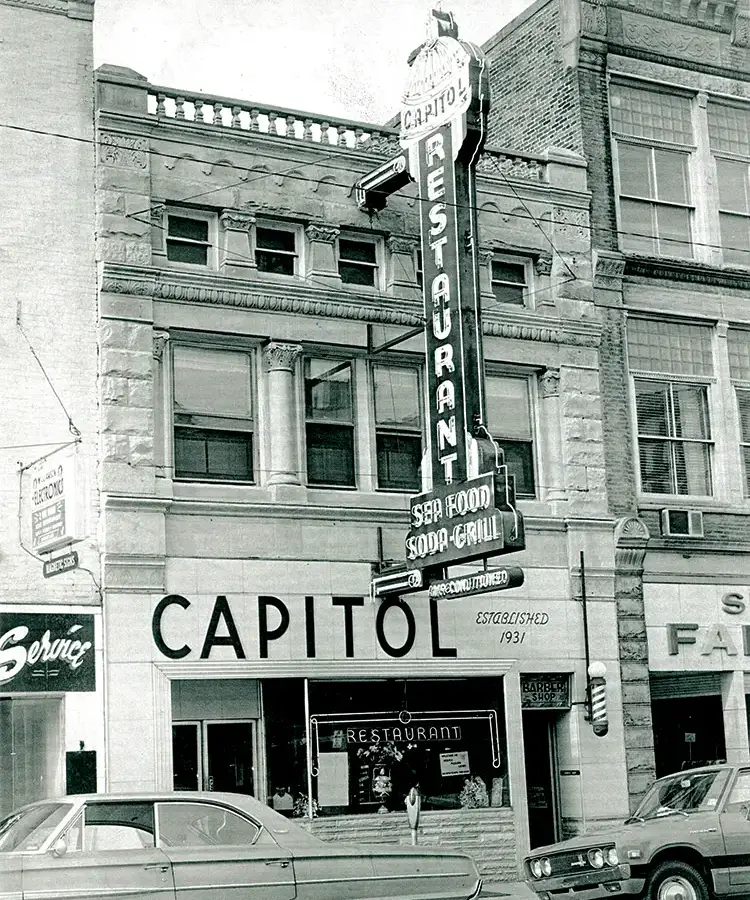
The Capitol Restaurant in downtown Indiana was a frequent stop for students in the 1960s and ’70s (Courtesy of John Busovicki)
Curfews were strictly enforced: 10:00 p.m. on weeknights, 11:00 p.m. on weekends. You had to check in with the housemother, who kept a sign-in sheet in her room.
Music majors practiced piano in the basement of Thomas Sutton, and we ate all our meals in the cafeteria on the first floor. Sometimes we’d walk downtown to the Capitol Restaurant for a special treat, a giant cinnamon bun, or Capitol roll, that cost a quarter. I was sad to learn that the restaurant closed in 1976.
If a boy came to call, he was asked to wait in the Blue Room, where the decor was inspired by a room in Florence’s Pitti Palace. Since the ratio of girls to boys at IUP was 5-to-1, dating was a competitive sport. A group of guys, usually football players or fraternity brothers, throwing a party would send an emissary to call the house phone and ask that 10 girls show up in the Blue Room in 15 minutes. At least twice that many, like contestants on The Bachelor, would fight for the chance to be selected .
By the time I returned in January 1966 to complete my freshman year, Indiana State College had become Indiana University of Pennsylvania, which carried a higher level of prestige. I was assigned to live in Grant House with three other girls, theater majors, who hoped to land roles in The Fantasticks. While they listened to show tunes, I was playing “Nowhere Man” on my portable record player. Let’s just say it was not a good fit. So, I got a pass to spend the weekends in John Sutton Hall with the friends I’d made that summer.
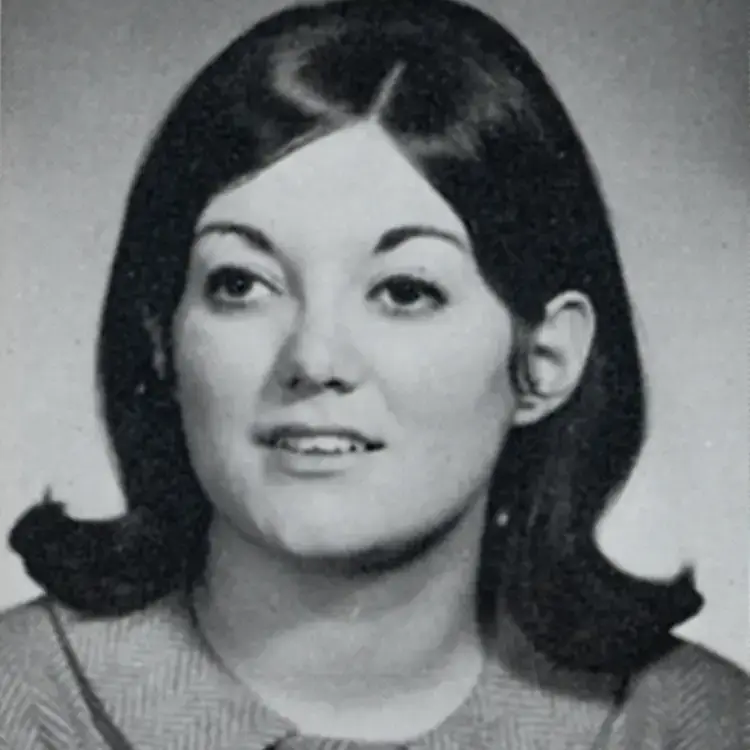
Debbie in the 1969 Oak yearbook (IUP Archives)
When we returned as sophomores in September, six of us lived on the first floor of John Sutton Hall in an apartment that included two bedrooms, a common living area, and a balcony. Claudia and Julie shared one bedroom, while Jayne and I shared the other. Sharon and her roommate, Debbie, slept in bunk beds in a hallway across from the bathroom. Jayne was the only one of us who loved jazz. So, to torment her, we locked her out on the balcony and played “Walk Away Renée” by the Left Banke on repeat. The Student Union had a soundproof room where you could listen to music on headphones. Jayne remembers listening to Bolero by Maurice Ravel, and I remember hearing “Somebody to Love” by Jefferson Airplane for the first time.
As an English major, I found Bob Dylan and Leonard Cohen’s lyrics as poetic as anything I was reading by Lord Byron. Paul Simon wrote most of the lyrics for music he recorded with Art Garfunkel, including these from “Dangling Conversation” about a relationship that has begun to unravel: Like a poem poorly written, we are verses out of rhythm, couplets out of rhyme, in syncopated time. Heady stuff for someone who loved language as much as I did.
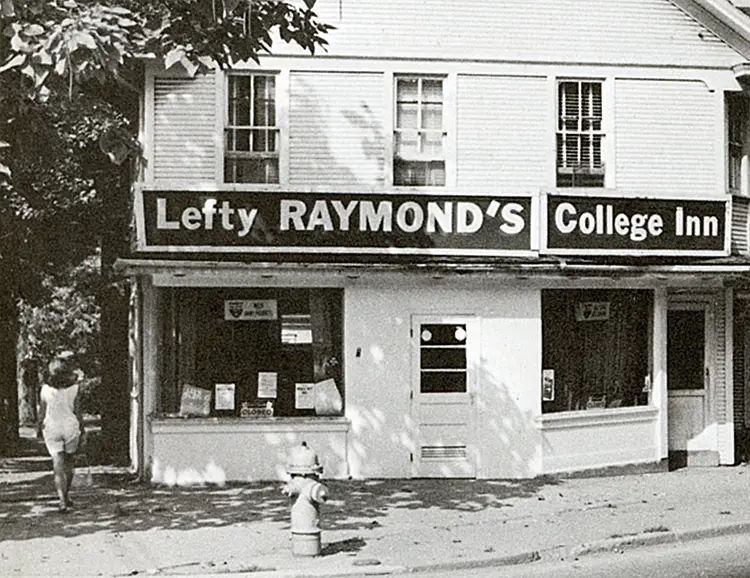
Lefty Raymond’s, in the building that became home to Pizza House and now Vocelli Pizza (IUP Archives)
I had a job as a waitress at Lefty Raymond’s College Inn. The location became the home of Pizza House and now houses Vocelli Pizza. It was snowing pretty hard one night, and after my shift, I got a lift back to the dorm with a boy I knew. We sat in the parking lot behind John Sutton Hall listening to the radio, which was playing “Sittin’ on the Dock of the Bay” by Otis Redding. We learned from the local DJ that the singer died in a plane crash that night. If that had happened today, the news would be all over social media.
Kids in San Francisco may have been wearing flowers in their hair and smoking marijuana in Haight-Ashbury, but at Indiana, we were insulated from so much of what was going on in other parts of the country. There were keg parties, which were illegal, and dances in the Student Union with Motown blaring from the speakers: the Four Tops, the Supremes, Little Anthony and the Imperials. In 1966, Tommy James and the Shondells had a hit song, “Hanky Panky,” that got everyone out on the dance floor.
Jayne and I shared a room in John Sutton Hall in the fall of our junior year before moving to a brand-new dorm, Stewart Hall (at the center of the Tri-Halls at Maple and 11th streets). One of the girls on our floor had a television in her room, and on March 31, 1968, I watched from the doorway while Lyndon Johnson announced he would not seek reelection. Four days later, Martin Luther King Jr. was assassinated. We had led a sheltered life in rural Pennsylvania, but it was becoming clear that the world was changing, and so were we. There had already been a march for civil rights on Philadelphia Street in 1965, and a young professor in the English Department named Gerald Stern was one of several faculty members who helped desegregate Mack Pool. A lifelong activist, Stern became one of the country’s most respected poets, winning the National Book Award for Poetry in 1998.
Student opposition to the war in Vietnam escalated between 1965 and 1968. IUP not only had a chapter of Students for a Democratic Society, a national organization known for its anti-Vietnam activism, but the student newspaper, The Penn, reported on protests and demonstrations. Senator Eugene McCarthy, who was running for president on an anti-war platform in 1968, had a campaign office in Indiana, and I planned to vote for him in November if he was the Democratic party’s nominee.
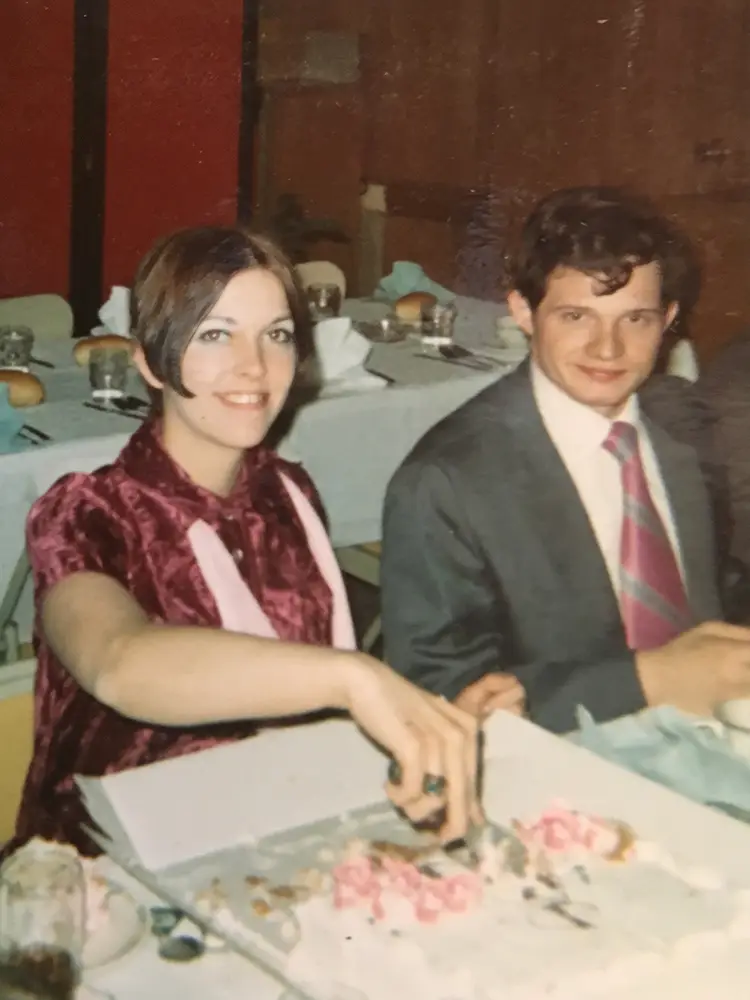
Marianne with Tom Lentz after their 1970 graduation (Courtesy of Marianne Dougherty)
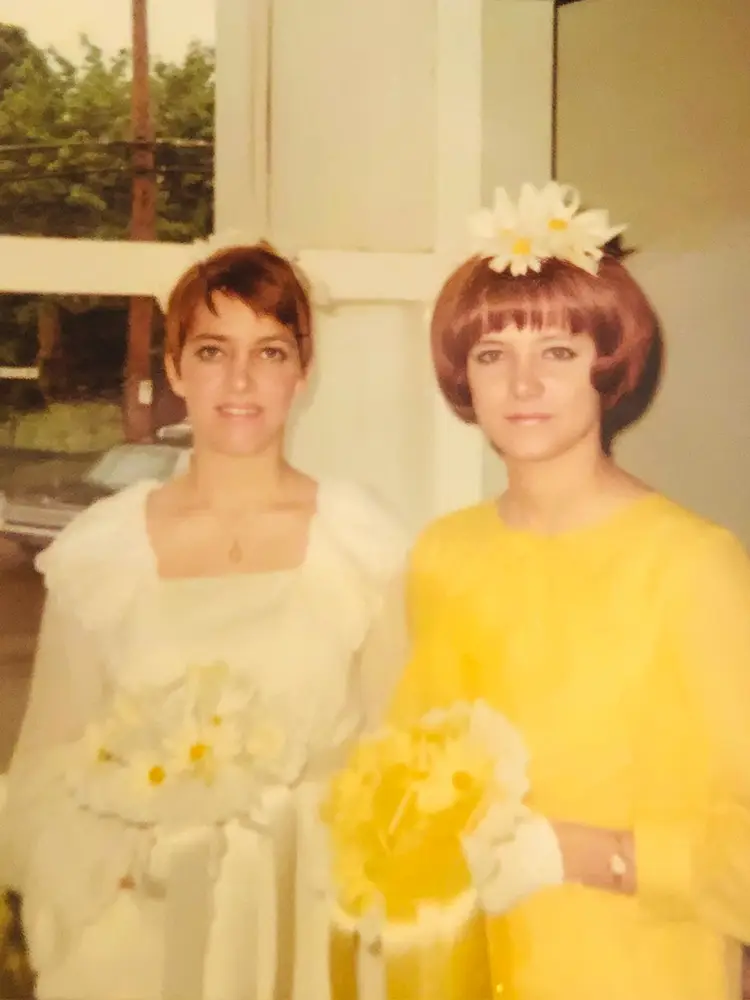
Marianne (with Jayne) on her wedding day in 1968 (Courtesy of Marianne Dougherty)
By May, I was a married woman living over a plumbing supply store on Philadelphia Street. Neither my husband nor I was old enough to walk into Coney Island and order a beer. In June 1968, Robert F. Kennedy was shot and killed, just like his brother Jack five years earlier. Six months later, at the tail end of one of the most tumultuous decades in American history, I gave birth to my daughter Rachel.
Her sister Erin likes to joke that their generation was raised on hose water and neglect, while I had a different kind of childhood, and she’s right up to a point. Baby Boomers like me, born into prosperity after a global depression and a world war, lived a privileged existence for the most part in two-parent households with stay-at-home moms. Going to college in a small town in what felt like the middle of nowhere when technology was virtually nonexistent was a gift. The campus occupied 70 acres, and we knew just about everyone; today it’s more than five times that size. Bombarded with social media and breaking news on their mobile phones, members of Gen Z have no escape. Just imagine the stories they’ll tell in 60 years.
The John Sutton Chicks
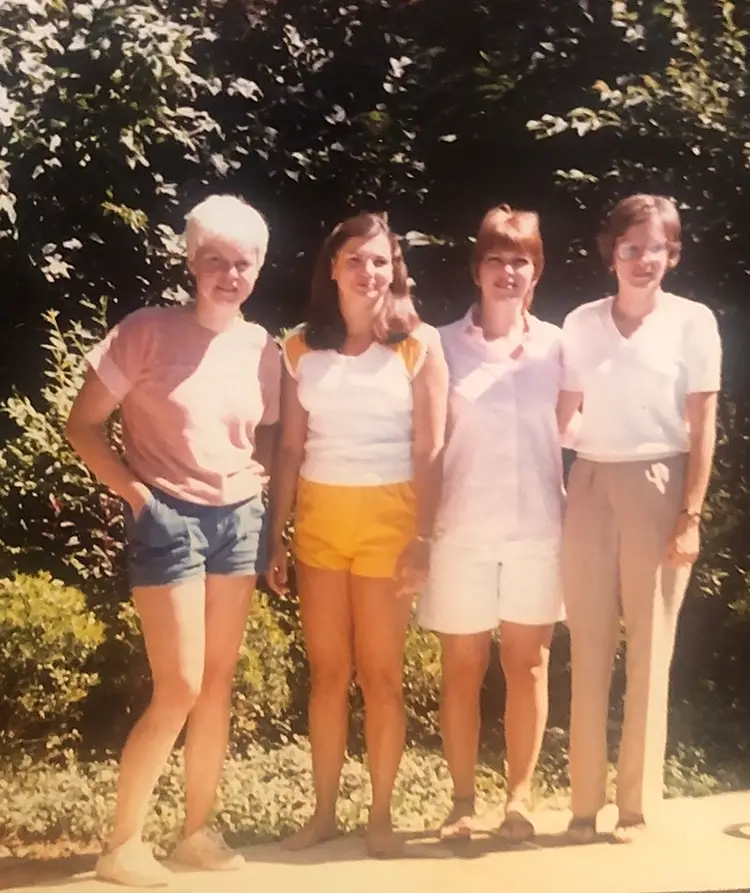
Claudia, Sharon, Marianne, and Jayne in State College in the early 1980s (Courtesy of Marianne Dougherty)
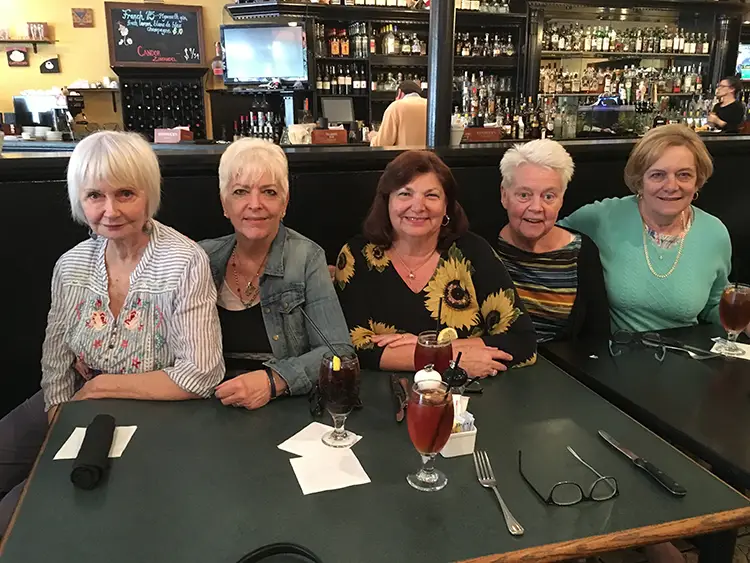
Julie, Marianne, Sharon, Claudia, and Jayne in Orlando in 2015 (Courtesy of Marianne Dougherty)
Over the years, we’ve been there for each other through good times and bad: marriage and divorce, milestone birthdays, births of children and grandchildren, deaths of parents and siblings, and the loss of Claudia’s son Cale in 2020, our friend Debbie in 2021, and Jayne’s husband, Bob, in 2025. Both Claudia and Julie are breast cancer survivors. Sharon and Jayne became great-grandparents this year. To paraphrase the Grateful Dead, what a long, strange trip it’s been.
- Marianne Jacob Lentz Dougherty (the author) grew up in Pittsburgh and enrolled with the Class of ’69. She married Thomas Lentz in 1968 and graduated with him in January 1970. A longtime magazine editor, she earned a master’s in English from the University of Scranton and is a member of the John Updike Society. She has a daughter, Rachel, from her first marriage and a daughter, Erin, from her second. Divorced and living in Santa Barbara, California, she is on the faculty of the Santa Barbara Writers Conference. Her first novel, What We Remember, was published in 2023 and is available through major retailers. Learn more at mariannedougherty.com.
- Sharon Davich Samko was born in Johnstown. She married Michael Samko in 1967, finished her degree in elementary education at Slippery Rock, and earned a master’s degree from the University of Central Florida. She and Mike, who live in coastal Georgia, have been married for 58 years and have two children, four grandchildren, and a great-grandson.
- Claudia Lison Clemente was raised in the Lawrenceville neighborhood of Pittsburgh and finished her degree in elementary education at the University of Pittsburgh. She married Frank Clemente ’67 and raised eight children, four of them adopted, in State College, where Frank was a Penn State sociology professor. They now live in Orlando and have 14 grandchildren.
- Julie Todd Cundiff ’69 grew up in Aliquippa. She taught art in Oneonta, New York, for a year before becoming a flight attendant for TWA. Married to Jim Cundiff for 36 years, she lives in Tucson, Arizona, and has a painting studio. See her work at fineartamerica.com.
- Jayne Hubley Mitten ’69 grew up in York. She and classmate Robert Mitten were married for 55 years, raised two daughters, had five grandchildren, and had just become great-grandparents when Bob died earlier this year. Jayne lives in Raleigh, North Carolina.
- Debbie Ferraco Glover ’69 was born in the Bloomfield neighborhood of Pittsburgh. She and husband Terry Glover met at IUP and were inseparable until her death in 2021. With Terry, she had two daughters and three grandchildren, who called her “G.”