The Madia Department of Chemistry, Biochemistry, and Physics is proud to highlight the accomplishments of alumnus Sky Semone, whose latest research—published in Physical Review B (PRB)—marks a significant contribution to the understanding of spin glasses, complex magnetic systems that have puzzled physicists for more than 50 years. Physical Review B, a flagship journal of the American Physical Society, is widely regarded as one of the most prestigious publications in condensed matter physics. Earning a publication in PRB is a major milestone for any researcher, and particularly noteworthy for an early-career scientist.
Semone, now a PhD student in electrical engineering at Penn State University, carried out this work in collaboration with his longtime mentor, Gregory Kenning, professor of physics at IUP. Their partnership began in 2015, when Semone joined Kenning’s research group as an undergraduate.
Semone’s academic journey began at IUP, where he completed a dual BS degree in physics and mathematics (2014–18). After two years in industry, he returned to IUP to pursue a master’s degree in mathematics (2021–23) before beginning his doctoral studies at Penn State, focusing on nonlinear and quantum optics and metasurfaces. Although his current research has expanded into new areas, his interest in spin glasses—and his collaboration with Kenning—has remained a consistent thread throughout his academic career.
Spin glasses, Semone explains, are “disordered magnetic systems usually consisting of metallic alloys,” and are far more unusual than their name suggests. In everyday magnets, atoms align in a uniform direction, creating north and south poles. In spin glasses, however, magnetic atoms are positioned at random distances from one another, causing their preferred orientations to vary unpredictably. “This results in an extremely complex structure that has challenged our understanding of physics for over 50 years now,” Semone said.
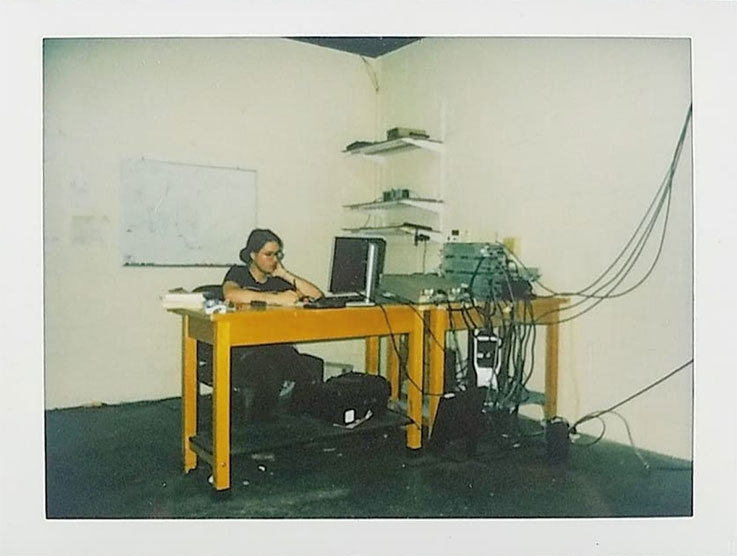
A Polaroid of Sky Semone when he joined spin glass research at IUP in 2018
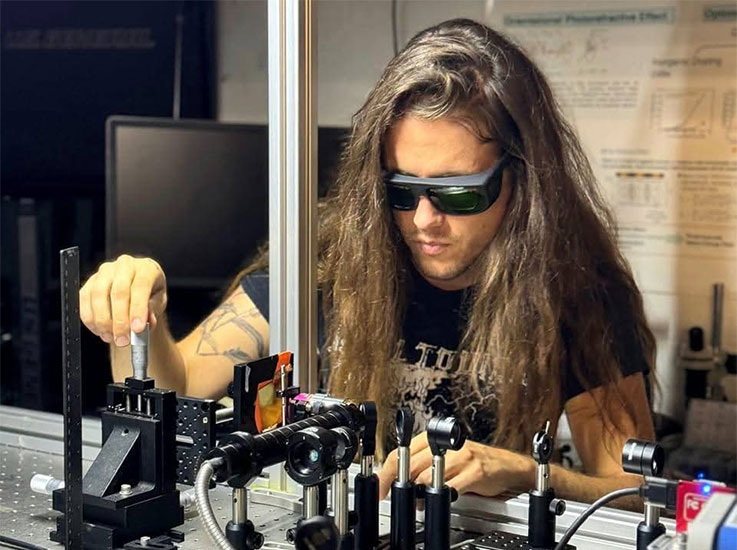
Sky Semone, working at his optical table at Penn State University (2025)
The recently published paper combines theory, numerical simulation, and experimental measurement to help clarify this complexity, offering new insights into the microscopic interactions that define spin-glass behavior. The scientific tools and mathematical methods developed to study them have proven influential far beyond magnetism. “The methods developed to understand them have found broader application in optimization, computer science, biology, and economics,” Semone noted. Furthermore, the highly sensitive magnetic sensors used to study spin glasses are now essential in quantum computing, single-photon detection, and precision metrology.
Semone attributes much of his scientific development to his time at IUP and to Kenning’s mentorship. “After taking Dr. Kenning’s introductory physics classes, I joined his research group and quickly became fascinated with the research process,” he recalled. “At a time when I was unsure if college was right for me, it helped me discover my love for science, which has only grown ever since. I can’t imagine being where I am now without the experiences and connections from my years at IUP.”
Sky Semone’s achievements illustrate the profound impact of early research engagement, dedicated mentoring, and the strong academic foundation provided by IUP’s physics and mathematics programs. His continued success reflects the university’s mission to prepare students for meaningful careers in science, engineering, and related fields.
The full paper, “Collapse of the effective response time near the spin glass transition temperature,” is available through the PRB website.