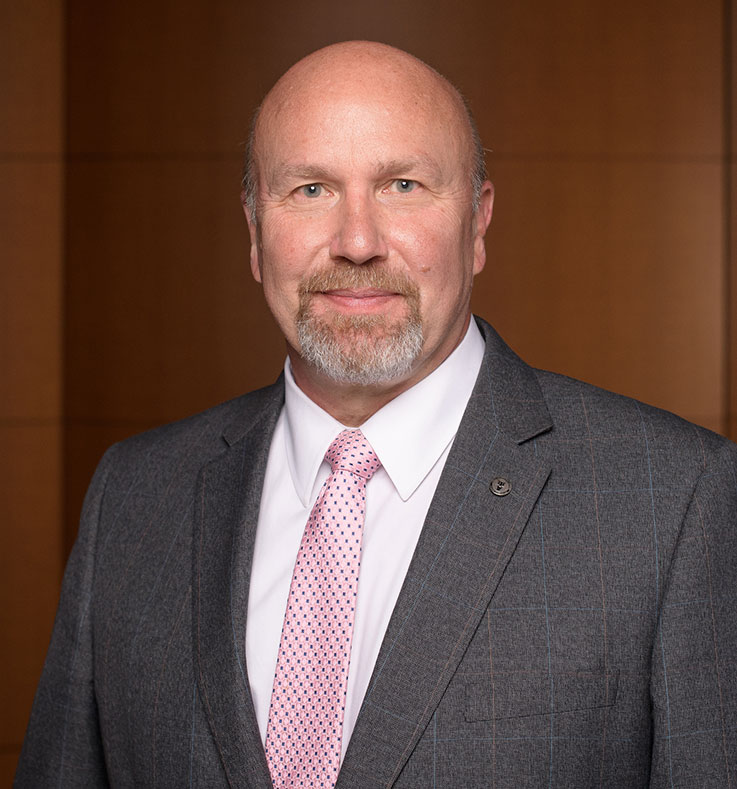
 Steve Hovan
Indiana University of Pennsylvania Dean of the John J. and Char Kopchick College of Natural Sciences and Mathematics Steve Hovan has been appointed to the United States Scientific Ocean Drilling Advisory Committee.
This committee is limited to 15 members from throughout the nation who are charged to formulate scientific and policy recommendations for the US National Science Foundation’s Scientific Ocean Drilling program; members come from academic institutions, government, and industry.
Hovan’s term begins in November and will extend for three years.
“Dr. Hovan’s national reputation as an outstanding scientist and researcher is well deserved, and we congratulate him on being selected to serve on the Drilling Advisory Committee,” IUP Provost and Vice President Lara Luetkehans said.
“Not only will his expertise and experience benefit the National Science Foundation and scientists around the globe in recommending research policy and promoting educational opportunities, his work with the Advisory Committee will provide unique opportunities for IUP faculty and students,” she said.
Hovan was selected as dean of the Kopchick College in January 2023 after two years of service as interim dean. He has been a member of the IUP community since 1993 as a faculty member in the Department of Geoscience (now Department of Anthropology, Geospatial and Earth Sciences) and was honored with the Distinguished University Professor recognition in 2007. He has extensive experience with the National Science Foundation, serving as a program manager for the NSF’s Division of Ocean Sciences in the Marine Geology and Geophysics program.
His scientific research has focused on examining the relationships between atmospheric circulation, oceanic currents, and global climate changes. He has conducted research on 16 ocean expeditions, most funded by the NSF, and has involved IUP students on a number of those expeditions.
He has published and presented extensively in his field throughout the United States and internationally and has been successful in securing millions of dollars in grant funding, including serving as principal investigator on two successful NSF research awards. His grant-funded projects include a range of climate studies, the acquisition of a scanning electron microscope, and development of a crowd-sourced phone application to identify and track environmental conditions of abandoned gas wells in Pennsylvania.
In addition to his research, teaching, and administrative responsibilities, Hovan has worked on a number of committee and board memberships, including Sigma Xi honor society, the Challenger Center Advisory Committee, the IUP Undergraduate Scholars Conference program, the IUP Student Co-op Board, the IUP Research Institute Faculty Advisory Board, multiple Middle States Accreditation Steering Committees, and the IUP Sustainable Energy Research Cluster.
He has served on a number of national and international advisory boards and panels related to ocean research and science education, including the Ocean Drilling Program Shipboard Software Evaluation and Development group, the Schlanger Fellowship Selection Committee, the National Ocean Sciences Bowl, the US Advisory Committee for Ocean Drilling, and the International Ocean Discovery Program Science Evaluation Panel. He served as instructor with a variety of workshop programs designed to enhance scientific understanding of global climate history and broaden participation in ocean sciences.
Currently, the United States National Science Foundation’s scientific ocean drilling is coordinated by the Scientific Ocean Drilling Coordination Office, which relies on two main advisory committees to guide the program: the Advisory Committee on which Hovan will serve, and the Safety and Environmental Panel that reviews all activities for safe operations and to mitigate environmental impacts of scientific ocean drilling.
“I have worked with the United States’ scientific ocean drilling program very closely since I was an early career marine scientist, even as far back as my undergraduate days while studying at the University of Michigan,” Hovan said.
“There have been multiple iterations of this program over the years, from the ‘Deep Sea Drilling Project’ that helped us understand and validate important ideas of plate tectonics and seafloor formation, to the Ocean Drilling Program, the International Ocean Drilling Program, and the Integrated Ocean Drilling Program which collaborated with multiple international partners to explore and reconstruct geological records of global climate changes and understand Earth history—including the major cause of the extinction of the dinosaurs at the end of the Cretaceous Period—and reorganization of ocean currents over time,” he said.
“I’m very excited to continue service to the scientific ocean drilling community and to the National Science Foundation and honored to be selected for the Advisory Committee,” he said.
Since its founding in 1875, IUP has evolved from a teacher-training institution into a doctoral research university recognized for its commitment to student success and achievement. IUP’s Impact 150 comprehensive campaign is designed to honor a legacy of educational excellence while looking toward a future of innovation, public service, and leadership in healthcare education, including the first college of osteopathic medicine at a public university in the commonwealth.