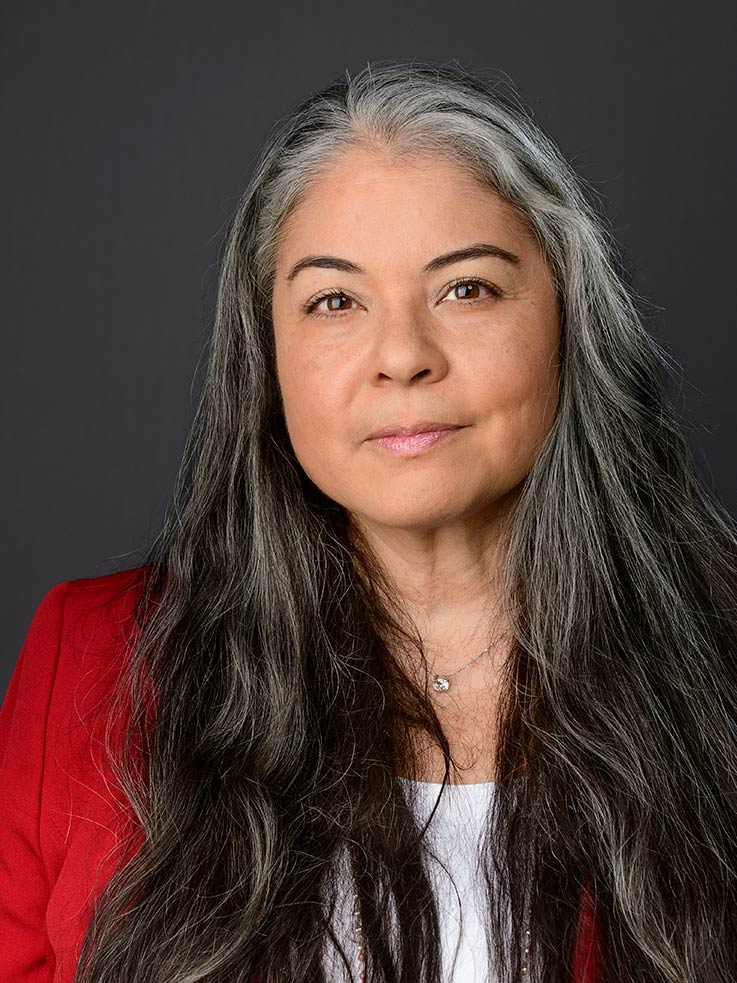
 Miko Rose
Indiana University of Pennsylvania’s College of Osteopathic Medicine Founding Dean Miko Rose has been selected as a “Trailblazer in Healthcare 2026” by City & State Pennsylvania.
Rose received the honor at a September 30 event in Philadelphia featuring Secretary of Human Services Valerie Arkoosh as the keynote speaker. The awards recognize the commonwealth’s “physicians, advocates, and visionaries keeping Pennsylvania and its healthcare sector healthy.”
“The leaders honored as this year’s Trailblazers in Healthcare not only find new ways to care for Pennsylvanians, they also tend the health of one of the state’s marquee industries, keeping the commonwealth on the medical cutting edge,” City & State officials said.
In selecting Rose as a Trailblazers in Healthcare, organization officials recognized that Rose led her team to achieve pre-accreditation status from the American Osteopathic Association’s Commission on Osteopathic College Accreditation in just 10 months from its initial candidate status; that she is responsible for direct recruitment of staff and students; and that she has secured a network of clinical training sites in underserved communities, well past the required number of sites for COCA accreditation.
“Founding Dean Rose’s passion for rural healthcare, combined with her experience, national presence in the osteopathic medical community, and leadership skills, has been key to our successes in advancing IUP’s College of Osteopathic Medicine,” IUP President Michael Driscoll said. “This is a well-deserved recognition, and I congratulate her on this honor,” he said.
IUP’s College of Osteopathic Medicine’s pre-accreditation status, announced in May, means that the college is permitted to recruit and admit students. The first class of students for the college will enter studies at IUP in fall 2027. Thousands of prospective students have selected IUP through the national admissions portal, and the College of Osteopathic Medicine team began weekly interview days for prospective students in September; all interview day slots are full through spring 2027.
“I am humbled and honored to be selected as a healthcare trailblazer and to be in the company of so many distinguished leaders in healthcare chosen for this award,” Dean Rose said. “But this award is not about me. It reflects the brilliant and insightful leadership of President Michael Driscoll and Provost Lara Luetkehans; the hard work of the entire IUP College of Osteopathic Medicine team and so many members of the IUP community; the mentorship of our advisory board, especially IUP College of Osteopathic Medicine Executive Mentor Dr. Jack Brose; and the unwavering support of our community, including our legislators at the local, state, and federal levels and healthcare leaders throughout the commonwealth.
“Going from visiting IUP to talk about the founding dean’s position in 2023, securing candidate status in 2025 and pre-accreditation status in 2026 for the college, to welcoming promising future students during our weekly interview sessions has truly been an incredible and breathtaking experience,” she said.
“I thank President Driscoll, Provost Luetkehans, and Dr. Brose for their mentorship, and thank everyone who has been, and continues to be, champions for this initiative,” she said.
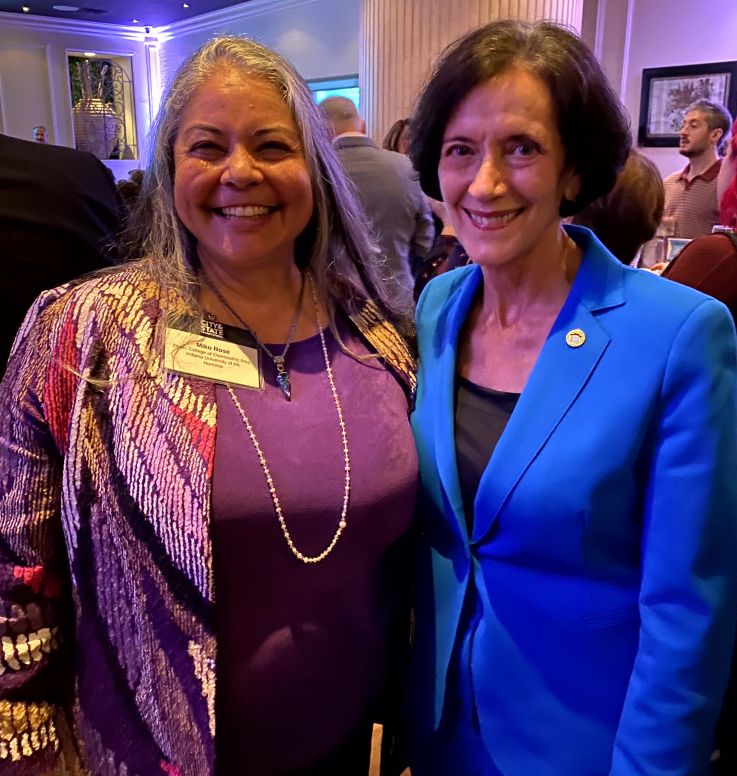
Founding Dean Rose with Secretary of Human Services Valerie Arkoosh, who was the keynote speaker for the Trailblazers in Healthcare event
About Dean Rose
Following a national search, Miko Rose, a board-certified physician in psychiatry and neurology nationally known for her wellness programming, was selected in November 2023 as the founding dean for IUP’s then-proposed College of Osteopathic Medicine.
She came to IUP from Pacific Northwest University of Health Sciences College of Osteopathic Medicine, where she was associate professor and chief of the Division of Psychiatry in the Department of Clinical Medicine and assistant dean for clinical education, and from her work as an associate professor and program director of the Joy Initiative Wellness Program at Michigan State University.
Rose is an elected fellow of the American College of Neuropsychiatrists by the Fellows of the American College of Neuropsychiatrists/American College of Osteopathic Neurologists and Psychiatrists. In 2019 and again in 2024, Rose received an award as one of the top medical educators in the country, the National American Osteopathic Medical Educator Fellowship Teaching award, which is a five-year fellowship.
She was honored by City & State Pennsylvania in 2024 as one of Pennsylvania’s “50 over 50” honorees.
Rose has been an invited presenter for international and state healthcare conferences and programs, including events coordinated by the National Academies of Sciences, Engineering, and Medicine; the American College of Neuropsychiatrists/American College of Osteopathic Neurologists and Psychiatrists; the Appalachian Regional Commission; the Federal Reserve Bank of Philadelphia; and the Pennsylvania State System of Higher Education.
She is a member of the editorial board and a frequent contributor to The DO, published by the American Osteopathic Association. She was recently featured on a national podcast, Is it Crazy to Start a New DO School in Pennsylvania? To Call the School Indiana University? This Psychiatrist Begs to Differ!
Rose is currently leading an initiative with the Center for Rural Pennsylvania to determine commonalities of physicians who commit to and stay in rural health care practice through a survey of commonwealth physicians.
As a physician and educator, she has spent more than a decade focusing on helping future physicians develop the unique skills they need to be caring and empathetic medical providers. She developed the first formal classes in medical schools in the nation on happiness and joy while a professor at Michigan State University College of Human Medicine and College of Osteopathic Medicine schools; these classes were the origin for her development of the Joy Initiative there. She expanded the Joy Initiative curriculum to provide training for peak performance for team coaches, trainers, and student athletes. This training has become formal coursework for credit, embedded into the core curriculum for medical students’ wellness and well-being requirements there.
She began her career as a program officer, fundraiser, and advocate for the underserved, including helping people working to overcome domestic violence and trauma in communities throughout the United States and Central America.
She is a graduate of Touro University College of Osteopathic Medicine, Michigan State University (medical training), and Wellesley College (BA in psychology).
About IUP College of Osteopathic Medicine
The IUP College of Osteopathic Medicine is dedicated to addressing the urgent need for healthcare professionals in rural and underserved communities by educating and training future osteopathic physicians committed to improving health outcomes in these areas. Its mission includes providing an affordable, high-quality education to qualified students who care about rural medicine and offering clinical opportunities throughout all four years of medical education at IUP.
A unique feature of IUP’s curriculum for the doctor of osteopathic medicine degree is its four-year, longitudinal required coursework on mental and behavioral health and rural health. The program requires future students to complete additional clinical rotations in rural primary care and psychiatry, beyond what is required by national accreditation standards.
IUP’s Council of Trustees endorsed the exploration of a possible development of an IUP College of Osteopathic Medicine in December 2022. There are only three colleges of osteopathic medicine in Pennsylvania, all at private universities; IUP’s College of Osteopathic Medicine is the only college of osteopathic medicine at a public university in the commonwealth.
IUP’s College of Osteopathic Medicine’s commitment to educating promising physicians who want to practice in rural communities is part of IUP’s commitment to addressing the rural health care crisis, including the lack of primary care physicians in rural communities.
This commitment to addressing the rural health crisis has resulted in more than $54 million in funding from individual donors, foundations, and agencies, including a total of six gifts of one million dollars, or multi-million-dollar gifts, and several million dollars in federal and state funding.
IUP anticipates its first class of 64 students entering the program in fall 2027. Colleges holding pre-accreditation status are permitted to admit no more than 50 percent of the approved class size in the first year, and no more than 75 percent of the approved class size in year two, transitioning to the approved class size in years three and four. IUP’s College of Osteopathic Medicine’s approved class size is 120 students.
Once fully operational, IUP’s College of Osteopathic Medicine is expected to generate almost $50 million in annual economic impact for the commonwealth by 2033, $2.3 million in annual economic benefit to each physician’s home community, and generate 7,800 new jobs in the region. Long-term, if just 60 percent of IUP’s College of Osteopathic Medicine graduates remain in Pennsylvania, the annual economic impact for the state is estimated at $1.3 billion.
IUP has completed 25 formal clinical training affiliation agreement signing events, including with three Department of Human Services hospitals (Clarks Summit State Hospital, Torrance State Hospital, and Warren State Hospital). Altogether, IUP’s College of Osteopathic Medicine has clinical training affiliation agreements in place with more than 40 sites, all in rural communities, including Croyle-Nielsen Therapeutic Associates, Inc. in Johnstown; Alternative Community Resource Program in Johnstown; Small Town Hope in Hastings; Matthew Dvorchak, MD, Family Medicine Practice in Hastings; Sharon Regional Health System; Conemaugh Meyersdale Medical Center; Conemaugh Miners Medical Center; Wayne Memorial Community Health Centers; Wayne Memorial Hospital; Chan Soon-Shiong Medical Center at Windber; Conemaugh Nason Medical Center; Penn Highlands Healthcare; Clarion Psychiatric Center; Armstrong County Memorial Hospital; Conemaugh Memorial Medical Center; Broad Top Area Medical Center; Hyndman Area Health Centers; Nulton Diagnostics and Treatment Center; The Primary Health Network; Indiana Regional Medical Center; and Punxsutawney Area Hospital. IUP also signed a formal preclinical training agreement with the Indiana County Coroner’s Office for IUP students in a number of programs, as well as for future students at IUP’s College of Osteopathic Medicine.
Since its founding in 1875, IUP has evolved from a teacher-training institution into a doctoral research university recognized for its commitment to student success and achievement. IUP’s Impact 150 comprehensive campaign is designed to honor a legacy of educational excellence while looking toward a future of innovation, public service, and leadership in healthcare education, including the first college of osteopathic medicine at a public university in the commonwealth.