While most of today’s students were born after September 11, 2001, many faculty and staff members—like others across the country—remember exactly where they were, what they were doing, and whom they were with as they learned of the attacks on the US that morning.
To mark the 25th anniversary of this national tragedy, members of the IUP community were asked to share their memories and the impact of that day, as well as how it shaped their perspective in the years that followed.
Read their reflections.
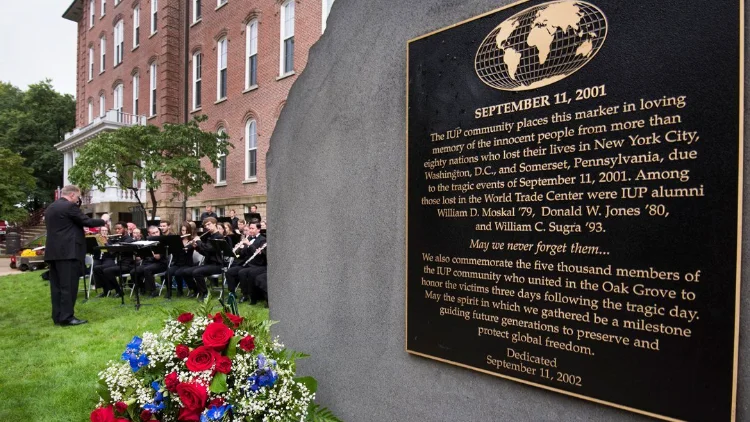
In September 2002, IUP held the first of what would become an annual remembrance ceremony. The memorial in the foreground was created by art professor James Nestor.
9/11 Memorial Ceremony
In recognition of the twenty-fifth anniversary of the events of September 11, 2001, the IUP community will reflect on that fateful day and how it changed our world.
Please join us on Friday, September 11, as we gather to remember the day, its victims, and its impact. The program will begin at 11:10 a.m. near the 9/11 memorial in the Oak Grove.
I walked into my 12th-grade Government class at Indiana Senior High School, and the students from the class prior were still in their seats, glued to the TV. I thought they were watching a documentary or something for the class, but then the teacher said it was a live news feed.
I went numb from the shock and terror of it all.
The rest of the day, in every class, we watched the coverage and talked about it. Would the plane that was hijacked and still in the air hit the power plant nearby to knock out power to the eastern side of the country? Were there more coming? Would the seniors who signed up for military service after graduation be going to war? What would happen next?
It was so surreal, and yet it was happening. I think it changed how we all thought moving forward, because there had never been such an attack in the continental US.
Rachel Partida
College of Osteopathic Medicine
I remember that day very specifically because nothing untoward seemed to be happening until I walked into the secretary’s office in the English department in what was then the old Leonard Hall in the Oak Grove. I remember both Jackie and Esther had wheeled the television into the main part of their office, and they were rapt with attention at the screen. When I asked them what had happened, they said with incredulity that it looked as if there had been a terrible accident in New York.
As I went up to my classroom for the first class of the day, word had spread quite rapidly among my students. They were as horrified as I was, and they did not know what was going on. All I remember from that week is that we were trying to process our emotions, and that much of our time was spent discussing our feelings about the event and how to make sense of what had happened in some meaningful way. They could not concentrate at all.
These events directly inspired me to create a syllabus in the years that followed, focusing on how the events of 9/11 and the subsequent developments in Iraq and Afghanistan were reflected in novels published after the attacks and in the years that followed. I also taught 9/11 drama. I deliberately chose to teach that course again this summer to reflect on the 25th anniversary.
Second, I remember how terrified my younger son was at the events, and I remember him coming home and asking if there were going to be more attacks. For at least the next six months, he kept looking anxiously at the skies and asked me whether that man was going to do the same terrible things again. He was only five.
Chris Orchard
Department of Language, Literature, and Writing
I was in a sixth-grade math class, and the teachers started gathering us into certain rooms. They turned on the TVs, and we watched it. Kids were going home left and right. We weren’t entirely sure what was going on, but once my mom came to get us, we started to understand the gravity of the situation. Lots of tears were shed, and I developed anxiety about wars and the end of the world.
Natasha Bonatch
Facilities, Planning and Construction
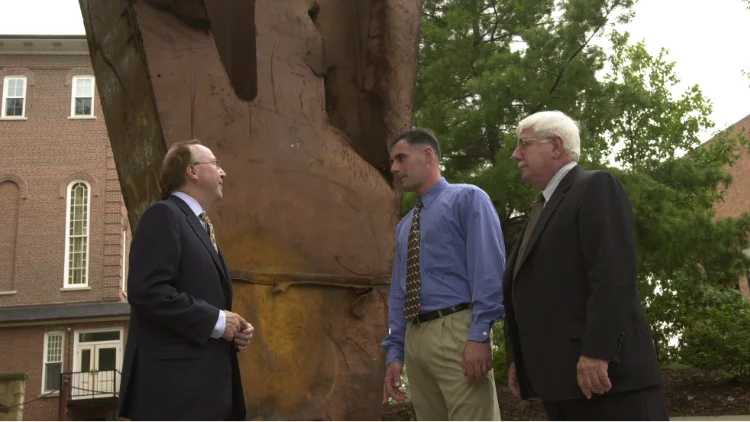
On long-term loan from the Kovalchick family, a remnant of the World Trade Center has been situated in the Oak Grove since 2002. At its dedication, from left, were IUP President Lawrence Pettit, Nathan Kovalchick, and Joseph Kovalchick.
On September 11, 2001, I was helping students in an English class with their research papers in the library at Burrell High School when the news first broke.
It was a beautiful, crystal-clear morning in western Pennsylvania. When we turned on the television in the library, we saw smoke billowing from the first tower against that same bright blue sky. At first, we assumed it was a terrible accident. Then, in stunned silence, we watched a second plane strike the other tower, and we realized we were witnessing an unimaginable act of terrorism.
My husband called and urged me to come home. He was there with our 16-month-old daughter. As reports came in about the attack on the Pentagon and the crash in Shanksville, nearby school districts began making plans for early dismissal, and an overwhelming sense of uncertainty settled over everyone.
That evening, I sat with my husband, holding our daughter close as we watched the tragic events of the day continue to unfold. We cried together, trying to process the enormity of what had happened. Looking at my young daughter, I found myself wondering what kind of future awaited her and realizing that the world she would grow up in had changed in an instant.
Even after 25 years, I can still picture that brilliant blue September sky and remember the profound feeling that our nation had been forever transformed.
Kelly Heider
University Libraries
That day still gives me chills as I think back on it.
I had been working at Armstrong County Memorial Hospital in the Billing Department and had been pulled in to help with incoming calls. ACMH had been an approved hospital since we were so close to Johnstown, so we were on alert to take in anyone overflowing from the other hospitals. However, that never happened due to the number of deaths.
I knew firemen from Armstrong County who went to the wreckage site of Flight 93, and their stories of what they saw were very haunting. My coworkers and I were so frantic about our kids and families, and where they were during this time.
It’s one day I will never forget, and I still pray for the families that had such horrible losses.
Michelle Lybarger
Facilities, Planning and Construction
I was working at the bank on September 11, 2001, sitting at my desk in my office, when I heard on the radio that a plane had crashed into the World Trade Center.
At that moment, I did not fully understand what the World Trade Center was or the significance of what was happening—I thought it was pilot error. When my boss walked by my office, I told him that a plane had crashed into the World Trade Center.
Just then, the news came over the radio that a second plane had hit the other tower. I remember saying that another plane had hit. I saw his expression change—his face turned to alarm. In that moment, we both realized this was not an accident. We didn’t know what was happening or what it meant, but we knew something unimaginable was unfolding.
At the time, my mother was battling breast cancer. She knew her time with us was limited, and one of the things that has stayed with me most was her reaction as she thought about the victims of September 11. She reflected on how each person had woken up that morning with plans for the day, never imagining that their lives would end before they returned home. They were taken unexpectedly—before they were ready and before many had the chance to say goodbye.
That thought deeply resonated with me.
September 11 reminds me that life is fragile and that we should never take a single day for granted—not one. The time we have with the people we love is precious, and we should hold it close, appreciate it, and never assume we are promised another day.
Lori Marshall
Office of Alumni and Friends
I was a graduate student at IUP on 9/11. I was working for the Office of Annual Giving on the third floor of Sutton Hall when the first two planes hit.
I remember us wheeling a TV on a cart into a room and watching the news coverage together. I was there for a few hours, then drove home to my apartment in town, where I met AJ (my now-husband). As I was driving home, the radio talked of the crash in Somerset County, and I can remember looking up at the clear blue sky, wondering what would be next.
AJ was in the Marine Reserves, and his unit was activated the next day. My Criminology classes were canceled for the evening, and so we went to AJ’s parents’ house and watched the news together.
Emily Smeltz
University Advancement
I was in my PhD program at the University of Maryland, already on campus for an early meeting, when an international student came into the office and said, “A plane just hit the World Trade Center.” I remember her hiccupping laugh—the hysteria—in her voice.
The Performing Arts Center was still a new building and didn’t have good TV or radio reception, but we managed to tune in a local public radio station; eight of us crammed into a four-person office, listening to events unfold. There was a false report of explosions along the National Mall, just before the Pentagon was hit. That’s when I picked up the phone and called my mother in Arizona. I managed to let her know I was okay before the phone lines jammed.
I spent the day frantically trying to connect with friends and family in DC and New York. Many of my friends in the New York City theatre scene had temp jobs in the Twin Towers. One was in the second tower. Luckily, he was already in the stairwell, heading down, when they gave the “all clear” signal that sent so many people back to their desks. He managed to get to the sidewalk just as the second plane hit.
It’s hard to believe 25 years have passed…
Carrie Cole
Department of Music, Theatre, and Dance
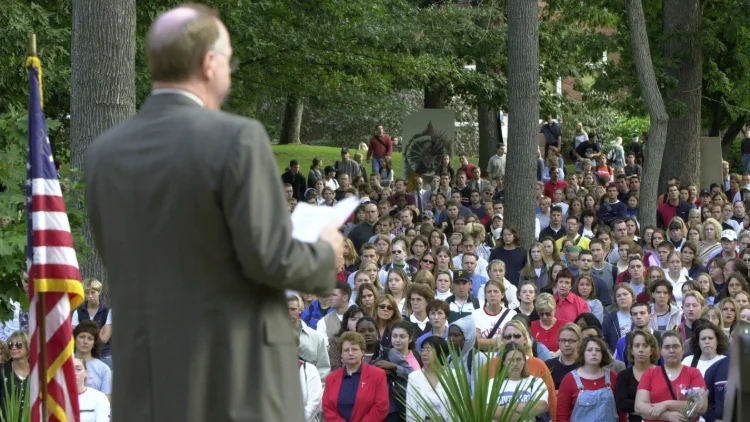
At the request of President George W. Bush, noontime memorial services were held across the country on September 14, 2001, three days after the attacks. At IUP’s service that day, IUP President Lawrence Pettit addressed a crowded Oak Grove.
The morning of September 11, 2001, I was off campus for a meeting at the Chamber of Commerce. The director had his television on, and we both stood there, stunned and silent. I saw the second plane hit the World Trade Center.
“What a horrible accident. How could that happen?” I remember asking out loud, thinking that the pilot must have made a tragic mistake or maybe the plane’s instruments had malfunctioned.
The response from the Chamber director is still with me. No words, just a look of disbelief, a failure to understand how I could be so naive as to think that these attacks were accidents.
And in seconds, I got it. A sickening realization of the truth. An immediate worry for my family, especially my children, who had just arrived at their fifth-grade classrooms at East Pike Elementary School.
If this could happen in America, in New York City, in Shanksville, at the Pentagon, could it happen here, in my town, at my university, to my home?
It was a question we all were asking.
In the weeks that followed, we met in small and large groups, discussing the best ways to help our students, parents, alumni, and staff and faculty, especially those with friends and family in New York City and abroad. We offered counseling. We assured worried parents.
We were afraid for our international students and faculty members, especially those who were Muslim, and tried to offer them as much support as we could.
We decided to keep business as usual, thinking it would give students something to do and think about if classes continued.
I hated that this tragedy had taken over our lives, that it was all that we could think about or talk about. I knew it had to be our priority, but I hated it.
I just wanted life before 8:46 a.m. September 11, 2001, back.
We spent a lot of hours discussing what we should do in response to September 11. We participated in President George W. Bush’s national call for a prayer and remembrance event.
More than 4,500 people gathered in the Oak Grove for a ceremony that still brings tears to my eyes when I think about it 25 years later.
We decided we needed some kind of educational program or discussion. We broke things down. It had to be a series, we felt. The issues surrounding September 11 were just too big for one presentation. What would we call it? How would it look?
We came up with “9-11: A Community Discussion.” It felt right for the first program to be about the basics. What had happened? What do we know? I remember suggesting to the planning committee that we should use the word “understand,” as in, “Understanding 9-11.”
Several heads nodded; people started to take notes. Good, I thought. Now we can move on and start planning the program. We can move on and go back to the way things used to be.
If we just understand the what and the why, it will never happen again. We can make sense of things again.
And then a student spoke up. “I don’t think that’s right,” she said. “I don’t think we should say ‘understand.’ I’ll never understand September 11. I can acknowledge it, I can cope with it, I can move past it, but I will never understand it.”
Her comment has been with me since. And 25 years later, I know she is right. I still struggle to “understand” the September 11 attacks.
I’ve moved forward, but without the sense of innocence I had before September 11, 2001. I no longer have the certainty that I had on September 10, 2001, that the violence of the following day just isn’t possible in my world.
I miss that innocence. I miss my children being that naive. I miss America being that naive.
I also continue to appreciate that the university and the Indiana community come together each September 11 to mark the day. I still find myself fighting back tears as I stand outside in the Oak Grove during our annual remembrance event, thinking of how our lives were forever changed by September 11, 2001.
I also watched the mother of one of our alumni lost in the World Trade Center attacks accept condolences and flowers from our president during the 2008 ceremony.
Her face, still full of grief and disbelief, will also always be with me. Too close to home for those of us who are mothers. It continues to break my heart.
In 2002, less than a month after the first anniversary of September 11, we dedicated an artifact from the World Trade Center, on loan from the Kovalchick family. I’ve watched tour groups pass by the monument, and I wonder what these high school students, most of whom weren’t even born in 2001, think of it. Maybe September 11 is just a day in their history books, and they don’t realize there was a time when the World Trade Center was a symbol of commerce and prosperity, and Shanksville was just a sleepy little farm town outside of Johnstown.
While I grieve for the loss of innocence and especially for the lives lost that day, I don’t have the fear and anger I used to have. Instead, I pray for peace.
Michelle Fryling
Office of Marketing and Communications
I vividly remember this day. It is seared into my memory.
I was at home here in Indiana. Like most people in the US, I was glued to the television screen, flipping back and forth between channels, trying to find out exactly what was going on.
The worst moments were watching live as people were jumping from the World Trade Center, choosing that fate over dying in the fire. It was a horrific day that changed everything about our world.
Stephan Schaffrath
Center for Civic Dialogue
During and after the events of September 11, 2001, I was working as a broadcast television journalist at WZTV in Nashville, Tennessee. My job was to cover the events in the community. I also specialized in reporting topics surrounding K-12 and higher education in central Tennessee.
My brother was, and still is, a pilot for a commercial airline. Nashville is an hour behind East Coast time, so I was asleep when the planes hit the towers. I awoke to a phone call from my mother saying that “my brother was in Newark, on the ground, and was OK.” I didn’t understand why she would call me with an opening line about my brother’s well-being. She told me to turn on the TV, and it became clear. I started watching the events unfold about 10 minutes before the first World Trade Center tower fell.
Shortly after I got off the phone with my mom, my phone rang again, this time from the assignment manager at the TV station telling me to get dressed and come into the station as quickly as possible.
By the time I had reached the station, there had been an evacuation of the tallest building in downtown Nashville, several businesses were letting their employees go home, and superintendents were deciding whether to send students home.
The Nashville metropolitan area is roughly the size of Pittsburgh. At the time, roughly 70,000 students were enrolled in Metro Nashville Public Schools. My assignment that day was to report on events in classrooms involving children and teachers, and on how the district was managing this historic event as it unfolded.
I was invited into a fifth-grade classroom to observe how the teacher was approaching the event as it unfolded live on national television. In the corner of the classroom was a television on a cart, and students were intently watching a broadcast. After I’d been in the classroom for some time, the teacher turned down the volume and asked students if they had questions about what they were seeing.
I vividly remember the first question came from a boy who pointedly asked, “Are we at war?” His question was so simple yet so complex. Hearing those words from a 10- or 11-year-old made me incredibly sad, knowing that he would always remember the day because he was old enough to understand that America was being attacked.
I went on to file a story about the experiences of those children in that classroom that day, as well as other newsworthy events assigned to me. There was no direct threat to Nashville or its people on that exact day.
Yet, in the days and weeks to come, my focus and storytelling assignment became the deployment of men and women from the 101st Airborne stationed at Fort Campbell, Kentucky, as they were the first regular Army unit sent to Afghanistan in November of 2001. The threat to them and their families was no longer about what happened on September 11.
Stephanie Keppich
Department of Communications Media
I was working for the culinary program in Punxsutawney at the time.
As you may know, the Punxsutawney campus has changed greatly over the past 25 years. At that time, we had students here from all over, especially from the Pittsburgh and Philadelphia areas.
Lori Roles, Sandy Lorenzo, and I were in the office that day, and Lori had gotten a phone call from her mom. I could hear her say that something unbelievable was happening in New York City. I had just happened to look something up on the internet, and at the same time, we were learning about the first plane hitting the tower. Not long after, it was difficult to get information on the internet as there were so many people on it, which is funny, because now there are probably that many people every day, but technology wasn’t where it is today.
Our maintenance man, Ken Covatch, found a radio for us to listen to so we could get as much information as possible, because soon we learned about the plane going down in Shanksville. There was a mention of Pittsburgh being the location of that downed plane, so there were a lot of concerned students trying to find out if their families were affected. One of the graduate assistants who worked in housing during that time was from New Jersey, and he could see the Manhattan skyline from his home. He said that things would be different when he went back home.
Not much work got done that day, as we were glued to the radio, searching for any bit of information we could find. I can remember for days after how quiet the sky was, because there were no planes flying anywhere.
I can also remember everyone just being a little kinder for a while after. I see people always saying that if our world today were as it was on September 12, 2001, it would be a better place.
It’s hard to believe that it has been 25 years. It really does feel like yesterday sometimes, and to think our freshman class only knows what happened from history books and word of mouth.
Mysti Dinger
IUP Punxsutawney
I was attending a Student Affairs Leadership Team (SALT) meeting in the HUB. The vice president for Student Affairs, Rhonda Luckey, gave us a break, as per usual, and we came out to see the news playing on the TVs in the lobby. We were just shocked, and I was scared. Dr. Luckey came out and said that the rest of the meeting was canceled.
I walked back to my office in Pratt Hall, terrified and worried about my two kids, in lockdown at the Indiana Junior High School. There is a feeling of terror knowing that you cannot get to your kids. I said something about that to my colleague, and he said something along the lines of “we’re in small-town, western PA, what could happen?” Then Flight 93 went down in Somerset.
I was to teach a class that afternoon. I remember asking if anyone needed to talk. They said no, and so we held class. I still wonder if it was the right thing to do. Is keeping normalcy and routine the right thing in a crisis, or is it better to leave normalcy and huddle together?
At the office that day and the day following, we tried to recall/identify if any of the staff in the Advising and Testing Center, peer advisers, or our students were from New York City or New Jersey, and then tried to reach out and offer them additional support.
From there, I remember watching a lot of the news. Having spent my high school and college years living in and visiting southern Connecticut, I was wondering how my friend’s dad (the head of the Port Authority of New York and New Jersey)—with whom I had lived—was doing.
My husband is from the Middle East, and my in-laws (who didn’t speak English and who wore traditional Arabic clothes) were visiting. We were grateful for the colleagues and neighbors (especially Ed McDowell and Mike and Connie Scanga) who went out of their way to check on them and to make them feel safe as emotions swirled.
Cathy Dugan
Department of Disability, Access, and Advising
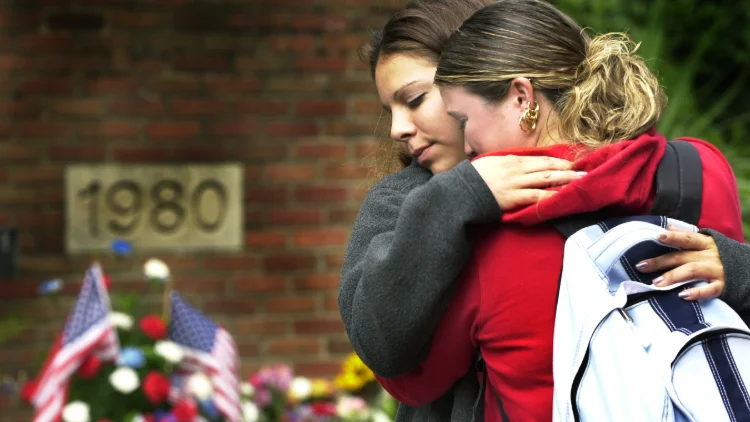
Students comforted one another in the days that followed the attacks.
The morning of 9/11, the weather was very nice. I remember the blue sky with hardly any clouds. I was in my office that morning and on the phone with a colleague speaking about some upcoming events, and they asked me if I was watching the television. I said, “No, there isn’t a television in my office.” They said, “Well, go and find one. A small plane has crashed into one of the twin towers.”
I went to my supervisor’s office and asked them to turn on the television, and at that point the second plane had not hit. I went back to my office and carried on with other work but did go back over to check and see what was on the TV in the other office. By then, the second plane had hit, and repeat footage of the first impact was airing.
In knowing that a second passenger liner had struck the building, it was obvious that this was no random accident. My work-study student had reported, and we were doing work together for the day and eventually wound up walking over to the HUB. They had set up a television in the lobby, and when I saw it, I was confused. It really looked like there was only one tower. I just felt it was some odd angle they were shooting from.
Once it became clear to me that the first tower had fallen, I really had a hard time accepting it. It just somehow seemed fantastical, and the footage of it was like something out of a disaster movie.
After understanding this, the student and I carried on with the work that we needed to, but after some short time I dismissed them, since they were clearly distressed. After seeing the collapse of the second tower, I didn’t achieve much useful work the rest of the day.
The following days are a bit of a blur, since although all the facts weren’t in, it was clear we’d been attacked, and I was really waiting for the other shoe to drop. All of it made me feel very badly for the people of New York, and Shanksville, the Pentagon, the people on the planes, the first responders—everyone.
I can remember my parents talking about the death of Kennedy when I was a child and remarking about how they would always remember where they were and what they were doing when it happened. It made me think of that.
David Surtasky
Performing Arts Center
Nearly 25 years later, the memories and emotions of 9/11 are still as vivid as if they had happened yesterday.
It was a beautiful Tuesday morning. My husband and I were living in Munhall, outside Pittsburgh, near Kennywood. He worked downtown, and I had just completed graduate school at Duquesne, so it was an ideal location for our first home. I was 25 and a stay-at-home mom. I had a two-year-old, and I was seven months pregnant with our second daughter.
My oldest daughter was obsessed with Little People on VHS tape. She could watch them on repeat. I had put a tape on for her in the living room and went upstairs to my bedroom to watch a little bit of the Today show. As the tragic events began to unfold live on TV, I just sat there on the edge of my bed, stunned and frozen in disbelief. It is just so surreal that something so utterly unbelievable could be happening in our country.
To this day I can still conjure those feelings. And I pray that my children will never have to witness such a violent and tragic act of terrorism against our country.
Julie Williams
Center for Career and Technical Personnel Preparation
I was teaching my first semester at IUP.
One of my colleagues came to the American Politics class I was teaching to tell me that a plane crashed into one of the World Trade Center towers, and I may want to dismiss class so students could watch coverage about it on TV. I didn’t quite understand why a plane accident would necessitate me dismissing the students, so I posed the question to the students, and the majority said they’d be OK with the class being dismissed early. So, I somewhat reluctantly obliged.
Shortly, I had another class begin, and I set up the TV so we could watch the live coverage, just in time to see the second plane crash into the second tower. This time, we all understood what was happening, and most of us were shocked. Not so much some of my international students. They understood that massive terrorist attacks happen all over the world. But even they were a bit surprised that an attack of this scale happened here, against the country with by far the biggest military in the world.
To my surprise, when I held my afternoon class (which was optional at this point at the direction of President Pettit), most of the students showed up; however, about half didn’t understand why we were watching news coverage about the event, even though it was a World Politics class. I tried to explain the significance and how this event would most certainly bring about long-lasting consequences for the US, but many were skeptical.
Sarah Wheeler
Department of History, Philosophy, Political Science, and Religious Studies
I was working in Pittsburgh and driving to a meeting in Beaver Falls on a gloriously beautiful morning when I heard the news that a plane had struck the first tower. I was listening to the live report when news came in that the second plane had hit.
Our meeting began, and it wasn’t too long before we were interrupted with news of the Pentagon and Shanksville. Needless to say, our meeting ended abruptly.
Driving back to my office was incredibly eerily silent; every driver in every car I passed had the same blank stare on their face. I was crying because I had just learned that I was expecting our first child, and I could not imagine what kind of world we were bringing this blessing into.
It saddens me that my daughters know only a “post-9/11” America, but I am confident that their generation is on the right track to make things great again for all Americans.
Susan Venatta
Department of Art and Design
On 9/11, I was an assistant director of Residence Life, and my office was in Turnbull Hall, part of the Tri-halls residential complex.
I was in my office that morning when my graduate assistant, Michelle Hosey, came in and asked, “Did you hear that a plane crashed into a building in New York?” We went into the main TV lounge to watch what was going on. As news about what happened to the World Trade Center’s North Tower was reported, another plane crashed into the South Tower. We were in disbelief. More students came into the lounge.
We heard about the flight that crashed into the Pentagon. Then we heard about Flight 93 near Shanksville. This was so close to us that everyone began to wonder what the pattern was, and because the newscaster said terrorists took over the planes, we began to wonder if universities and other target-rich environments were next.
One student from New York City tried calling home, to no avail. We later learned that phone lines were down. Another student had a father who worked in the South Tower. I’ll never forget the fear in his eyes. To witness the pain of not knowing what is happening to the family during this crisis was heart-wrenching.
I also recall the lounge being alive with support, hugs, discussion, speculation, and togetherness. People were literally huddled together, watching the events unfold in disbelief. But somehow our bearing witness to this tragedy together made it bearable. It bonded our community. We later found out that both students’ loved ones were OK.
Julene Pinto-Dyczewski
Office of Housing and Dining
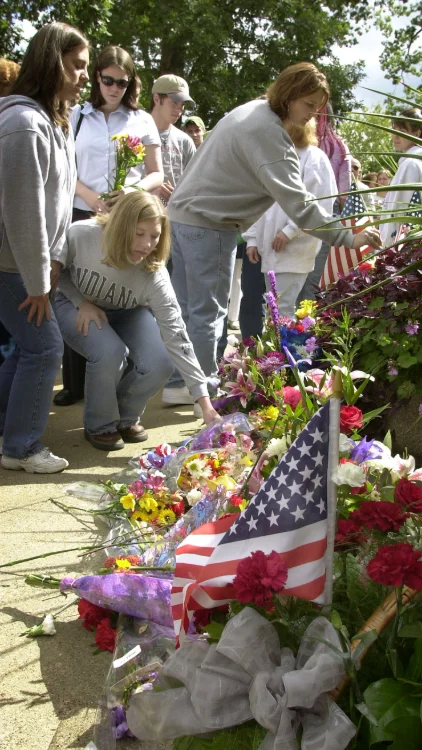
Students laid flowers and flags at one of the makeshift memorials on campus.
It was a cool, brisk, fall morning—perhaps the perfect late summer day. I had just started at IUP as a new residence director a month and two days earlier.
I was observing a student conduct hearing that morning in the conference room in Pratt Hall as part of training as a new staff member. Once the case ended, I walked into the Housing office, and everyone was watching the television at the front desk, seeing the replay of the planes crashing into the Twin Towers. At first, I thought it was an advertisement for a new movie, but the others and I quickly realized that this was a horrible tragedy.
The office quickly sprang into action. I returned to my building, Wallace Hall. I remember we had a television in the building’s office, and so it was turned on, and I started informing resident assistants and office workers. We also had a huge television in the lounge, turned on so people could gather around. As the situation unfolded, people grew concerned about the Homer City Generating Station.
We learned of the attack at the Pentagon. I started trying to reach an aunt who worked there in the chaplain’s office. We learned about the crash of Flight 93 in Shanksville. There were students in the building who were EMTs and firefighters. Some military students would be called to active duty. Many, many people were struggling to contact family and friends in the days that followed.
One of the alarming outcomes was seeing armed guards at the service entrance road on Route 119, which led to the Homer City Generating Station.
On campus, there was a huge gathering of students and employees in the Oak Grove, which highlighted for me the hallowedness of the Oak Grove. It is IUP’s gathering space, for joy, for sorrow, for mourning, and for celebration. I remember how our campus vowed to continue setting aside time to commemorate the events. There was a sense of being lost and unsure about what would happen next, but also reassurance that the university would address any concerns together. I have attended almost every 9/11 memorial service in my 25 years here.
I remember another residence director and I were exhausted mentally, emotionally, and spiritually, and we found ourselves looking for a church service in the days that followed. Many of the local houses of worship hosted vigils and services. We made our way to one for a moment of emotional release.
People began tying yellow ribbons around everything. Even some of the artwork around campus had big yellow ribbons.
Tedd Cogar
Military and Veterans Resource Center
On September 11, 2001, my wife and I were both working at the United States Military Academy at West Point, New York.
That morning, we were in a game-day operations meeting for football. During the meeting, we were alerted that planes had struck the World Trade Center and the Pentagon—and that they had flown directly down the Hudson River, right over the academy, on their way to the towers.
It was a surreal moment. Sitting at that table were key military personnel, including the Military Police leadership responsible for base security, who made the initial announcement. Shortly after, the academy was locked down for a couple of days so leadership could assess the situation and establish new security protocols.
Fall sports were suspended for about days before the decision was made to bring athletics back as part of the healing process. But from that day forward, everything changed. Base security and game-day operations were completely transformed.
Working with the student-athletes took on a whole new meaning, knowing that these young men and women—especially the seniors—would be going to war. Seeing them embrace their military obligations and take full ownership of what they signed up for was deeply inspiring. Beyond the cadets, several staff members in the athletic department were reassigned or deployed to other installations nationwide as security measures escalated.
That shift culminated later that season at the Army-Navy game, which felt like far more than just a football game—the entire nation was watching. President Bush, John McCain, and numerous high-ranking dignitaries attended. Preparation was intense: There were 45 snipers stationed throughout the stadium. Seeing Army, Navy, and all the security forces come together under those circumstances created an incredible sense of unity.
I spent three and a half years at West Point and built lasting friendships with many people—both colleagues and cadet-athletes—who went on to serve in the war. While born out of a terrible national tragedy, it remains an era and a community I will never forget.
Todd Garzarelli
Athletics
On 9/11, I was a doctoral student at Brown University studying molecular neurobiology. I arrived very early that morning at my laboratory on campus to start a new experiment. During an incubation period, I pulled up the New York Times website, which was reporting breaking news that a plane had hit the World Trade Center. I assumed it was a small craft that had hit the radio tower and continued with my research, but as my colleagues began to arrive, each added more information to the story. By mid-morning, we were gathered in the conference room watching an old TV in shock as we saw the tragic event unfold in real time.
As emergency response teams from around the country mobilized, I reached out to my old volunteer EMT/fire station (I had been a volunteer EMT and firefighter outside of Philadelphia) to see whether they were going to Manhattan and whether I could be of assistance. My CPR for first-responders certification had expired, and to volunteer, all my credentials needed to be up to date.
I called the American Red Cross in Rhode Island to see when the next certification course would be offered. That weekend, I enrolled in the course, and the instructor was Ben Ford. This is how I met my future husband.
I received my updated credentials, and while my old fire station couldn’t assist with the recovery effort at Ground Zero, the experience led me to connect with volunteers in Rhode Island for other meaningful opportunities.
When Ben and I got married several years later, in lieu of gifts, we asked folks to make donations to the American Red Cross.
9/11 was a tragedy, but also a powerful moment of national unity. And, for me personally, the event that set in motion meeting my future husband.
Hilliary Creely
Office of Research and Innovation
On September 11, 2001, I was in my second week of doctoral studies in New York City, having moved there that summer. I will always remember the clear blue sky over Lincoln Center Plaza that morning.
When a friend told me he had heard that a plane had crashed into the World Trade Center, we nervously laughed it off; surely it had to be a joke. A few minutes later, we were summoned to the dormitory lobby, where my colleagues and I watched in horror as the second plane crashed. Seeing it unfold live made the nightmare painfully real, and we consoled one another as we struggled to comprehend what was happening.
In the days that followed, I remember how the city came together in the face of such profound adversity. Before 9/11, life in New York had often seemed noisy, impersonal, rude, and fast-paced. Suddenly, strangers stopped to help one another and asked, “How are you doing?” In the evenings, the streets fell eerily silent as traffic was blocked from entering the city, creating a solemn stillness I had not experienced before. Living uptown, I was somewhat shielded from the destruction, but nothing could mask the pungent smell that lingered.
While many residents fled the city, this tragedy somehow brought me closer to a place I had only recently adopted as home. Twenty-five years later, I continue to call both New York City and Indiana, Pennsylvania, home.
This past summer, I visited the 9/11 Memorial. I stood quietly, watching the beautiful waterfalls cascade over the footprints of the towers. What was once a place of unimaginable horror and destruction was now transformed into a serene space of remembrance. It was a deeply moving visit, and a day I will never forget.
Henry Wong Doe
Department of Music, Theatre, and Dance
Reflecting on September 11, 2001, is never easy. It remains one of those days when everyone remembers exactly where they were as the attacks unfolded. While the memories are painful, time has revealed important lessons about what truly matters in life—especially the relationships we build.
I share this story with our students because college is often where lifelong friendships and professional connections take root. The relationships you form at IUP can shape your identity, support your growth, and stay with you far beyond graduation.
My own experience on 9/11 is tied to one of those lasting friendships. From 1978 to 1982, I attended Slippery Rock University as a physical education major. I lived in a second-floor apartment with a roommate, and four other PE majors lived directly below us. We quickly became inseparable—studying together, laughing together, and figuring out who we wanted to become. It’s a familiar story—one many of our students can relate to.
After graduation, we scattered into our careers and promised to reunite every year. As life got busier, the reunions became less frequent, but whenever we did reconnect, it felt like stepping back in time to age 21 again.
One of those friends and I stayed close while pursuing our master’s degrees. He eventually returned home to New York and worked for a national fitness organization headquartered one block from the World Trade Center. In 2001, he was working in that building.
On the morning of September 11, I was directing a private fitness center. With televisions throughout the facility, everyone watched the attacks in real time. I remember how differently people reacted—fear, shock, silence, worry for loved ones. One employee said, “I have to go to church and pray,” and walked out.
As I tried to support my staff and members, my thoughts kept returning to my college friend in New York. I hadn’t spoken to him in six months, but the memories of our early adulthood together flooded back. I reached out later that day and learned he had been away at a conference. Sixteen of his coworkers were not as fortunate.
And here is the part you may not believe—but it truly happened. As I typed this very story to submit, my phone chimed. I looked over and saw a text message from that same college friend, someone I hadn’t spoken with in over a year.
Goosebumps ran up my arms.
I immediately called him and told him what I had been writing. After reflecting on that tragic day, we found ourselves simply appreciating how meaningful our friendship has been for more than four decades—and reaffirming that we will always stay in touch.
Leslie Stenger
Department of Allied and Public Health
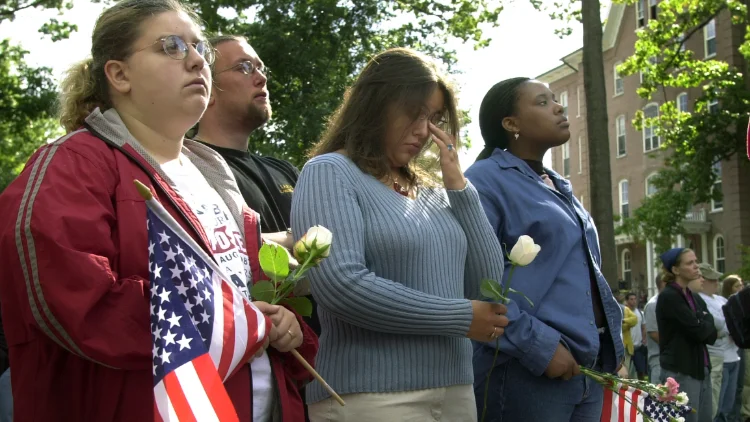
During the National Day of Prayer and Remembrance on September 14, 2001, students attended IUP’s service in the Oak Grove.
Before coming to IUP in 1994, I taught at Pace University in New York City. I often had to go through the World Trade Center when I took the Port Authority Trans-Hudson train from New Jersey. As a graduate student for five years just across the Hudson River, I had been in New York City literally hundreds of times for work, for fun, and as a “tour guide” for scores of friends and family from all over. The area had become a second home.
On September 11, 2001, as I was about to leave home to get to my IUP office, a friend who still lived in the New York City area called me to say that a plane had hit one of the World Trade Center towers. My wife and I thought it was just an accident involving a small aircraft and switched on the TV. Within minutes, along with millions of others, we experienced the horror of the second building being hit, followed by the collapse of the two towers and the attacks on the Pentagon.
For some time, there was the fear of the fourth plane flying over western Pennsylvania, which soon crashed in nearby Shanksville, thanks to the heroic efforts of the passengers. I am a student of history and had read about “The Day of Infamy” and “D-Day,” but September 11, 2001, will stay in my living memory as the bloody day when thousands of innocent people lost their lives while just trying to go about their regular lives.
The impact of that day, and that of the long war that ensued, continues to linger even after 25 years. By the end of that fateful Tuesday in 2001, I realized that 9/11 would profoundly and dramatically change our way of life, and it certainly did.
A simple example: my wife and infant daughter were traveling to India just a few months before 9/11. I was not traveling with them, and all I had to do was request at the airport check-in counter if I could accompany them until they boarded the plane, and I got a pass to go all the way to their seat, just by showing my ID. After 9/11, the security system at airports (and everywhere else) underwent a metamorphosis.
But more profoundly, 9/11 changed the way people around the world thought of each other, and it was mostly negative stereotyping. This was one of the main reasons I made it a personal mission to start more international collaborations for IUP, since I firmly believe people-to-people contacts help bring cultures and countries together and minimize the possibility of violence. 9/11 was a disastrous day, and I hope we never forget the innocent lives lost and we learn that mutual interdependence and lasting peace are the best ways to make progress.
Prashanth Bharadwaj
Eberly College of Business
9/11 was a very eventful day for our family in two ways. Our youngest child, then seven years old, was scheduled to have the first stage of brain surgery that day, involving placing a grid of electrodes on the surface of his brain and under his cheekbones to hopefully locate his seizure focus. If this was successful, it would be followed by brain tissue resection a week later. This was the second time he had undergone this operation in two years.
For some reason, and completely against what I would normally have done, I insisted that his two siblings (another son, age 12, and our daughter, age 14) go with us that morning. Both sets of grandparents, as well as our pastor, insisted on being at the hospital. I was embarrassed by how many people we had in the waiting room and worried we would take up too much room.
After he went into surgery, we joined everyone in the waiting room. I was talking to my mother when I noticed the TV. I asked my older son what he was watching. His response was, “I don’t know. I think it’s some movie about a plane crashing into a building.”
About that time, another plane crashed into the building beside that one, and Matt Lauer came on. I said, “That’s not a movie. I think that’s real.” Our focus had suddenly shifted. We were talking about what might be going on to cause two accidents like that so close together. Then the news came that a third plane had changed course and was not communicating. Then we knew something unimaginable was happening. We sat in almost total silence, even the children, as we took it all in. And we prayed. We were thankful to be all together. And no one else ever came into the waiting room.
When the doctor came in to talk with us post-surgery, he told us that they had canceled all other surgeries and that our son’s was completed because he had already been under anesthesia when they, along with other buildings in Pittsburgh, got the news to evacuate. And the hospital was expecting possible casualties. None came.
After everyone else left the hospital and our son and I were back in the epilepsy center, I spent the night watching news with the sound as low as I could have it and still hear something. When my son woke, I would turn it off. It was like I was split in half. One half was concerned and focused on my son, and the other half was wanting to know what was happening outside those hospital walls and was just feeling lost. I was hearing the news and trying to imagine—but not even coming close—the pain and horror happening in New York, in Shanksville, and at the Pentagon. All I could do was pray.
One of the technicians in the epilepsy center was trying to get in touch with her brother, who was supposed to be working at the towers that day. She finally heard in the wee hours of the morning that he was okay—he had never gone to the towers that day. We still kept praying—for those who did go and for those who didn’t.
I remember, those days in the hospital, how eerie it was. So silent. The halls and cafeteria so empty. All the voices so low. When I would leave the room, I felt like I was somewhere I wasn’t supposed to be.
A couple of weeks later, we went home from the hospital after the second stage of the surgery was completed. The world still seemed so quiet. Where we live, we see a lot of trails behind planes in the sky above our house. There were so few now, and most of the time, none. It was like you could feel the world shift. We kept praying.
That’s my story. I remember everything so clearly, more clearly than I remember today. I can see my kids curled up on chairs. I know where everyone was sitting. I can still see the TV in my mind.
Karen Cramer
Office of Alumni and Friends
I worked in Stewart Hall, which was a student dorm. It was break time, and another coworker said that it was on the radio that a plane had hit the World Trade Center. We thought at first it must be a small plane, like a two-seater, but little did we know. We all went up to the first-floor lounge, where the big TV was. We all stood frozen, just watching the tower burn. Moments later, in horror, we watched the second plane crash into the other tower. I remember saying out loud, “It’s going to come down,” and it did. Before that day, no one messed with the USA, but on that day, Americans were beside themselves. I never want any generation to face the uncertainty of what could have become of our nation.
Jennifer Sutter
Facilities, Planning and Construction
On September 11, 2001, I was serving as a full-time member of the Pennsylvania Air National Guard assigned to the Willow Grove Joint Reserve Base. That morning was busy as we prepared equipment for our upcoming deployment to Kuwait. When I returned to my office, I noticed that someone had left the television on in our break area. The second airliner had just struck the World Trade Center. I called out to a colleague, who came in and watched the footage. After about 10 seconds of stunned silence, we both said, “We’re under attack.”
The next several hours became a blur of activity; my role was to support the Fighter Wing with munitions supply, and my customers were scrambling. The base rapidly locked into the most urgent force protection status, and we anticipated the next attack. Thankfully, nothing happened locally. Our base was located near an approach pattern for Philadelphia International Airport. It was surreal to see empty skies overhead.
For me, along with the rest of the American citizenry, the next several weeks were heart-wrenching as the aftermath of the attacks unfolded. Five weeks after September 11, my deployment started. Instead of the initially planned support mission for the United Nations’ No-Fly Zone enforcement in southern Iraq, I now had custodial responsibility for the Wing’s munitions account. This meant knowing the disposition of every explosive component we flew and employed from our aircraft for our strikes into Afghanistan.
I had the rare opportunity to be part of our initial national response to these terror attacks. I served alongside deployed members of the New York Air National Guard. Some of these service members were New York City Fire and Police personnel who had to leave recovery work in Manhattan, then don their military uniform and head to war. Serving beside these heroes, who were unquestionably grieved by their personal losses, drove a perfect clarity of purpose for the herculean task of bringing the responsible terrorists to justice. During subsequent deployments to this region through the remainder of my military career, the events of late 2001 were always at the forefront of my mind as we prosecuted this Global War on Terror.
Kevin Chambers
Department of Safety Sciences and Environmental Engineering
September 11, 2001, was my senior year at IUP. I remember getting up that morning and getting ready to head out to my science lab. I didn’t usually turn the TV on in the morning, but for some reason, that morning I did. I decided to turn on the news just to have some background noise while I got ready for the day. I was in shock at what I saw. Tower 1 had already been hit, and then, on live TV, I watched the second plane hit tower 2. I remember the news helicopters circling the towers, capturing video of people begging to be saved, but they couldn’t help anyone. And then, those same reporters saying they had to back away from the towers because they were too close and capturing people jumping hundreds of stories to their death. Then the news shifted. They started reporting about the Pentagon being hit and then a downed plane in Shanksville (not too far from IUP). Suddenly an attack that I was watching happen in real time on TV started hitting very close to home. All I could think about was where is my dad and is he OK?
I grew up in Arlington, Virginia. My dad worked at the Pentagon for the Army division of the Department of Defense. Our family home was less than three miles from the Pentagon. This wasn’t just a place that you learned about in school or a city where you went with your family on vacation. For me, this was a place where I grew up and had known my whole life, where my friends and family worked, and I watched it be destroyed on national television. I frantically started calling everyone in my family. The phone lines were so busy that I couldn’t get ahold of anyone. I felt helpless, 350 miles away from my whole family, and all I could do was watch. It took a couple of hours, but I was finally able to get through to my mom. She let me know that my brother was able to get ahold of my dad, find him amid all the commotion, and take him home. He was safe. Thank God!
In the coming days after the attack, I was able to get back home to be with my family. We made a trip down to the Pentagon to see the damage firsthand. We could only get within about 200 yards of the building, but to see it in person was just devastating.
In the months/years following this tragedy, some things came to light that made us realize how lucky my family was that day. It really put into perspective how one simple change in your day or a different life decision could have changed your whole future.
At the time of the attacks, my dad had been temporarily moved to another office building while his office at the Pentagon was under renovation. Every morning, he would drive to the Pentagon, park his car, and then take the bus to his temporary office about a mile away. When the plane hit that morning, he was already on the bus heading to his temporary office. If he had been at that bus station 10 minutes later, he would have been standing right in front of the building where the plane hit. His car ended up being parked about 100 yards from the impact, and although it wasn’t damaged, he wasn’t able to pick it up for a few weeks due to it now being part of a crime scene. When he got it back, it was still covered in dust from the building.
2001 was my senior year at IUP. I was a music major and member of the IUP Marching Band. Coming into my senior year, I wasn’t sure that I wanted to march. The director who had been at IUP had just retired at the end of our last season. I was torn between having my last year be the same as his or staying to march one more year and help through the transition with the new director. I ended up being offered a section leader role, so I decided to stay and march one more year. My parents have always been big supporters and hardly missed a performance. On our schedule for that year was a performance for the weekend following 9/11. My dad was supposed to head to a conference in California that week but decided not to go so that he could come to my marching band show that weekend. Had I not marched that year, he would have been scheduled to travel on 9/11. He would have boarded a plane, that morning, from Dulles International Airport to head to California. The plane that crashed into the Pentagon, American Airlines Flight 77, departed Dulles International Airport in Northern Virginia at 8:20am to head toward Los Angeles International Airport. Had I not marched that year, my dad could have very easily been on that plane. To say that the IUP Marching Band saved my dad’s life that day is maybe a little drastic, but that decision to march one final year kept him from having to travel on that fateful day.
In the years following 9/11, my parents eventually retired and moved up here to be closer to me, my husband, and our kids. Having my dad there for all of my major life events has been a blessing. He walked me down the aisle when I got married. He was there the day both my girls were born. He’s been to every softball game, from Little League through IUP college games, and all the band concerts in between. He’s been there every step of the way. My oldest daughter is now a proud IUP alumna herself, and my youngest is one of the newest members of the IUP Marching Band this year. Twenty-five years later, we have come full circle and get to follow along as he watches his granddaughter march in the same band that he faithfully followed all those years ago.
Meghan Moore
Office of Student Billing
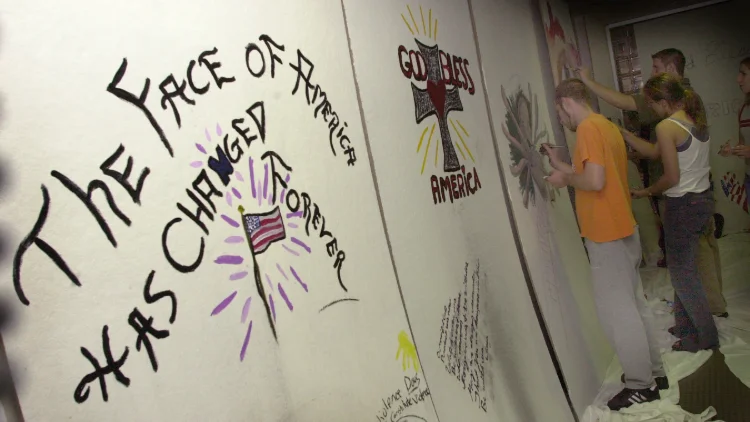
Students worked on a mural in the days that followed the September 11 attacks.
The week leading up to 9/11 was a very difficult time in our department. Tim Singel, a starting safety on the IUP football team and a safety sciences major, died on the morning of September 7 from injuries he sustained in a hit-and-run accident the night before. I had just nine students in his class that semester and wondered how I would ever get us all through the rest of the semester.
As a western Pennsylvania native, I should have had no difficulty remembering how to get to Johnstown from Indiana, but I was just so shaken that I called my mom the morning of 9/11 to confirm how to get there (such a simple drive!). Keep in mind, this was all pre-GPS and cell phones. While we were on the phone, she said, “They have hit another building!” I said, “It’s an accident. You know a plane hit the Empire State Building once.” (It was part of my history of safety events that I had just shared in class!)
As I drove to St. Mary’s Byzantine Catholic Church in Johnstown, I listened to the radio coverage and watched car after car heading OUT of Johnstown. I would later find out that Flight 93 flew very close to Johnstown before turning southeast toward Shanksville in Somerset County. The streams of motorists leaving Johnstown are a vivid memory of that day.
I remember that, and as a person of strong faith, I knew that if something devastating happened to us, I’d be happy to be in a church. I was awestruck by the coach buses parked outside the church that had been full of IUP students. Heartbroken for all the boys on the team and Tim’s family, I left in a daze and drove back to Indiana and picked up my second grader. I couldn’t begin to explain anything to him. It is still a blur.
The next day, I had to face the remaining eight students, determined to carry us to the end of the semester somehow. As I approached the classroom door to start class, Dr. Ferguson, then chair of the department, pulled me aside and told me that one of my interns, Joe Ellis, was killed on his way home from an air ambulance company. IUP safety graduate Jim Blakely, also a pilot, was his supervisor at that company. Joe had been dismissed early because the air ambulances were being scrambled to Shanksville.
Joe, ironically a skilled race car driver, was struck by another vehicle while making a left turn at a light on September 11. I have no recollection of going into that class or whether I attempted to teach that day.
Unbelievably, I’m still piecing that era together. I’ve visited the Flight 93 Memorial and have been deeply moved by the voice recording and the beautiful sounds of the carillon. Just this summer, I listened to Decision Points by then-President George W. Bush and gained a perspective I’ve never had before. The 9/11 discussion moved me to tears.
I think mostly because of what I missed as a citizen of a larger group that suffered devastating loss while we, in Johnson Hall, were struggling through a different kind of loss in the midst of tragedy all around us.
As I reflect now, and as we prepare for another school year, I hope students know that we care deeply about them and their families. Faculty grow to love our students and want a healthy and prosperous life for each of them while at IUP and in their future.
Despite the heartbreak that happens sometimes as a teacher, I’m excited for a new year—a new era of amazing individuals to pass through Johnson Hall.
Laura Helmrich-Rhodes
Department of Safety Sciences and Environmental Engineering
I remember the day. It was a beautiful sunny day. 9/11 happened at a time when, earlier that same year, we experienced a tragedy and unexpected death in our immediate family.
I had been trying to find new meaning and purpose in my life by helping children and had been working a new job in a local school district for a little over two weeks. That morning, as we walked in the halls between classes, we saw the footage on the overhead TVs of the plane that had crashed into one of the Twin Towers. We watched in horror as another plane crashed into the second tower, and we knew it couldn’t be a coincidence. We did not know if this was the beginning of an attack on our soil or what was going on. The principal then announced over the intercom what had happened: we should remain calm, everyone should remain in their classrooms, and the school would be on lockdown until we received more information. Everyone was afraid and became more so as we heard of the Pentagon being attacked and a fourth hijacked plane en route to what officials believed to be the White House. Everything was happening so fast, and yet time seemed to be frozen. We heard rumors from people who “knew” people that the power plant in Homer City was on high alert as a bomb target. It was as if my world was crashing in around me all over again. Extreme emotions of grief, fear, anxiety, hopelessness, and shock washed over me like a flood. All I could think of was this: Are my two young children going to die? Is my husband going to die? My parents, my husband’s parents, everyone I love? If we don’t die, what is going to happen to us? I wanted to run out of the school, go get my children, who were at another school, go home, lock the doors, hide, and somehow have all of my family together in my home, just hug them, and pray. It seemed like forever until we were dismissed and I could go home and be with my family. My oldest child was six, and my youngest was only four.
The anniversary is always a day of deep reflection. I think of the thousands who lost their lives that day—the people on the planes, the people in the towers, the first responders—and the families they left behind. Even after 25 years, I feel somber, sad, and angry, but I also feel so very grateful my family is alive and grateful I live in such a wonderful, free country. We can practice any religion, eat and drink whatever we want, troll on social media ad nauseam, and our purchasing options are endless.
Today, our son serves in the armed forces, and I have a profound appreciation for his putting his life on the line every day, protecting the abundant freedoms we experience here in the US. We cannot discount that evil and terrorism are as much a threat today as they were on September 11, 2001. May it remain a day when we remember that day and all days that our world has been attacked by terrorism, when we honor the lives that were lost, remembering that their lives were brutally cut short, torn from those they love by a most heinous act. May it also remain a day of being grateful for the life that we have, the ones that we love, and all the freedoms we experience.
Celia Barber
Career and Professional Development Center