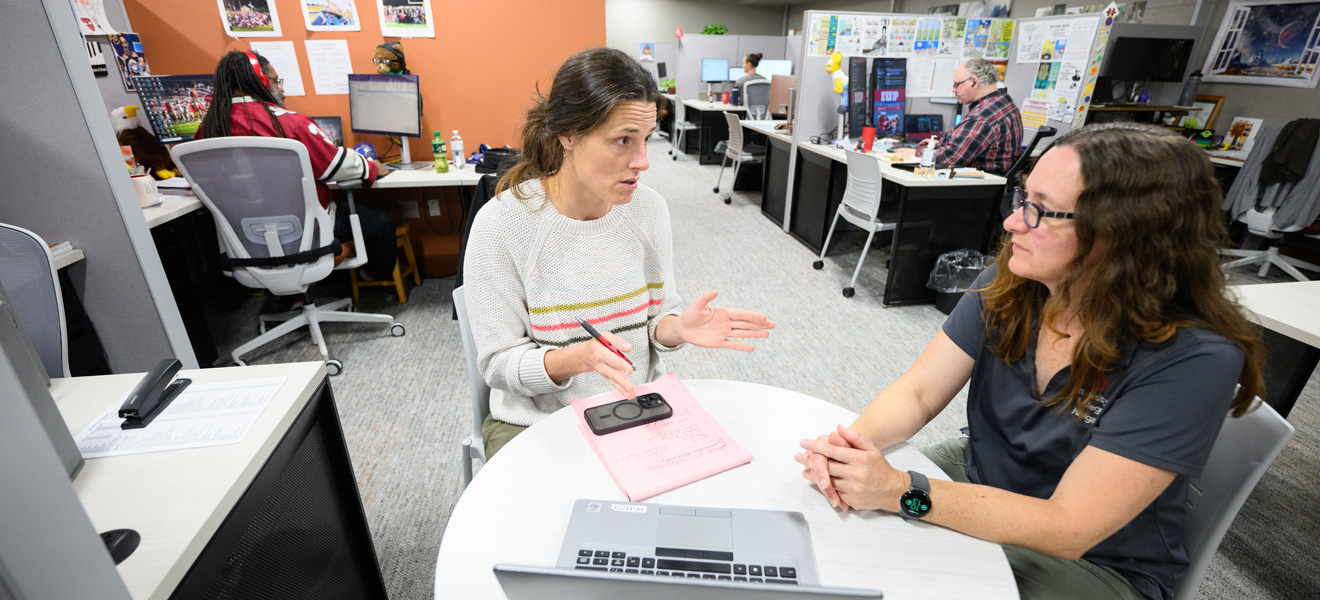
IUP navigators Emily Briggs and Yvonne Branan in Stapleton Library. Navigators are a key component of the student success infrastructure.
First-Year Student Retention Rates
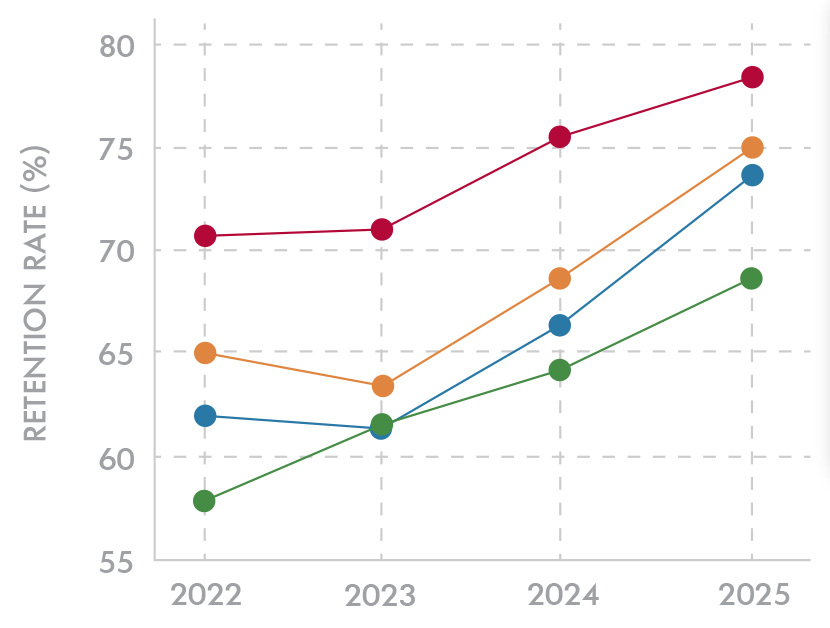
- All
- Pell Eligible
- First-Generation College
- Underrepresented Minority
Retention rates have gone up for first-year students, including some subgroups. A Federal Pell Grant is a need-based form of financial aid.
In the summer of 2023, IUP launched its student success infrastructure, a collaborative, university-wide approach that changed the culture around how IUP supports its students. Three years after its rollout, the results look promising.
Inspiration for the infrastructure came from IUP’s strategic plan, which called for a cultural transformation “to enhance the student experience by fostering exceptional student-centeredness.”
“A lot of people at IUP were doing impactful work for specific groups of students,” said Paula Stossel, strategic advisor to the president for Student Success. “We needed to institutionalize these efforts—to scale our practices so they reach every student while integrating additional best practices along the way.”
The infrastructure engages students, faculty members, and staff members in a shared responsibility for student success. These are its three key components:
- The navigators—17 full-time staff members who build relationships with their assigned students and support them through graduation.
- The Advising Center, a year-round service that provides coordinated, student-centered support to guide students in making academic decisions and in completing their educational goals
- Increased use of data and technology to identify and address barriers to student success before they arise
Monitoring for barriers starts at admission, said Amber Racchini M’03, D’10, vice provost for Academic Success and dean of the University College, which houses most of IUP’s student success resources. She emphasized that the infrastructure is for all students—from high school students taking college courses to graduate students to “clock-hour” students in the Criminal Justice Training Center. “And the communication, outreach, and support are tailored to each individual,” she said.
While the university has not yet achieved President Michael Driscoll’s top goal from 2023—to keep every student who comes to IUP—it has made significant progress.
From 2022 to 2025, student retention from the first to second year rose by nearly 8 percentage points (70.51 percent to 78.20 percent). And some subgroups have experienced even greater gains, thus closing the retention gap (see graph).
Similarly, the undergraduate persistence rate to the third year (junior year) jumped nearly 5 percentage points (61.70 percent to 66.10 percent) from 2024 to 2025.
While the number of high school graduates in the region declines, IUP’s overall enrollment held steady from fall 2024 to fall 2025 (9,081 to 9,082), which Driscoll described as a “testament to everyone’s hard work.”
Although they take pride in the rising numbers, both Stossel and Racchini said the benefit to students is far more important.
“We’re continually evaluating, enhancing, and identifying other elements we need to address,” Racchini said, “to keep more students and to ensure timely progression to degree completion.”
Behind the Numbers
By Robin Jennings
While statistics are essential to show the effectiveness of the student success infrastructure, the real-life stories behind the numbers also tell the tale.
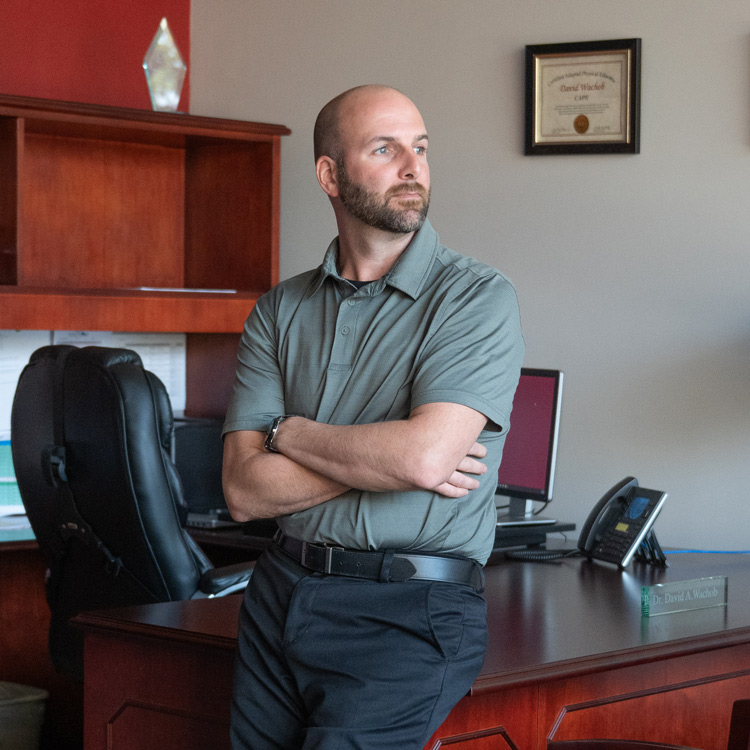
The Program Coordinator
When IUP rolled out its student success infrastructure, introducing navigators as a key component, David Wachob ’05, M’09, D’12 questioned the impact these new hires could have.
But his skepticism gave way to endorsement. As chair of the Department of Career and Wellness Education and coordinator of its teacher education programs, he said the navigators “have become essential to my program.”
While IUP offered many resources to help students succeed, his knowledge of those resources was limited. “The navigators have the answers or will get them,” he said. “I value their attention and follow-through so much that I copy the navigators on communication with my students so that, if there are any barriers, they get identified and addressed. I count on them.”
Wachob guides more than 100 graduate students from diverse undergraduate disciplines—from accounting to criminology to fashion merchandising—as they seek teacher certification.
One of his students contemplated withdrawing from a semester because of financial difficulties. “His navigator was able to assist him with applying for financial aid and with other billing questions,” he said. “So, rather than dropping out for one term, or permanently, he has a way forward.”
Wachob noted that graduate students as well as first-time students benefit from having a go-to person.
“There’s a misperception that once you graduate high school or college, you’re an adult and you’ll just figure things out,” he said. “Having someone point you in the right direction and encourage you along the way can make a huge difference. It’s more than academic advice; it’s assuring you that you have a handle on life.”
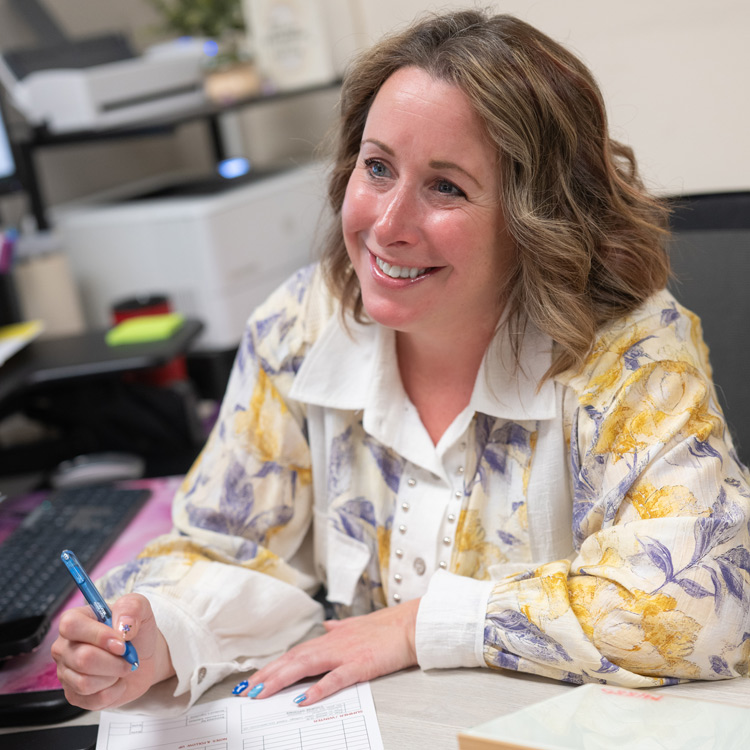
The Advising Center Lead
As director of Advising, Transition, and Support, Meghan Erwin ’08, M’09, M’11 leads the University College’s Advising Center, which removes obstacles for students as they discern their career interests, select courses, add a minor, or change majors.
“Who really knows what you want to pursue when you start out?” Erwin said. “There are multiple career options, and you don’t always know what a program is until you’ve gotten started. We’re able to help with scheduling and making transitions between majors or departments. And there’s lots of follow-up.”
Also an associate professor in the Department of Student Affairs, Student Success, and Disability Access, she said the Advising Center’s work complements that of her faculty peers.
“There are program-specific academic advisors, and that’s what they know,” she said. “In the Advising Center, we can liaise across departments and help with advisor reassignments when there is a change in majors so students are paired with the appropriate person.”
Predictive software, which monitors risk factors for student success, is essential to Erwin’s work. “Looking at a student’s GPA is a start,” she said. “Are they on track? What progress has been made? What credits were attempted? From there, we can have sensitive, thoughtful conversations about what might be a better path forward.”
Coaching and mentoring are also key to achieving a positive outcome and can begin as early as high school for students in IUP’s Dual-Enrollment Program.
Readmitted students are another population Erwin’s team helps. “Perhaps a student stepped away from classes to have a child or to help out with an aging parent,” she said. “When they return to campus, we’re updating them on what’s new and the many resources available to them to continue to their goal.”
The Continuing Student
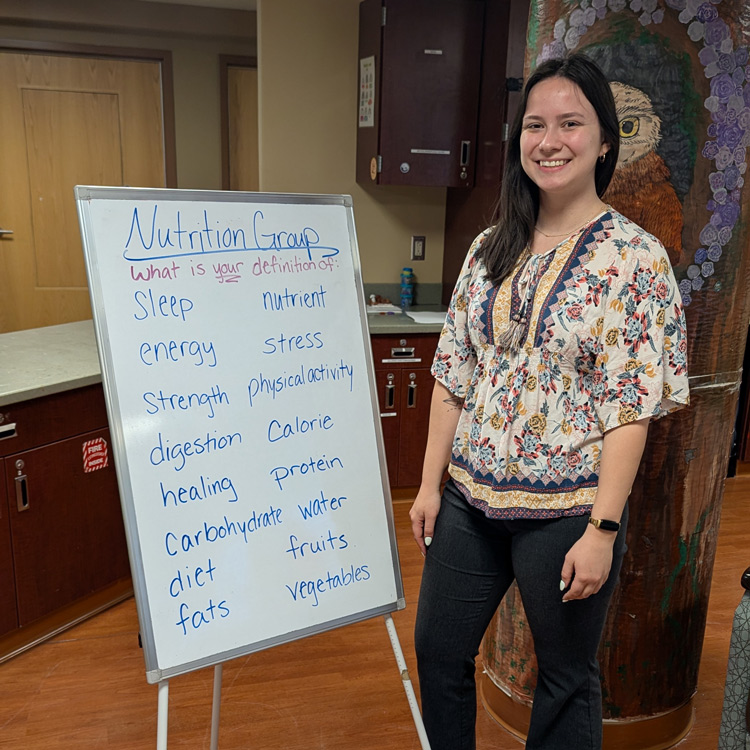
Since September, Sarah Anderson, a registered and licensed dietitian-nutritionist, has worked in a behavioral health setting at UPMC Presbyterian Shadyside, where she addresses the nutritional concerns of people with eating disorders and other mental health conditions.
That’s the career she wanted, but to get there, she took a winding path through IUP, picking up a certificate and three degrees and making use of components of the student success infrastructure, as well as other IUP resources.
In high school, Anderson wanted to be an executive banquet chef. She received a scholarship to the IUP Academy of Culinary Arts, earning a certificate in 2019 and an associate degree in 2022.
But after injuring her back in a car accident and doing a three-month externship at the Breakers, a luxury resort in Palm Beach, she questioned pursuing a career that required such long hours on her feet.
She segued into a bachelor’s program in nutrition, concentrating in culinary dietetics. With help from her academic advisor, Nicole Clark M’94, the transition was seamless, she said.
A required course in psychology would prove pivotal. “I ultimately turned that into a minor,” she said. “It helped me refocus and settle on a career in which I can touch food and help people.”
After earning her bachelor’s in 2023, she entered a master’s program in food and nutrition. Her faculty advisor, Jodie Seybold ’06, M’07, D’21, helped her with a plan to reach her academic goals and move on to a career as a clinical dietitian.
With the launch of the student success infrastructure, Anderson also had a navigator, Yvonne Branan ’01, who helped her with billing issues and other “struggles with navigating my graduate program as a burned-out, financially insecure student,” she said.
“At first I wondered why I needed a navigator when I’d been figuring things out all my life,” said Anderson, who earned her master’s in May 2025. “But it became very clear very quickly what a benefit this was to me and can be to others.”
The Academic Success Assistant
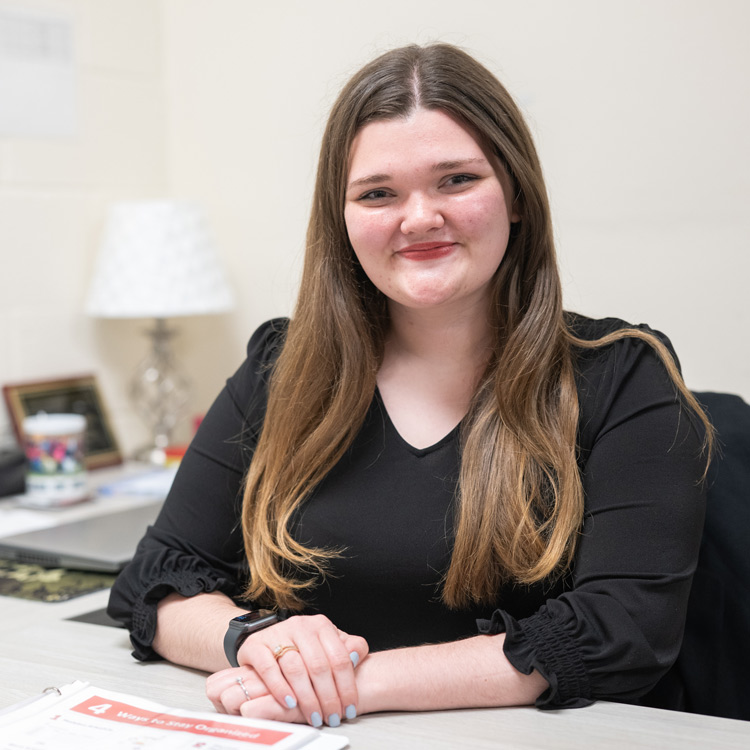
Before graduating with two master’s degrees in May, Abigail Hancox spent two years as an academic success assistant in IUP’s Advising Center. It was a graduate assistantship, and she worked closely with students on academic probation, providing individualized attention to encourage academic recovery.
The reasons they ended up on probation varied widely, she said. “Basic needs, like food or housing or transportation, can be a challenge for students from low-income families,” she said. “Or, just getting classroom supplies—a folder or a notebook. Sometimes little things are big things.”
Isolation during the pandemic may also have led to underdeveloped life skills, she said. “Time management, self-care, socialization, and interpersonal relationship building—these are things we can teach,” Hancox said. “Helping students find their purpose and where they see themselves in the future is also part of what we do. As awful as COVID was, it pointed out just how important the programs offered through the University College are.”
First-generation students, in particular, may miss classes and not realize how that impacts their grades, she said, and mental health concerns, such as anxiety and depression, may be at the root of poor performance. “Getting students to the Counseling Center can be an important step,” she said. “Not just telling them about it, but physically walking with them.”
Hancox, who received her bachelor’s from IUP in 2024, remembers feeling “lonely and homesick” her first year before she got involved in the Student Government Association, eventually serving as president. She also served as a student member of the State System Board of Governors.
But from her role as an academic success coach, she learned that no “one size fits all.”
“Success is finding the individual’s path to a life of fulfillment and purpose,” she said. “Higher education is a gateway to that end.”
Editor’s Note: Robin Stahl Jennings ’79 is a freelance writer.