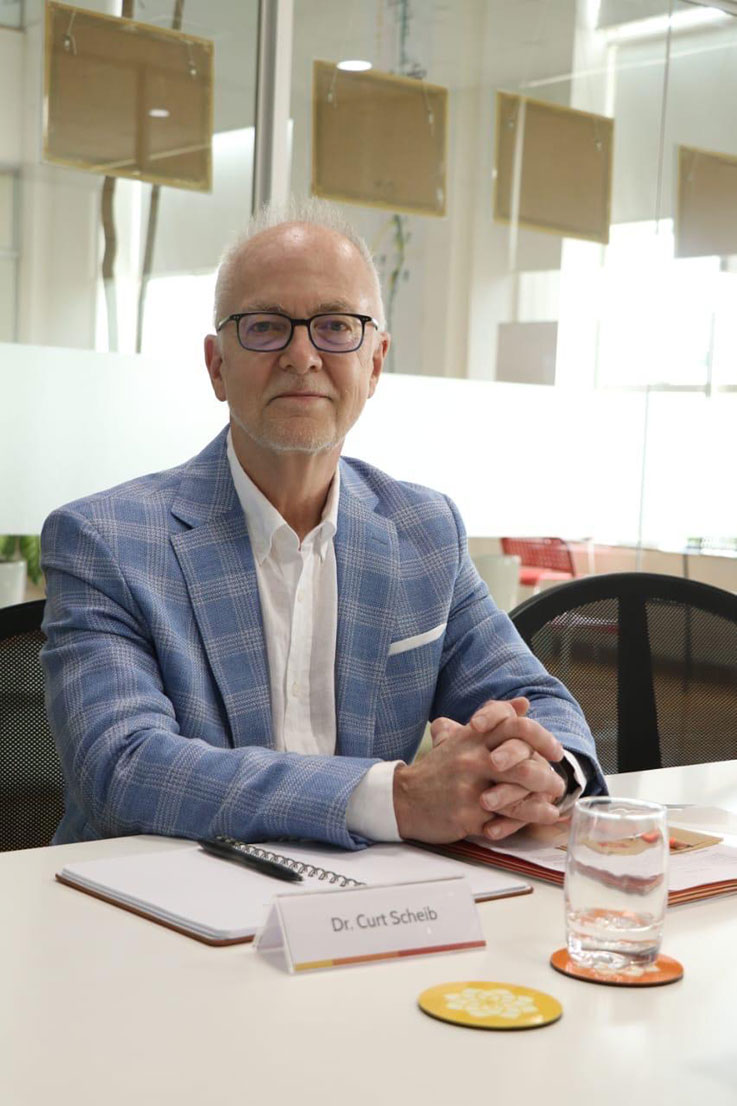
Curt Scheib
Curt Scheib’s love of music shapes his outlook on retiring just as it shaped his long, successful career – from opera singer to dean of the College of Arts, Humanities, Media, and Public Affairs.
“In my view, I think it’s part of being a singer to know when it’s time to exit the stage,” he said with a smile.
Scheib is leaving Indiana University of Pennsylvania after seven years of service as a dean, but his connection to IUP goes all the way back to his freshman year in college.
After playing piano since second grade, he came to IUP to audition to be a piano major. At that time, students had to sing a song as part of the audition. He played his piano pieces, sang his song, and was told to wait in the hall. He was then asked to sing his song again for the voice faculty.
When the letter came in the mail from IUP, it said he was accepted into the Music Education program with a focus on voice, not piano.
“I wasn’t sure I was happy about that at first,” he said, “but once I came to IUP and set out on that path, I came to realize that was indeed the direction I should take and where I would find success.
Faculty mentors, like his voice teacher, John Dietz, helped him become a more skillful singer and musician. Hugh Johnson, the director of the orchestra at IUP, who was also the conductor of the Mendelssohn Choir of Pittsburgh, gave him the opportunity to sing with the choir for a number of years, which included performances with the Pittsburgh Symphony Orchestra.
“He (Johnson) was the first person that pulled me aside and said, ‘you know, you could do more than you think you can,’” Scheib said. “In any event, IUP is the place where I discovered possibilities for myself that I had never before realized and where I also discovered the path I would take for my life.”
Music and Leadership Talents Grow
After graduating from IUP with a bachelor’s degree in music education in 1977 and then a master’s degree in organ performance a year later, he moved on to the University of Cincinnati College-Conservatory of Music, where he earned a master of music degree in voice and an artist diploma in opera.
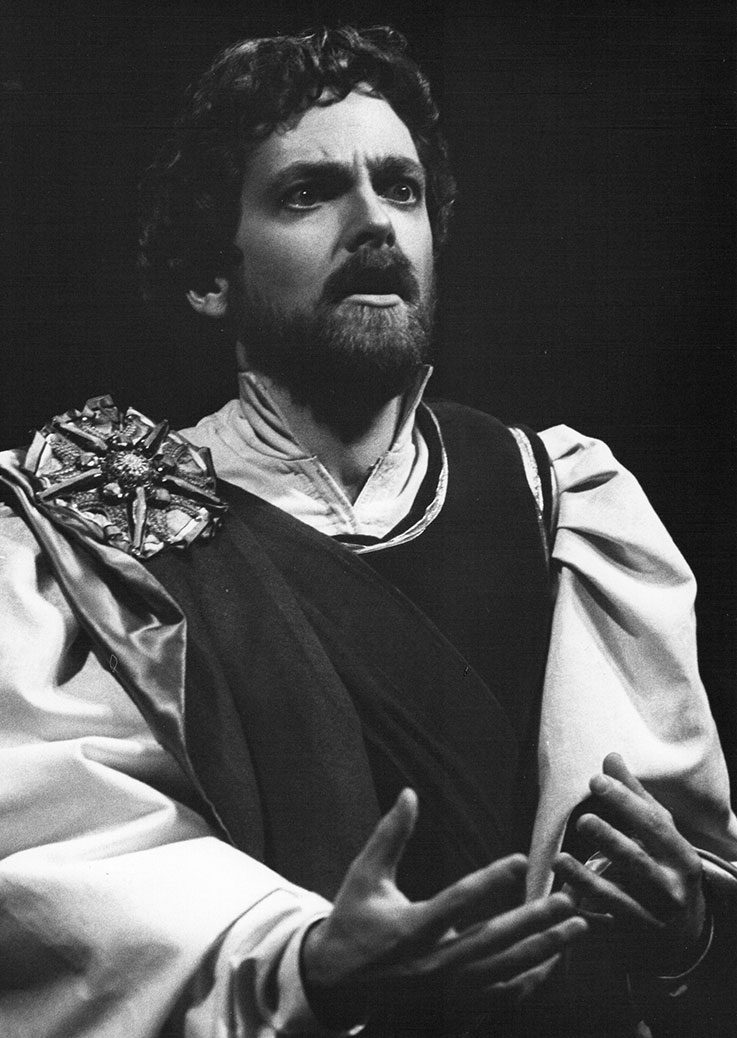
Curt Scheib sings the role of Ottone from the opera L’incoronazione di Poppea (the Coronation of Poppea) by Claudio Monteverdi at the University of Cincinnati College-Conservatory of Music.
After finishing at Cincinnati, he set out to make a living singing. He sang with the Central City Opera in Colorado, toured for a year with the Houston Grand Opera, moved to New York City for a while, and then was a resident artist for the Connecticut Opera.
When a job as an assistant professor of music opened up at Seton Hill University, he returned to his hometown of Greensburg, where his mother was living. The job let him put his IUP training as a music educator to work, while also giving him the opportunity to help his mother during the last part of her life. While teaching at Seton Hill, he also maintained an active career as a singer, with performances throughout the region.
After about three years of teaching at Seton Hill, Scheib became the department chair.
“It was a rotating series. Everybody had to take their turn, and I was at first hesitant to take on the role” he said. “I didn’t really think of myself in those terms, but I had a wonderful mentor who kept saying, ‘you know, you really have a talent for this, you can do it.’”
At first, Scheib remembers trying to act like “who he thought he was supposed to be” as the chair.
“I came to the very quick realization that I had to figure out how to just do it as myself, that it’s not like inhabiting some role, and I have to act in a certain way,” he said. “I’m just going to be me, and, for better or for worse, that’s what you get.” During that time, he also completed the doctor of musical arts degree at West Virginia University and pursued many opportunities to develop the skills for academic leadership.
At Seton Hill, he rose to become the dean of the School of Visual and Performing Arts and nurtured two major building projects from development and planning to completion—the Seton Hill University Performing Arts Center and the Seton Hill Arts Center, a facility to house art and design, as well as dance.
IUP Connection Stays with Him
Through all his years at Seton Hill, he never lost the connection he felt to IUP. He had kept in touch with a few of his former professors and reconnected with Jack Stamp, an IUP music professor he had gone to school with at IUP.
During that time, he was a guest baritone soloist for numerous concerts with IUP ensembles and did three CD recording projects with Jack Stamp and university ensembles. In 2017, he was again asked to be a guest artist when IUP performed the opera The Tender Land in Waller Hall.
“I sang the role of grandpa. Mary Logan Hastings convinced me to do it because we were very dear friends,” he said. “It’s a wonderful American opera composed by Aaron Copland. It was also being conducted by Jack Stamp, during his last year on the faculty, so I just had to say yes.”
Scheib was starting to look for his next professional move around the time Dean of Fine Arts Michael Hood was retiring. He applied, was interviewed, and was offered the position.
“It’s been great to be back at IUP. It’s really been a full-circle moment for my life. I was very grateful for the opportunity to come back to the place that did so much for me,” Scheib said.
When he walks into the Oak Grove and passes the side door of Fisher Auditorium, it’s like the pages flip back to the beginning of his IUP story.
“I used to always go in that door and practice the organ, and so I’d remember my 18-year-old self walking in there to practice,” he said. “All these years later, I’m still walking by. Just the arc of all that has been really special to me.”
Finding New Paths Through Change
Like his first days at IUP as a voice major, his path as a dean took some unexpected turns as the college he led was restructured twice. As it grew from the College of Fine Arts to the College of Arts and Humanities, and then to the College of Arts, Humanities, Media, and Public Affairs, new departments came under his leadership.
“I’m a person who tends to be curious,” he said. “I’m a good listener and am always interested in people’s thoughts. So a lot of my focus was just spending time with the faculty, staff, and students to determine how we would come together to create broader and more diverse colleges.”
Scheib looked for ways to help the faculty navigate through this time of change. He tried to plan in a way that respected the differences and individual identities of the many programs.
“It’s been a really wonderful experience for me to have this broader group of disciplines that I didn’t expect I would have,” he said. “In making the decision to retire, I am confident that the college is ready for new leadership with a new dean who can lead our wonderful college into the future.”
Scheib’s summer plans following retirement include trains to ride, trips to take, shows to see, and things he wants to do, but he’s not planning too far ahead on purpose.
“I’m very curious to see what the next part of my life is going to bring and what directions I will choose to take,” he said. “I am also interested to discover what making music means for me at this point in my life. Wherever it leads, I am ready for this next journey, knowing that I will also stay connected with IUP and the many friendships I have developed. Those things will always be with me.”