A newly signed agreement between Indiana University of Pennsylvania and Temple University provides qualified IUP physics students with an accelerated 3+2 pathway to earn a BS in physics and a master’s degree in mechanical engineering, electrical and computer engineering, or bioengineering. Students will complete at least 90 articulated credits at IUP before transitioning to Temple, where they will complete their remaining bachelor’s requirements while beginning graduate coursework. The master’s degree can be completed by the end of the fifth year.
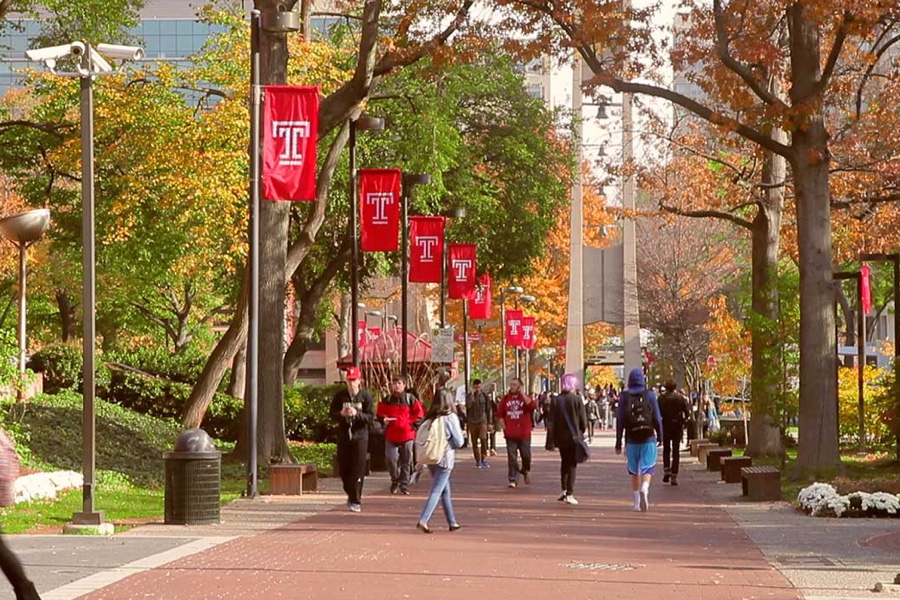
The iconic Bell Tower at Temple University
Indiana University of Pennsylvania physics and pre-engineering students now have a new pathway to earn a bachelor’s degree in physics and an accelerated master’s degree in engineering through a newly signed agreement between IUP and Temple University.
The Program Articulation Agreement establishes a connected “3+2” degree pathway linking IUP’s bachelor of science in physics with three Temple master’s degree programs: mechanical engineering, electrical and computer engineering, and bioengineering. The agreement provides qualified students with a structured path from undergraduate physics study at IUP to graduate-level engineering education at Temple.
Under the agreement, students complete at least 90 articulated credits at IUP before transitioning to Temple. During their first year at Temple, students complete any remaining requirements for the IUP bachelor’s degree while beginning graduate coursework toward their master’s degree.
Up to 30 credits of successful undergraduate and graduate coursework completed at Temple may be transferred back to IUP to satisfy the 120-credit requirement for the bachelor’s degree. In addition, up to 12 graduate credits may be dual-counted toward both the undergraduate and master’s degrees, subject to the requirements of the agreement.
The master’s degree will be completed by the end of the student’s fifth year, providing an accelerated pathway from undergraduate physics to graduate engineering education.
Nathan McElroy, chair of the Madia Department of Physics, Chemistry, and Biochemistry, said, “This agreement gives our physics students a clear, connected path to an engineering master’s degree—without losing time or momentum after graduation.”
Three Engineering Pathways
Students participating in the program can choose from three Temple master’s degree programs:
- Master of Science in Mechanical Engineering
- Master of Science in Electrical and Computer Engineering
- Master of Science in Bioengineering
Each pathway includes a specifically developed course sequence that builds on the mathematics, physics, chemistry, computing, electronics, and other STEM coursework students complete at IUP. The agreement includes detailed suggested curricula for each pathway.
Who Can Participate?
To be considered for the Connected Program, students must:
- Complete at least 90 articulated credits at IUP;
- Earn a minimum cumulative GPA of 3.3;
- Provide three satisfactory academic or professional letters of recommendation; and
- Complete the Temple Graduate Admissions application by the end of their fifth semester in IUP’s Bachelor of Science in Physics/Pre-Engineering program.
Because each pathway follows a carefully coordinated course sequence, students interested in the program are encouraged to work with their IUP physics advisor early in their undergraduate studies. Students accepted into the Connected Program will also be assigned an academic advisor at Temple.
A Direct Path from Physics to a Master’s Degree in Engineering
The agreement reflects a shared commitment by IUP and Temple to create a more connected transition for students seeking both bachelor’s and master’s degrees while expanding opportunities to combine a broad physics education with advanced engineering training.
For IUP physics students interested in engineering careers, the new 3+2 pathway provides a structured way to build on their physics foundation while gaining advanced preparation in mechanical engineering, electrical and computer engineering, or bioengineering.
The current agreement covers the period from fall 2026 through spring 2031.
For more information, contact Dr. Andrew Zhou (fzhou@iup.edu).